

Omaha
Omaha es una ciudad ubicada en el extremo este del condado de Douglas, estado de Nebraska, Estados Unidos.
Government administration · United States · 0 followers
Overview
Omaha es una ciudad ubicada en el extremo este del condado de Douglas, estado de Nebraska, Estados Unidos. Tiene una población estimada, a mediados de 2021, de 487 300 habitantes.
Interested in working with us in the future?
Follow to see new jobs and posts in your feed.
No news yet.
About

Omaha es una ciudad ubicada en el extremo este del condado de Douglas, estado de Nebraska, Estados Unidos. Tiene una población estimada, a mediados de 2021, de 487 300 habitantes.
Kaynak: Wikipedia · CC BY-SA 4.0
Historia
Antes de que fuera legal reclamar tierras en el territorio indígena, William D. Brown operaba el ferry Lone Tree, que transportaba colonos desde Council Bluffs, Iowa, al área que más tarde se convertiría en Omaha. Se le atribuye a Brown la primera visión de una ciudad donde hoy está Omaha.
La promulgación de la Ley Kansas-Nebraska en 1854 fue precedida por la delimitación de reclamaciones de tierra en la zona que habría de convertirse en Omaha por parte de residentes del vecino Council Bluffs. El 4 de julio de 1854, la ciudad fue establecida informalmente durante un pícnic en Capital Hill, en el sitio actual de la escuela secundaria Omaha Central. Poco después, se formó el Omaha Claim Club para imponer justicia por mano propia contra los llamados «claim jumpers» (los que ocupaban terrenos reclamados por otros) y otros que invadían las tierras de muchos de los padres fundadores de la ciudad. Parte de esas tierras, que ahora rodean el centro de Omaha, más tarde se usaron para atraer a los legisladores territoriales de Nebraska hacia un área llamada Scriptown. Aunque Omaha fue la capital del territorio, cuando Nebraska se convirtió en estado en 1867, la capital se trasladó a Lincoln. La Corte Suprema de los EE. UU. posteriormente falló en contra de numerosos terratenientes cuyas acciones violentas fueron condenadas en el caso Baker v. Morton.
Muchos de los personajes fundadores de Omaha se alojaron en el Douglas House o en el Cozzens House Hotel. La calle Dodge fue importante en los comienzos comerciales de la ciudad; las calles Norte y Sur 24 también se desarrollaron independientemente como distritos comerciales. Los primeros pioneros fueron enterrados en el cementerio Prospect Hill y el cementerio Cedar Hill. El cementerio Cedar Hill cerró en la década de 1860 y sus tumbas fueron trasladadas a Prospect Hill, donde los pioneros fueron luego acompañados por soldados del Fuerte Omaha, afroamericanos e inmigrantes europeos. En Omaha también existen varios otros cementerios históricos, sinagogas judías históricas e iglesias cristianas que datan de la era pionera.
Geografía

Localizada en la frontera este de Nebraska, se encuentra a 30 km al norte de la desembocadura del río Platte. Situada en el medio oeste de los Estados Unidos, a orillas del río Misuri, gran parte de Omaha está construida en el valle del río Misuri. Otros cuerpos de agua importantes en el área metropolitana de Omaha-Council Bluffs incluyen el lago Manawa, Papillion Creek, Carter Lake, Platte River y Glenn Cunningham Lake.
El área metropolitana de Omaha-Council Bluffs consta de ocho condados; cinco en Nebraska y tres en Iowa. El área metropolitana ahora incluye los condados de Harrison, Pottawattamie y Mills en Iowa y los condados de Washington, Douglas, Sarpy, Cass y Saunders en Nebraska. Esta área se conocía anteriormente solo como el Área Estadística Metropolitana de Omaha y constaba de solo cinco condados: Pottawattamie en Iowa y Washington, Douglas, Cass y Sarpy en Nebraska.
Geográficamente, se considera que Omaha se encuentra en el «Heartland» de los Estados Unidos. Los impactos ambientales importantes en el hábitat natural de la zona incluyen la propagación de especies de plantas invasoras, la restauración de praderas y hábitats de robles de sabana, y el manejo de la población de venado cola blanca.
Demografía
En el censo del año 2000, la ciudad tenía una población de 390 007 habitantes. El censo de población de 2004 la población de Omaha había crecido a 409 114 habitantes. Según estimaciones para el 2006, la población de Omaha se acercaba a los 427 872, incluyendo las 8300 personas que viven en la ciudad aledaña de Elkhorn. En el año 2021 el número de habitantes ascendía a la cifra de 487 300, con una densidad de 1320.24 habitantes por kilómetro cuadrado.
Personajes famosos

Nicholas Sparks: Escritor estadounidense.
Frank Rinehart: Fotógrafo estadounidense famoso por fotografiar a personalidades y escenas de los pueblos nativos americanos.
Fred Astaire: Actor, cantante, bailarín y coreógrafo.
Adele Astaire (1896-1981): Actriz y bailarina, hermana del anterior.
Andrew Rannells: Actor, actor de teatro, actor de televisión, actor de voz y cantante.
Andy Roddick: Famoso tenista estadounidense.
Warren Buffett: Inversionista, uno de los hombres más ricos del mundo.
Malcolm X: Activista afro-estadounidense.
Paul Williams: Músico, compositor y actor.
Gerald Ford: Presidente de Estados Unidos (1974-1977).
311: Banda estadounidense de rock alternativo fue formada en Omaha, Nebraska.
Terence Crawford: Campeón mundial de los pesos ligueros WOB.
Sting: Luchador profesional estadounidense conocido como la cara de la WCW, actualmente trabaja para la AEW.
Skate Maloley (Nate Maloley): Cantante de hip hop.
Sammy Wilk (Samuel Wilkinson): Cantante de hip hop.
Sarah Rose Summers: Reina de belleza, Miss Estados Unidos 2018.
Área metropolitana

La ciudad de Omaha es el centro del área metropolitana de Omaha-Council Bluffs. Council Bluffs es una ciudad del estado de Iowa, al otro lado del río Misuri, frente a Omaha. Las dos ciudades juntas formaron el corazón de la sexagésima área metropolitana más grande de los Estados Unidos en el año 2000 con una población de 767 041 personas repartidas en ocho condados.
Kaynak: Wikipedia – Omaha (Nebraska) · CC BY-SA 4.0
Tarihçe
Omaha komşu olan Council Bluffs, İowa şehrinde yaşayan zengin arazi spekülatörleri tarafından 1854'te Missouri Nehrinin batısında kuruldu. Council Bluffs şehrinden bu yeni yerleşkeye geçiş Missouri Nehri üzerinde bulunan "Lone Tree Ferry" adlı atlı araba taşıyan feri ile geçiş mevkinden olmaktaydı. Bunun için Omaha "Batı'ya Kapı" takma adını aldı. 19. yüzyılda Omaha'nın ABD içindeki merkezi konumu şehrin önce bir araba yolu ve sonra bir demiryolu merkezi olmasına yol açtı. 19. yüzyıl boyunca Omaha'nın ekonomisinde taşımacılık, demiryolları, toptan ticaret ve bira üretimi önemli rol oymadı. 20. yüzyılda Omaha'da bulunan "Omaha Stockyards" büyükbaş hayvan pazarları ve et sanayi ile şehir ABD'nin Chicago'dan en önemli etçilik merkezi oldu. Günümüzde de Omaha önemli ekonomi merkezi olmayı korumaktadır. ABD'de en büyük firmalar listesi olan Fortune 500 şirketler listesinde bulunan 5 şirketin merkezliğini yapmaktadır. Bunlar "ConAgra Foods", "Union Pacific Corporation", "Mütual of Omaha", "Peter Kiewit and Sons, Inc." ve "Berkshire Hathaway"'dir.
İklim
Omaha'da karasal iklim hakimdir. Kışlar soğuk olup ortalama ısı -6.1 °C olur. Yazlar kuru ve nispeten sicak geçer; ortalama ısı Temmuz'da 24.9 °C olarak kaydedilmiştir. Yıllık ortalama yağış 758.4 mm olarak gözümlenmiştir.
Demografi
Şehir sınırları içinde nüfus (2010 Nüfus Sayımı itibarıyla) 408958 kişidir. Böylece nüfus bakımından ABD'nin 42. büyük şehri olmaktadır. Şehir "Omaha-Council Bluffs metropoliten bölgesi"'nin en önemli merkezi olup bu bölge Omaha'dan gecen Missouri Nehri'nin karşı sahilinde bulunan Council Bluffs, Iowa kentini de içine alır. Omaha-Council Bluffs Metropoliten Bölgesi nüfusu 885350 kişi olmaktadır. Boylece ABD'de metropoliten kentsel bölgeler nüfus büyüklük sıralamasında 60. gelmektedir.
Kardeş şehirler
Omaha Şehri'nin şu kentlerle kardeş şehir bağlantıları bulunur:
Kaynak: Wikipedia – Omaha · CC BY-SA 4.0
History

Various Native American tribes had lived in the land that became Omaha since the 17th century, including the Omaha and Ponca, Dhegihan-Siouan language people who had originated in the lower Ohio River valley and migrated west by the early 17th century; Pawnee, Otoe, Missouria, and Iowa. The word Omaha (Omaha–Ponca: Umoⁿhoⁿ or Umaⁿhaⁿ) in the Omaha language means 'Upstream People' or 'Against the Current'.
In 1804 the Lewis and Clark Expedition passed the riverbanks where the city of Omaha would be built. Between July 30 and August 3, 1804, members of the expedition, including Meriwether Lewis and William Clark, met with Oto and Missouria tribal leaders at the Council Bluff at a point about 20 mi (32 km) north of present-day Omaha. Immediately south of that area, Americans built several fur trading outposts in succeeding years, including Fort Lisa in 1812; Fort Atkinson in 1819; Cabanné's Trading Post, built in 1822, and Fontenelle's Post in 1823, in what became Bellevue. There was fierce competition among fur traders until John Jacob Astor created the monopoly of the American Fur Company. The Mormons built a town called Cutler's Park in the area in 1846.
While it was temporary, the settlement provided the basis for further development.
Through 26 separate treaties with the United States federal government, Native American tribes in Nebraska gradually ceded the lands that now make up the state. The treaty and cession involving the Omaha area occurred in 1854 when the Omaha Tribe ceded most of east-central Nebraska. Logan Fontenelle, an interpreter for the Omaha and signatory to the 1854 treaty, played an essential role in those proceedings.
Pioneer Omaha
Before it was legal to claim land in Indian Country, William D. Brown operated the Lone Tree Ferry that brought settlers from Council Bluffs, Iowa, to the area that became Omaha. Brown is generally credited as having the first vision for a city where Omaha now sits. The passage of the Kansas–Nebraska Act in 1854 was presaged by the staking out of claims around the area to become Omaha by residents from neighboring Council Bluffs. On July 4, 1854, the city was informally established at a picnic on Capital Hill, current site of Omaha Central High School. Soon after, the Omaha Claim Club was formed to provide vigilante justice for claim jumpers and others who infringed on the land of many of the city's founding fathers. Some of this land, which now wraps around Downtown Omaha, was later used to entice Nebraska Territorial legislators to an area called Scriptown. The Territorial capitol was in Omaha, but when Nebraska became a state in 1867, the capital was relocated to Lincoln, 53 mi (85 km) southwest of Omaha. The U.S. Supreme Court later ruled against numerous landowners whose violent actions were condemned in Baker v. Morton.
Geography

According to the United States Census Bureau, the city has a total area of 130.58 sq mi (338.20 km2), of which 127.09 sq mi (329.16 km2) is land and 3.49 sq mi (9.04 km2) is water. Situated in the Midwestern United States on the bank of the Missouri River in eastern Nebraska, much of Omaha is built in the Missouri River Valley. Other significant bodies of water in the Omaha-Council Bluffs metropolitan area include Lake Manawa, Papillion Creek, Carter Lake, Platte River and the Glenn Cunningham Lake. The city's land has been altered considerably with substantial land grading throughout Downtown Omaha and scattered across the city. East Omaha sits on a flood plain west of the Missouri River. The area is the location of Carter Lake, an oxbow lake. The lake was once the site of East Omaha Island and Florence Lake, which dried up in the 1920s.
Metropolitan area
The Omaha-Council Bluffs metropolitan area consists of eight counties; five in Nebraska and three in Iowa. The metropolitan area now includes Harrison, Pottawattamie, and Mills Counties in Iowa and Washington, Douglas, Sarpy, Cass, and Saunders Counties in Nebraska. This area was formerly referred to only as the Omaha Metropolitan Statistical Area and consisted of only five counties: Pottawattamie in Iowa, and Washington, Douglas, Cass, and Sarpy in Nebraska. The Omaha-Council Bluffs combined statistical area comprises the Omaha-Council Bluffs metropolitan statistical area and the Fremont Micropolitan statistical area; the CSA has a population of 858,720 (2005 Census Bureau estimate). Omaha ranks as the 41st-most populous city in the United States, and is the core city of its 60th-largest metropolitan area. There are no consolidated city-counties in the area; the City of Omaha studied the possibility extensively through 2003 and concluded, "The City of Omaha and Douglas County should merge into a municipal county, work to commence immediately, and that functional consolidations begin immediately in as many departments as possible, including but not limited to parks, fleet management, facilities management, local planning, purchasing and personnel."
Demographics

2020 census
The 2020 United States census counted 486,051 people, 189,922 households, and 113,245 families in Omaha. The population density was 3,406.8 per square mile (1,315.4/km2). There were 203,215 housing units, at an average density of 1,424.4 per square mile (550.0/km2). The racial makeup (including Hispanics in the racial counts) was 65.47% (318,218) white, 12.4% (60,280) black or African-American, 1.12% (5,426) Native American, 4.6% (22,377) Asian, 0.09% (461) Pacific Islander, 7.25% (35,233) from other races, and 9.06% (44,056) from two or more races. Hispanic or Latino of any race was 14.0% (67,715) of the population.
Of the 189,922 households, 28.3% had children under the age of 18; 43.0% were married couples living together; 29.2% had a female householder with no husband present. 33.2% of households consisted of individuals and 10.7% had someone living alone who was 65 years of age or older. The average household size was 2.5 and the average family size was 3.2.
24.5% of the population was under the age of 18, 9.6% from 18 to 24, 28.2% from 25 to 44, 23.2% from 45 to 64, and 13.1% who were 65 years of age or older. The median age was 34.9 years. For every 100 females, the population had 97.1 males. For every 100 females ages 18 and older, there were 95.0 males.
The 2016–2020 5-year American Community Survey estimates show that the median household income was $62,213 (with a margin of error of +/- $969) and the median family income $80,956 (+/- $1,380). Males had a median income of $41,528 (+/- $592) versus $31,295 (+/- $490) for females. The median income for those above 16 years old was $36,290 (+/- $532). Approximately, 8.0% of families and 12.0% of the population were below the poverty line, including 15.6% of those under the age of 18 and 7.8% of those ages 65 or over.
Economy

With diversification in several industries, including banking, insurance, telecommunications, architecture/construction, and transportation, Omaha's economy has grown since the early 1990s, and six national fiber optic networks converge in Omaha.
Omaha's most prominent businessman is Warren Buffett, nicknamed the "Oracle of Omaha", who for decades has ranked as one of the richest people in the world. Four Omaha-based companies: Berkshire Hathaway, Union Pacific Railroad, Mutual of Omaha, and Kiewit Corporation, are among the Fortune 500.
Omaha is the headquarters of several other major corporations, including the Gallup Organization, Werner Enterprises, First National Bank of Omaha, WoodmenLife, Gavilon, Scoular and First Comp Insurance. Many other large national firms have major operations or operational headquarters in Omaha, including Bank of the West, First Data, Sojern, PayPal, LinkedIn, Pacific Life, MetLife and Conagra Brands. The city is also home to three of the 30 largest architecture firms in the United States, including HDR, Inc., DLR Group, Inc., and Leo A Daly.
Top employers
According to the Greater Omaha Chamber of Commerce, the largest regional employers are:
Tourism
Tourist attractions in Omaha include history, sports, outdoors and cultural experiences. Its principal tourist attractions are the Henry Doorly Zoo and the College World Series. The Old Market in Downtown Omaha is another major attraction and is important to the city's retail economy. Famous early visitors included British author Rudyard Kipling and General George Crook. In 1883 Omaha hosted the first official performance of the Buffalo Bill's Wild West Show for 8,000 attendees. In 1898 the city hosted more than 1 million visitors from across the United States at the Trans-Mississippi and International Exposition, a world's fair that lasted for more than half the year.
Arts and culture

Several national newspapers, including the Boston Globe and The New York Times have lauded Omaha's historical and cultural attractions.
The city is home to the Omaha Community Playhouse, the largest community theater in the United States. The Omaha Symphony Orchestra and its modern Holland Performing Arts Center, the Opera Omaha at the Orpheum theater, the Blue Barn Theatre, American Midwest Ballet, and The Rose Theater form the backbone of Omaha's performing arts community. Opened in 1931, the Joslyn Art Museum has large art collections. Since its inception in 1976, Omaha Children's Museum has been a place where children can challenge themselves, discover how the world works and learn through play. The Bemis Center for Contemporary Arts, one of the nation's premier urban artist colonies, was founded in Omaha in 1981, and the Durham Museum is accredited with the Smithsonian Institution for traveling exhibits. The city is also home to the largest singly funded mural in the nation, "Fertile Ground", by Meg Saligman. The annual Omaha Blues, Jazz, & Gospel Festival celebrates local music along with the Omaha Black Music Hall of Fame.
In 1955, Omaha's Union Stockyards overtook Chicago's stockyards as the United States' meat packing center. This legacy is reflected in the cuisine of Omaha, with renowned steakhouses such as Gorat's and the recently closed Mister C's, as well as the retail chain Omaha Steaks.
Henry Doorly Zoo
The Henry Doorly Zoo is widely considered a premier zoo. The zoo is home to the world's largest nocturnal exhibit and indoor swamp; the world's largest indoor rainforest, the world's largest indoor desert, and the largest geodesic dome in the world (13 stories tall). The zoo is Nebraska's number-one paid attendance attraction and has welcomed more than 25 million visitors over the past 40 years.
Sports
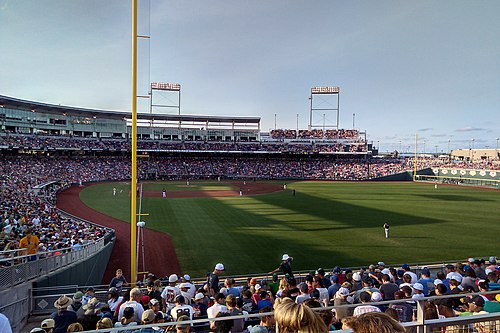
Sports have been important in Omaha for more than a century, and the city plays host to three minor-league professional sports teams.
Omaha has hosted the annual June NCAA College World Series men's baseball tournament since 1950. It has been played at the downtown Charles Schwab Field since 2011.
The Omaha Sports Commission is a quasi-governmental nonprofit organization that coordinates much of the professional and amateur athletic activity in the city, including the 2008, 2012 and 2016 US Olympic Swimming Team Trials and the building of a new stadium in North Downtown. The University of Nebraska–Lincoln and the Commission co-hosted the 2008 National Collegiate Athletic Association (NCAA) Division One Women's Volleyball Championship in December of that year. The 2016 Big Ten baseball tournament championship was also played at the College World Series Stadium. Another quasi-governmental board, the Metropolitan Entertainment and Convention Authority (MECA), was created by city voters in 2000, and is responsible for maintaining the CHI Health Center Omaha (formerly CenturyLink Center Omaha).
The Omaha Storm Chasers play at Werner Park. They won seven championships (in 1969, 1970, 1978, 1990, 2011, 2013, and 2014). Omaha is also home to the Omaha Diamond Spirit, a collegiate summer baseball team that plays in the MINK league.
The Omaha Supernovas are a professional indoor volleyball team based in Omaha, Nebraska. The team competes in the Pro Volleyball Federation (PVF). The Supernovas began play in the league's inaugural 2024 season. The team plays its home games at CHI Health Center Omaha. The Supernovas won the inaugural championship in May 2024. During its championship run in the inaugural PVF season, Omaha and the Supernovas became the league's shining star, hosting 134,969 fans across the 15 matches held at the CHI Health Center. That includes a whopping 9,656 average mark for the 12 Supernovas' home matches, plus the 19,094 spectators who attended the PVF Semifinals and Championship. The Supernovas' 9,656 attendance match average has been the No. 1 mark amongst professional volleyball teams in the world. The team set a record with 12,090 spectators packing into the CHI Health Center to see the Supernovas beat the Orlando Valkyries in four sets.
Parks and recreation
Omaha has a thriving running community and many miles of paved running and biking trails throughout the city and surrounding communities. The Omaha Marathon involves a half-marathon and a 10 km (6.2 mi) race that takes place annually in September. Omaha also has a history of curling, including multiple junior national champions.
The city's historic boulevards were originally designed by Horace Cleveland in 1889 to work with the parks to create a seamless flow of trees, grass and flowers throughout the city. Florence Boulevard and Fontenelle Boulevard are among the remnants of this system. Omaha boasts more than 80 mi (129 km) of trails for pedestrians, bicyclists and hikers. They include the American Discovery Trail, which traverses the entire United States, and the Lewis and Clark National Historic Trail passes through Omaha as it travels 3,700 mi (5,950 km) westward from Illinois to Oregon. Trails throughout the area are included in comprehensive plans for the city of Omaha, the Omaha metropolitan area, Douglas County, and long-distance coordinated plans between the municipalities of southeast Nebraska. The city also has a park dedicated to pollinating bees and insects called 'Pacific Preserve'
Government

Omaha has a strong mayor form of government, along with a city council elected from seven districts across the city. The mayor is John Ewing Jr., who was elected in May 2025. The longest-serving mayor in Omaha's history was "Cowboy" Jim Dahlman, who served 20 years over eight terms. He was regarded as the "wettest mayor in America" because of the flourishing number of bars in Omaha during his tenure. Dahlman was a close associate of political boss Tom Dennison. During Dahlman's tenure, the city switched from its original strong-mayor form of government to a city commission government. In 1956, the city switched back.
The city clerk is Elizabeth Butler. The City of Omaha administers twelve departments, including finance, police, human rights, libraries and planning. The Omaha City Council is the legislative branch and has seven members elected from districts across the city. The council enacts local ordinances and approves the city budget. Government priorities and activities are established in a budget ordinance approved annually. The council takes official action through the passage of ordinances and resolutions. Nebraska's constitution grants the option of home rule to cities with more than 5,000 residents, meaning they may operate under their own charters. Omaha is one of only three cities in Nebraska to use this option, out of 17 eligible. The City of Omaha is considering consolidating with Douglas County government.
Although registered Republicans outnumbered Democrats in the 2nd congressional district, which includes Omaha, Democratic presidential candidate Barack Obama opened three campaign offices in the city with 15 staff members to cover the state in fall 2008. Mike Fahey, the Democratic mayor of Omaha, said he would do whatever it took to deliver the district's electoral vote to Obama; and the Obama campaign considered the district "in play". Former Nebraska U.S. Senator Bob Kerrey and then-U.S. Senator Ben Nelson campaigned in the city for Obama, and in November 2008 Obama won the district's electoral vote. This was a historic win, as Obama became the first Democratic presidential candidate to win an electoral vote in Nebraska since 1964, only made possible by Nebraska's split electoral vote system.
Education
Primary and secondary education
Omaha has many public and private educational institutions, including Omaha Public Schools, the largest public school district in Nebraska, which serves more than 47,750 students in more than 75 schools. After a contentious period of uncertainty, in 2007 the Nebraska Legislature approved a plan to create a learning community for Omaha-area school districts with a central administrative board.
The Westside Community Schools, also known as District 66, is a district in the heart of Omaha. It serves students in pre-kindergarten through the 12th grade and recorded a district enrollment of 6,123 students K–12 for the 2015–16 school year.
Through annexations Omaha also has the Millard Public Schools and Elkhorn Public Schools. Omaha is also home to Brownell-Talbot School, Nebraska's only preschool through grade 12, independent college preparatory school.
The Roman Catholic Archdiocese of Omaha operates numerous private Catholic schools with 21,500 students in 32 elementary schools and nine high schools. They include St. Cecilia Grade School in Midtown Omaha, Holy Cross in Morton Meadows, St. Robert Bellarmine School at 120th and Pacific Street, St. Stephen the Martyr School in Millard, and Creighton Preparatory School, all of which have received the U.S. Department of Education Blue Ribbon School award.
Higher education
There are eleven colleges and universities among Omaha's higher education institutions. The largest public school is University of Nebraska Omaha, which was founded in 1908 and is currently an NCAA Division I school with over 15,000 students. The University of Nebraska Medical Center in midtown Omaha is home to the Eppley Cancer Center, one of 66 designated Cancer Centers by the National Cancer Institute in the United States. The University of Nebraska College of Medicine is also on the UNMC campus.
Media

The city is the focus of the Omaha designated market area, and is the 76th largest in the United States.
Newspapers
The major daily newspaper in Nebraska is the Omaha World-Herald, formerly the largest employee-owned newspaper in the United States. Weeklies in the city include the Midlands Business Journal (weekly business publication); American Classifieds (formerly Thrifty Nickel), a weekly classified newspaper; The Reader, as well as The Omaha Star. Founded in 1938 in North Omaha, the Star is Nebraska's only African-American newspaper.
Television stations and cable TV
Omaha's three television news stations include: KETV 7 (ABC- branded NewsWatch 7), KMTV-TV 3 (CBS- branded 3 News Now), and WOWT 6 (NBC Omaha). KPTM 42 (FOX 42/CW 15) and KXVO 15 (TBD) do not air local news content. Cox Communications provides cable television services throughout the metropolitan area. Prism TV, offered through CenturyLink, is a broadband TV option also available throughout the Omaha area. Satellite providers such as DirecTV and Dish Network and the local programming they offer are also available throughout the metropolitan area.
Infrastructure

Omaha's growth has required the constant development of new urban infrastructure that influence, allow and encourage the constant expansion of the city.
Utilities
Retail natural gas and water public utilities in Omaha are provided by the Metropolitan Utilities District. Nebraska is the only public power state in the nation. All electric utilities are non-profit and customer-owned. Electricity in the city is provided by the Omaha Public Power District. Public housing is governed by the Omaha Housing Authority. Metro Area Transit provides public transportation. CenturyLink and Cox provide local telephone and internet services. The City of Omaha maintains two modern sewage treatment plants.
Portions of the Enron corporation began as Northern Natural Gas Company in Omaha. Northern provides three natural gas lines to Omaha. Enron formerly owned UtiliCorp United, Inc., which became Aquila, Inc. Peoples Natural Gas, a division of Aquila, Inc., serves several surrounding communities around the Omaha metropolitan area, including Plattsmouth.
Health care
There are several hospitals in Omaha. Research hospitals include the Boys Town National Research Hospital, the University of Nebraska Medical Center and the Creighton University Medical Center. The Boys Town facility is well known for hearing-related research and treatment. The University of Nebraska Medical Center hosts the Eppley Institute for Research in Cancer and Allied Diseases, a world-renowned cancer treatment facility named in honor of Omahan Eugene Eppley.
Transportation
Omaha's central role in the history of transportation across America earned it the nickname "Gate City of the West". Despite President Lincoln's decree that Council Bluffs, Iowa, be the starting point for the Union Pacific Railroad, construction began from Omaha on the eastern portion of the first transcontinental railroad. By the middle of the 20th century, nearly every major railroad served Omaha.
Sister cities
Braunschweig, Lower Saxony, Germany (1992)
Places of interest
Tourist attractions in Omaha include history, sports, outdoors and cultural experiences. Its principal tourist attractions are the Henry Doorly Zoo and the College World Series. The Old Market in Downtown Omaha is another major attraction and is important to the city's retail economy. Famous early visitors included British author Rudyard Kipling and General George Crook. In 1883 Omaha hosted the first official performance of the Buffalo Bill's Wild West Show for 8,000 attendees. In 1898 the city hosted more than 1 million visitors from across the United States at the Trans-Mississippi and International Exposition, a world's fair that lasted for more than half the year.
Research on leisure and hospitality situates Omaha in the same tier for tourists as the neighboring cities of Des Moines, Iowa; Topeka, Kansas; Kansas City, Missouri; Oklahoma City, Oklahoma; Denver, Colorado; and Sioux Falls, South Dakota. A recent study found investment of $1 million in cultural tourism generated approximately $83,000 in state and local taxes, and provided support for hundreds of jobs for the metropolitan area, which in turn led to additional tax revenue for government.
Kaynak: Wikipedia – Omaha, Nebraska · CC BY-SA 4.0