
Plano
Plano es una ciudad ubicada en el condado de Collin en el estado estadounidense de Texas.
Government administration · United States · 0 followers
Overview
Plano es una ciudad ubicada en el condado de Collin en el estado estadounidense de Texas. En el censo de 2010 tenía una población de 259 841 habitantes y una densidad poblacional de 1394,51 personas por km².
Interested in working with us in the future?
Follow to see new jobs and posts in your feed.
No news yet.
About

Plano es una ciudad ubicada en el condado de Collin en el estado estadounidense de Texas. En el censo de 2010 tenía una población de 259 841 habitantes y una densidad poblacional de 1394,51 personas por km².
Kaynak: Wikipedia · CC BY-SA 4.0
Geografía
Plano se encuentra ubicada en las coordenadas 33°3′3″N 96°44′53″O. Según la Oficina del Censo de los Estados Unidos, Plano tiene una superficie total de 186.33 km², de la cual 185,39 km² corresponden a tierra firme y (0,5 %) 0,94 km² es agua.
Clima
En promedio, el mes más cálido es julio.
La temperatura más alta registrada fue de 47.77 °C en 1936.
La temperatura más baja registrada fue de –21 °C en 1930.
El mayor promedio de precipiaciones se da en mayo.
Historia
A principios de la década de 1840, varios colonos llegaron el área de los alrededores de Plano. Instalaciones tales como un aserradero, un molino de granos, y una tienda trajeron más gente al área. Se estableció el servicio de correo, y luego de rechazar varios nombres para el pueblo en ciernes (incluyendo nombrarlo en honor al entonces presidente Millard Fillmore), los lugareños sugirieron el nombre de «Plano», por el vocablo español, haciendo referencia al terreno del lugar. El nombre fue aceptado por la oficina de correos.
En 1872, la culminación del ferrocarril de Houston y Texas ayudó al crecimiento de la ciudad, y la población creció a más de 500 habitantes para el año 1874. En 1873, la ciudad fue incorporada oficialmente.
En 1881, un incendio atravesó el distrito corporativo central, destruyendo la mayoría de los edificios: 51 en total. El pueblo fue reconstruido, y los negocios otra vez florecieron durante la década de 1880. En 1895, se formó el PISD (Plano Independent School District: Distrito Escolar Independiente de Plano).
A diferencia de muchos de los otros suburbios de Dallas, que eran más cercanos a la Dallas misma, la población de Plano creció lentamente en un principio, llegando a los 1304 habitantes en 1900 y aumentando a 3695 en 1960. Para 1970, Plano comenzó a sentir algo de la bonanza que sus vecinos experimentaron luego de la Segunda Guerra Mundial. Una serie de proyectos de trabajos públicos y un cambio en el sistema tributario que removía a la comunidad granjera del pueblo ayudaron a aumentar la población de Plano. En 1970, la población alcanzó las 17 872 personas, y para 1980, la población explotó a 72 000. Cloacas, escuelas y el desarrollo de las calles se mantuvo a la par del masivo incremento, ampliamente debido a la topografía plana del lugar, el diseño de cuadrícula y las iniciativas de urbanismo.
Demografía
Según el censo de 2010, había 259841 personas residiendo en Plano. La densidad de población era de 1394,51 hab./km². De los 259 841 habitantes, Plano estaba compuesto por
Del total de la población el 14,69 % eran hispanos o latinos de cualquier raza.
Según una estimación de 2007, la renta mediana para una casa en la ciudad fue de 84 492 dólares, y la renta mediana para una familia era de $101 616. Alrededor del 3 % de las familias y el 4,3 % de la población vivían bajo la línea de pobreza, incluyendo 4,6 % de menores de 18 años y el 7,8 % de 65 años o más, ganando menos de 59 873 dólares.
Plano fue el lugar con el ingreso más alto con una población de 130 000 o más en el año 2000.
Plano fue categorizada la ciudad más afluente con una población de más de 250 000 en los Estados Unidos con la tasa de pobreza más baja, de 6,3 %. Su vecina, Frisco, fue categorizada la ciudad más rica con una población de menos de 250 000 en los Estados Unidos con una tasa de pobreza del 2,7 %. En el año 2007, Plano tenía el más alto ingreso promedio de una ciudad con una población de más de 250 000 en la nación con 84 942 dólares.
Según las estadísticas del crimen, en el 2006 en Plano hubo 4 homicidios, la tasa más baja de homicidios de todas las ciudades de los Estados Unidos de 250 000 o más habitantes.
Transporte
Plano es uno de los 12 del área de Dallas que optó ingresar al sistema de transporte público DART (transporte rápido del área de Dallas). Durante la mayoría de su membresía con DART, Plano fue interconectada parcialmente por líneas de autobuses; pero en actualmente, la Línea roja del proyecto ferroviario DART ha abierto estaciones en el centro de Plano y en Parker Road, lo que ha permitido el acceso a las personas que viajan diariamente a su trabajo desde otras partes del área de Dallas. Aproximadamente el 1 % de la población de la ciudad utiliza el DART.
Plano fue la primera ciudad del Condado de Collin en adoptar un plan maestro para su sistema vial. El uso de carreteras anchas, muti-carril y divididas para todos los caminos más importantes, permite límites de velocidad más altos en las mismas, generalmente 40 o 45 mph, pero a menudo hasta 89 km/h) en la sección del norte de la calle Preston.
Plano está conectada directamente por varias carreteras y autopistas importantes. El centro de Plano está bordeado al este por la Autopista Nacional 75, al oeste por la autopista de peaje Dallas North, al sur por la autopista Presidente George Bush y al norte por la SH 121. La calle Preston o Autopista estatal 289 es una importante carretera que atraviesa la ciudad.
Economía

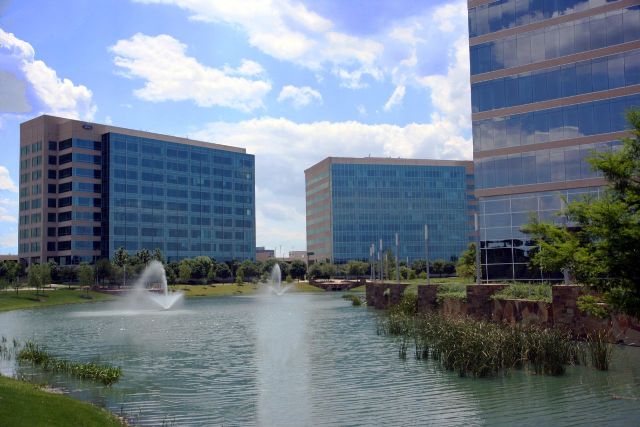
Plano es la sede corporativa de algunas de las más grandes y reconocidas empresas del país. Tree-lined Legacy Drive en el código postal 75024, entre Preston Road y el Dallas North Tollway, está lleno de campus corporativos.
Las siguientes empresas tienen sede en Plano:
Dr Pepper Snapple Group (anteriormente Cadbury Schweppes Americas Beverages).
Metromedia Restaurant Group (Bennigan's, Steak & Ale).
Cerca de un 80 % de los visitantes a Plano son viajeros de negocios, debido a su proximidad con la ciudad de Dallas y a las múltiples sedes centrales de sociedades anónimas. La ciudad también posee un centro de convenciones que es propiedad de la ciudad y es operado por la misma. Plano tiene un festival anual de globos aerostáticos.
Plano ha hecho un esfuerzo coordinado para atraer los negocios de venta al por menor hacia la zona céntrica y a Shops at Legacy con la intención de incrementar los retornos del impuesto a las ventas. El área de Shops at Legacy tiene apartamentos, tiendas y restaurantes construidos con la nueva filosofía de urbanismo. Un supercentro de lujo experimental Wal-Mart está ubicado en Park Boulevard con Dallas North Tollway.
Educación
En Plano hay 70 escuelas públicas, 16 escuelas privadas, 2 campus del Distrito de la Universidad Comunitaria del Condado de Collin y 6 bibliotecas.
El Distrito Escolar Independiente de Plano sirve a la mayoría de Plano. El enrolamiento de estudiantes ha incrementado dramáticamente en las últimas décadas. Plano tiene un sistema de educación secundaria único, en el que los grados 9 y 10 pertenecen a la secundaria y los grados 11 y 12 pertenecen a la secundaria superior. Hay 3 secundarias superiores en Plano: Plano East, Plano Senior y Plano West.
Pequeñas partes de Plano son atendidas por el Distrito Escolar Independiente de Lewisville, el Distrito Escolar Independiente de Frisco, y el Distrito Escolar Independiente de Allen.
Plano es sede de dos campos del Collin College (anteriormente el Collin County Community College District, Distrito de la Universidad Comunitaria del Condado Collin), uno en el Courtyard Center en el Boulevard Preston Park y el más grande Spring Creek Campus en Spring Creek Parkway en Júpiter.
En el 2006, el Distrito Escolar Independiente de Plano anunció que 115 alumnos superiores habían sido elegidos como semifinalistas del Programa Nacional de Becas al Mérito, la mayor cantidad en la historia del distrito.
Plano ha dado 1100 millones de dólares de los ingresos del impuesto a la propiedad a otros distritos escolares a través de la ley Robin Hood de Texas, que requiere que los distritos escolates que están designados como afluentes den un porcentaje de sus ingresos del impuesto a la propiedad a otros distritos fuera del condado. En el 2008, PISD entregó 86 millones de dólares. La polémica estalló cuando los salarios de los maestros de los distritos menos afluentes, como Garland ISD, exedieron los salarios de los maestros en los distritos que tenían que pagar bajo la ley Robin Hood.
Residentes destacados
La siguiente es una lista de residentes pasados y presentes de Plano, que han alcanzado la fama fuera de la comunidad:
Troy Aikman (1966-), jugador de fútbol americano.
Lance Armstrong (1971-), ciclista profesional.
Fred Couples (1959-), golfista profesional.
Michael Irvin (1966-), jugador de fútbol americano.
Deon Sanders, jugador de fútbol americano.
Zig Ziglar (1926-2012), expositor motivacional, autor y filántropo.
Kaynak: Wikipedia – Plano (Texas) · CC BY-SA 4.0
Tarih

1840'larda ilk yerleşimciler bugünkü Plano yakınlarına yerleşmişlerdir. Yerleşimcilerin bölgede kereste fabrikası, un değirmeni ve mağaza açması bölgeye daha fazla insanın gelmesine neden oldu. Posta servisinin de kurulması ile oluşmaya başlayan kasabaya bir isim verilmesi gerekti, birkaç isim verilmek istendiyse(başkan Millard Fillmore onuruna verilen isim dahil) de olmadı. Halk İspanyolcada düz anlamına gelen Plato ismini layık gördü. İsim posta ofisi tarafından da isim kabul edildi. 1872'de Houston and Central Texas Railway'in de tamamlanması şehrin büyümesinde önemli bir rol oynadı ve 1873'te resmi olarak şehir oldu. 1874'te şehrin nüfusu 500'ü aştı. 1881'deki yangında binaların birçoğu yıkıldı. 1880'lerde şehir tekrar inşa edildi ve işler normale dönmeye başladı.
Plano'nun nüfusu 1900 yılında 1.304'e ulaştı ve yavaş büyüerek 1960'ta 3.695'e ulaştı. 1970'te nüfus 17.872'ye ulaşıp 1980'de 72.000'i aştı. Plano şehrinin engebeli olmaması altyapının şehrin büyümesine paralellik göstermesini sağladı.
1981'de düzenlenen yarışmayı uzun süredir Plano şehrinde yaşayan profesyonel ressam ve tasarımcı James R. (Jim) Wainner tarafından tasarlanan çizim kazandı ve Plano Şehir Konseyi tarafından logo benimsendi. Çıkarılan yasa ile belediye meclisinden onay alınmadan logonun herhangi bir kuruluş, firma veya filmde kullanılması ve herhangi bir ekipman, ticari üründe kullanılması yasaklanmıştır.
1980'lerde J. C. Penney ve Frito-Lay gibi birçok büyük şirket, merkezlerini Plano'ya taşıdı ve bu durum şehrin büyümesine büyük yardımı oldu. 1990'da şehrin nüfusu 128.713'e ulaştı, bu durum county başkenti McKinney'i gölgede bıraktı. 1994'te All-America City ödülünü alan şehir. ülke çapında tanınma fırsatını buldu. 2000 yılında şehrin nüfusu 222.030'e ulaştı
Coğrafi özellikler

Amerika Birleşik Devletleri Sayım Bürosu'nun kayıtlarına göre şehrin toplam yüzölçümü 185,5 km²dir (71.6 mil kare).
İklim
Şehirde genel olarak nemli subtropikal iklim görülür. En yüksek sıcaklık 1936'da 118 °F (48 °C) olarak kaydedilmiştir. Şehrin en serin olduğu ay ocak, en sıcak ayı ise temmuzdur. En düşük sıcaklık 1930'da -7 °F (-22 °C) olarak kaydedilmiştir. Şehir en çok yağışı ise mayıs ayında alır.
Yönetim
Eyalet yönetimi
Plano Teksas senatosu tarafından temsil edilmektedir.
Federal yönetim
Federal seviyede Teksas'ın 2 adet Birleşik Devletler Senatörü bulunmaktadır.
Ekonomi
Plano'nun 2011 yılı mali raporuna göre Plano'da en çok işçi çalıştıran şirketler:
Şirketler
Ülkenin en büyük şirketlerinin bazılarının merkezleri Plano'dadır. Aşağıdaki şirketlerin merkezleri ya da bölgesel merkezleri Plano'dadır:
Eğitim
Plano'da 70'i eyalet, 16'sı özel olmak üzere toplam 86 okul, Collin County Community College'e ait 2 kampüs bulunmaktadır. Ayrıca şehirde 6 adet kütüphane yer alır.
Nüfus
2010 sayımına göre şehirde 259,841 kişi yaşamaktadır. 2000 sayımına göre şehirde 80.875 hane bulunmakta ve 60.575 aile de ikamet etmektedir. Kilometre kare başına 1.197,8 kişinin düştüğü şehirde, kilometre kare başına 464.4 hane düşmektedir. Şehir nüfusunun % 66,9'u beyaz (%58,4'ü Hispanik olmayan) %7,6'sı Afroamerikan, %0,36'sı Yerli, %16,9'u Asyalı, %0,1'i Pasifik Adalı, %3,36'sı diğer ırklardan ve %3'ü melezdir.
80,875 haneden %42,0'ında 18 yaşından küçük çocuk bulunmaktadır.
Tarihi yerler
Plano Station, Texas Electric Railway (1908)
Kaynak: Wikipedia – Plano, Teksas · CC BY-SA 4.0
History
Several Native American tribes have passed through what is now Plano, including the Comanche, Caddo, and Wichita. Settlers came to the area near present-day Plano in the early 1840s. Facilities such as a sawmill, a gristmill, and a store soon brought more people to the area. A mail service was established, and after rejecting several names for the nascent town (including naming it in honor of then-President Millard Fillmore), residents suggested the name Plano (from the Spanish word for "flat") in reference to the local terrain. The post office accepted the name.
In 1872, the completion of the Houston and Central Texas Railway helped Plano grow, and it was incorporated in 1873. By 1874, the population was over 500. In 1881, a fire raged through the business district, destroying most of the buildings. Plano was rebuilt and business again flourished through the 1880s. Also in 1881, the city assumed responsibility for what would eventually become Plano Independent School District (PISD), ending the days of it being served only by private schools.
At first, Plano's population grew slowly, reaching 1,304 in 1900 and 3,695 in 1960. By 1970, Plano began to feel some of the boom its neighbors had experienced after World War II. A series of public works projects and a change in taxes that removed the farming community from the town helped increase the population. In 1970, the population reached 17,872, and by 1980, it had exploded to 72,000. Sewers, schools, and street development kept pace with this massive increase, largely because of Plano's flat topography, grid layout, and planning initiatives.
During the 1980s, many large corporations, including J. C. Penney and Frito-Lay, moved their headquarters to Plano, spurring further growth. By 1990, the population reached 128,713, dwarfing the county seat, McKinney. In 1994, Plano was recognized as an All-America City. By 2000, the population grew to 222,030, making it one of Dallas's largest suburbs. Plano is surrounded by other municipalities and so cannot expand in area, and there is little undeveloped land within the city limits. But as of July 2012, one large tract of land was being developed: Turnpike Commons at the intersection of Renner Road and the George Bush Turnpike (also bordered by Shiloh Road to the east). The development is expected to feature apartments, medical facilities, restaurants, a Race Trac gas station, and a hotel.
Geography
According to the United States Census Bureau, Plano has an area of 71.6 square miles (185.5 km2). Plano is about 17 miles (27 km) from Downtown Dallas.
Plano is in the humid subtropical climate zone. The highest recorded temperature was 118 °F (48 °C) in 1936. On average, the coolest month is January and the warmest is July. The lowest recorded temperature was –7 °F (–22 °C) in 1930. The maximum average precipitation occurs in May.
Demographics

Racial and ethnic composition
As of the 2020 United States census, there were 285,494 people, 107,320 households, and 76,211 families residing in the city. As of the census of 2010, Plano had 259,841 people, 99,131 households and 69,464 families, up from 80,875 households and 60,575 families in the 2000 census. The population density was 3,629.1 inhabitants per square mile (1,401.2/km2). There were 103,672 housing units at an average density of 1,448.6 per square mile (559.3/km2).
In 2010, the racial makeup of the city was 67% White (58.4% non-Hispanic white), 7.5% Black, 0.36% Native American, 16.9% Asian (6.5% Asian Indian, 5.2% Chinese, 1.2% Vietnamese, 1.2% Korean, 0.6% Filipino, 0.2% Japanese, 1.9% Other), 0.1% Pacific Islander, 3.86% from other races, and 3.0% from two or more races. Hispanic or Latino made up 14.7% of the population (10.6% Mexican, 0.5% Puerto Rican, 0.2% Cuban, 3.5% Other). By 2020, the racial makeup was 46.3% non-Hispanic white, 8.77% Black or African American, 0.3% Native American, 24.08% Asian, 0.05% Pacific Islander, 0.47% some other race, 4.0% multiracial, and 16.04% Hispanic or Latino of any race, reflecting nationwide trends of greater diversification.
Of the 99,131 households in 2010, 35.8% had children under the age of 18. Married couples accounted for 56.7%; 9.7% had a female householder with no husband present, and 29.9% were non-families. About 24.4% of all households were individuals, and 5.3% had someone living alone who was 65 years of age or older. The average household size was 2.61, and the average family size was 3.15. Data indicates that 28.7% of Plano's population was under the age of 18, 7.0% was 18 to 24, 36.5% was 25 to 44, 22.9% was 45 to 64, and 4.9% was 65 years of age or older. The median age was 34. For every 100 females, there were 99.3 males. For every 100 females age 18 and over, there were 97.2 males.
Economy
Top employers
According to the 2025 Corporate Regional Headquarters Report, Plano's top 10 employers were:
About 80% of Plano's visitors are business travelers, due to its close proximity to Dallas and the many corporations headquartered in Plano. The city also has a convention center owned and operated by the city. Plano has made a concerted effort to draw retail to its downtown area and the Legacy West in an effort to boost sales tax returns. It has two malls, The Shops at Willow Bend and The Shops at Legacy. Collin Creek Mall closed in 2019. There is an area that has apartments, shops, and restaurants constructed with the New Urbanism philosophy. An experimental luxury Walmart Supercenter is at Park Boulevard and the Dallas North Tollway.
Headquarters of major corporations
Some of the country's largest and most recognized companies are headquartered in Plano. Legacy Drive in ZIP Code 75024, between Preston Road and Dallas North Tollway, has many corporate campuses. The following companies have corporate headquarters (Fortune 1000 headquarters) or major regional offices in Plano:
In 2014 Toyota Motor North America announced its U.S. headquarters would move from Torrance, California, to Plano. In 2015, Liberty Mutual announced its plans to build a new corporate campus just a few blocks east of Toyota's, bringing an estimated 5,000 jobs to the community. In January 2016, JP Morgan Chase and mortgage giant Fannie Mae announced they would move their regional operations to Plano, bringing a combined 7,000 new jobs to the community.
Arts and culture
The Plano Public Library System (PPLS) consists of the W.O. Haggard Jr. Library, the Maribelle M. Davis Library, the Gladys Harrington Library, the Christopher A. Parr Library, the L.E.R. Schimelpfenig Library, and the Municipal Reference Library. The Haggard Library houses the system's administrative offices.
The Plano Symphony Orchestra is partially funded by the city, performing regularly at St. Andrew United Methodist Church and the Charles W. Eisemann Center for Performing Arts in nearby Richardson.
Historic sites
Plano Station, Texas Electric Railway (1908)
Sports
Plano is set to be the location of the new arena for the Dallas Stars of the National Hockey League (NHL) in 2031, which will be located at the former site of The Shops at Willow Bend mall.
Parks and recreation

Although Plano is named for the flat plains of the area, large trees abound in the city's many parks. One such tree, estimated to be over 200 years old, is in Bob Woodruff Park, near Rowlett Creek on the city's east side.
There are two main open space preserves: Arbor Hills Nature Preserve (200 acres) and Oak Point Park and Nature Preserve (800 acres). Bob Woodruff Park and Oak Point Park and Nature Preserve are connected by biking trails, making the green space one large uninterrupted park space larger than New York City's Central Park (840 acres). Go Ape, a family-friendly place with outdoor activities like ziplining and Tarzan swings, is at Oak Point Park and Preserve. The Plano Balloon Festival, which happens every September, also takes place at Oak Point Park and Preserve. Another open space is Haggard Park, which hosts the annual Plano AsiaFest in May. Acreage of all spaces the Parks Department manages totals 3,830.81. The Plano Master Plan has the acreage growing to 4,092.63 when complete.
There are five recreation centers: Tom Muehlenbeck Recreation Center, Carpenter Park Recreation Center, Oak Point Recreation Center, Liberty Recreation Center, and Douglass Community Center. While Oak Point Recreation Center and Tom Muehlenbeck Recreation Center have both indoor and outdoor pools, Carpenter Park Recreation Center and Liberty Recreation Center has only an indoor and outdoor pool, respectively. Plano Senior Recreation Center is a recreation center dedicated to seniors. There are three swimming pools owned by Plano Parks & Recreation: Harry Rowlinson Community Natatorium, Jack Carter Pool, and Plano Aquatic Center. All the pools are indoor except Jack Carter Pool. Douglass Community Center houses the Boys & Girls Club of Collin County. For pet owners, there are The Dog Park at Jack Carter Park, The Dog Park at Bob Woodruff, and Dog Park at Windhaven Meadows Park.
Government

Local government
Plano has a council-manager form of government, with a part-time city council that sets city policy and a city manager responsible for city operations. The Plano City Council has eight members elected on a nonpartisan basis in staggered odd-year elections every other May. Council members and the mayor are elected by and serve the city at large. Council members serving in places one, two, three, and four must reside in that district, and the mayor always serves in place six. The mayor receives a yearly stipend of $8,400, and each council member receives $6,000.
All council members, including the mayor, serve a maximum of two consecutive four-year terms. The mayor and city council members could serve for a maximum of three consecutive three-year terms until voters approved changes to the city charter in 2011.
Mark Israelson has served as city manager of the city of Plano since May 2019.
The 38th mayor of Plano was businessman Harry LaRosiliere, who was elected the first African-American mayor of Plano in 2013. Plano elected its first African-American city council member, David Perry, in 1990.
On December 8, 2014, the city council passed an amendment to its civil rights act to include sexual orientation and gender identity as protected. The ordinance drew the ire of conservative groups such as the Liberty Institute, which argued that it infringed on business owners' religious rights. Many civil rights organizations were not supportive either, such as the Human Rights Campaign, which argued that the policy's exclusion of transgender individuals from being able to use bathrooms and locker rooms that align with their gender identity rendered the ordinance not worth defending.
In the 2008 fiscal year Comprehensive Annual Financial Report, Plano reported $194 million in revenue, $212 million in expenditures, $278 million in total assets, $31.4 million in total liabilities, and $337 million in cash and investments.
Education

Plano has 70 public schools, 16 private schools, and two campuses of Collin College.
Primary and secondary schools
The Plano Independent School District serves most of the city. Student enrollment has increased dramatically till 2012. However, the district has seen a decline since then, which resulted in two middle schools and two elementary schools to be closed for the 2025–2026 school year. Plano has a unique high school system, in which grades 9–10 attend a high school and grades 11–12 attend a senior high. There are three senior high schools (grades 11–12) in PISD: Plano East, Plano, and Plano West. Small portions of Plano are served by the Lewisville Independent School District, Frisco Independent School District, and Allen Independent School District.
Plano schools graduate more of their students than comparable districts. In 2010, 93% of Plano Independent School District students graduated from high school, 18 percentage points higher than Dallas ISD's rate. In 2012, Plano Independent School District announced that 128 seniors were selected as National Merit Semifinalists.
Plano has given $1.2 billion in property tax revenue to other school districts through Texas's "Robin Hood" law, which requires school districts designated as affluent to give a percentage of their property tax revenue to other districts outside the county. In 2008, PISD gave $86 million. Controversy erupted when the salaries of teachers in less affluent districts—such as Garland ISD—exceeded the salaries of teachers in districts that had to pay into "Robin Hood".
In the 2013–14 school year, Plano ISD opened two four-year high school academies, one focusing on STEAM (STEM education plus Media Arts) called Plano ISD Academy High School, and the other on health science. Additionally, the district modified its International Baccalaureate program to allow freshmen and sophomores in the program to be housed at Plano East Senior High School.
Infrastructure

Transportation
Plano is one of 12 suburbs of Dallas that opt into the Dallas Area Rapid Transit (DART) public transportation system. During its early membership in DART, Plano was lightly served by bus lines, but in 2002, the Red Line of the DART rail project opened stations in Downtown Plano and at Parker Road, which provide access to commuters traveling to work elsewhere in the Dallas area. The Orange Line traverses the same route for selected weekday/peak hour trips. Bus routes serve areas of downtown, south central, and west Plano, but no bus routes serve the far north, north central, and far east areas. Instead, DART's GoLink on-demand service serves these areas. The Silver Line operates in Southern Plano and has two stops: Shiloh Road Station and 12th Street Station. Approximately 1% of the city's population uses DART. The Parker Road station charged for parking for non-member city residents from April 2, 2012, to April 3, 2014, as a part of the Fair Share Parking initiative. Two DART park-and-ride bus facilities, separate from the rail lines, are in Plano: Jack Hatchell Transit Center and Northwest Plano Park & Ride.
Plano was the first city in Collin County to adopt a master plan for its road system. The use of multi-lane, divided highways for all major roads allows for higher speed limits, generally 40 mph (64 km/h), but sometimes up to 55 mph (89 km/h) on the northern section of Preston Road. Plano is served directly by several major roadways and freeways. Central Plano is bordered to the east by U.S. Highway 75, the west by Dallas North Tollway, the south by President George Bush Turnpike (Texas State Highway 190 (east of Coit Road)), and the north by Sam Rayburn Tollway (Texas State Highway 121). Preston Road (Texas State Highway 289) is a major thoroughfare that runs through the city. Plano is Texas's largest city without an interstate highway.
Sister cities
Brampton, Canada, was also a sister city to Plano until 2018.
Kaynak: Wikipedia – Plano, Texas · CC BY-SA 4.0