
Port St. Lucie
Port St. Lucie es una ciudad estadounidense ubicada en el condado de Santa Lucía, en el estado de Florida.
Government administration · United States · 0 followers
Overview
Port St. Lucie es una ciudad estadounidense ubicada en el condado de Santa Lucía, en el estado de Florida. En el Censo de 2010 tenía una población de 164.603 habitantes y una densidad poblacional de 551,44 personas por km².
Interested in working with us in the future?
Follow to see new jobs and posts in your feed.
No news yet.
About

Port St. Lucie es una ciudad estadounidense ubicada en el condado de Santa Lucía, en el estado de Florida. En el Censo de 2010 tenía una población de 164.603 habitantes y una densidad poblacional de 551,44 personas por km².
Kaynak: Wikipedia · CC BY-SA 4.0
Geografía
Port St. Lucie se encuentra ubicada en las coordenadas 27°16′51″N 80°23′2″O. Según la Oficina del Censo de los Estados Unidos, Port St. Lucie tiene una superficie total de 298.5 km², de la cual 295.14 km² corresponden a tierra firme y (1.13%) 3.36 km² es agua.
Demografía
Según el censo de 2010, había 164.603 personas residiendo en Port St. Lucie. La densidad de población era de 551,44 hab./km². De los 164.603 habitantes, Port St. Lucie estaba compuesto por el 74.29% blancos, el 16.34% eran afroamericanos, el 0.38% eran amerindios, el 1.98% eran asiáticos, el 0.07% eran isleños del Pacífico, el 3.91% eran de otras razas y el 3.02% pertenecían a dos o más razas. Del total de la población el 18.38% eran hispanos o latinos de cualquier raza.
History
The name "St. Lucie" is originally derived from the name of a settlement near Jupiter Inlet, which was founded on St. Lucia's Day in 1566. Due to numerous errors, the name later came to be associated with the present-day town of St. Lucie Village, Florida, north of present-day Port St. Lucie. After La Florida and St. Augustine, it is the oldest still-in-use European place name in the United States. In the early 1890s, an early pioneer settlement named Spruce Bluff was located along the St. Lucie River, which consisted of a community of several families with a school, post office, pineapple plantation, and sawmill. Currently, the land the settlement was located on is part of the Spruce Bluff Preserve. Along with an old cemetery near the old settlement, the preserve also contains a hiking area, canoe access, observation areas, and a prehistoric Ais Indian mound located on the southern end of the preserve.
In the 1950s, the land that eventually became Port St. Lucie was a largely uninhabited tract of land south of White City, composed of a fishing camp (Burt Pruitt's Fishin' Farm) along the St. Lucie River, a few farms and businesses near U.S. 1. In 1958, with a budget of $50 million, the General Development Corporation (GDC) purchased the River Park development and 40,000 acres (160 km2) along the North Fork of the St. Lucie River. In 1959, the GDC opened its first bridge over the St. Lucie River, allowing for direct automobile access to Port St. Lucie.
By February 25, 1961, 250 homes were in the new city. GDC requested the state legislature to incorporate 70 mi (110 km), along with the River Park settlement, into the City of Port St. Lucie. River Park did not incorporate into the city at the request of its residents. Port St. Lucie became a city on April 27, 1961, with the passage of House Bill No. 953, proposed by State Representative Rupert Smith and approved by Florida Governor C. Farris Bryant.
Geography

According to the United States Census Bureau, the city has a total area of 76.7 sq mi (198.6 km2), of which 1.2 sq mi (3.0 km2) (1.50%) are covered by water.
Neighborhoods
In late 2019, Port St. Lucie began naming different neighborhoods throughout the city. As of 2020, 33 neighborhoods are named in Port St. Lucie:
Climate
Port St. Lucie is located in the broad transition zone between a humid subtropical climate (Cfa), which prevails in Central Florida, and within the northern extent of the tropical climate typical of South Florida. Summers are usually hot, with high temperatures averaging in the low 90°Fs. Winters are usually mild to warm, with average high temperatures in the 70s. The average yearly precipitation is around 53.5 in.
In 2004 and 2005, Port St. Lucie was hit directly by three hurricanes: Frances (category 2), Jeanne (category 3), and Wilma (category 3).
Demographics
2020 census
As of the 2020 United States census, 204,851 people, 68,241 households, and 51,199 families were residing in the city.
2010 census
As of the 2010 United States census, 164,603 people, 56,408 households, and 41,785 families resided in the city.
2000 census
As of the census of 2000, 88,769 people, 33,909 households, and 25,736 families were living in the city. The population density was 453.7 people/km2 (1,175 people/mi2). There were 36,785 housing units at an average density of 188.0 units/km2 (487 units/mi2). In 2000, the population was 87.88% White, 7.09% Black or African American, 0.23% Native American, 1.24% Asian, 0.03% Pacific Islander, 1.77% from other races, and 1.76% from two or more races. 7.52% of the population were Hispanic or Latino of any race.
In 2000, 31.6% of households had children under 18 living with them, 61.8% were married couples living together, 10.0% had a female householder with no husband present, and 24.1% were not families. Of all households, 18.2% were made up of individuals, and 8.9% had someone living alone who was 65 or older. The average household size was 2.60 and the average family size was 2.94.
In 2000, the city's age distribution was 24.3% under 18, 5.9% from 18 to 24, 28.1% from 25 to 44, 22.8% from 45 to 64, and 18.8% who were 65 or older. The median age was 40 years. For every 100 females, there were 94.5 males. For every 100 females 18 and over, there were 91.4 males.
As of 2000, the median income for a household in the city was $40,509, and for a family was $44,162. Males had a median income of $31,730 versus $23,702 for females. The per capita income for the city was $18,059. 7.9% of the population and 5.7% of families were below the poverty line, including 11.1% of those under 18 and 5.8% of those 65 or over.
Languages
As of 2000, 88.05% of residents spoke English as their first language, while 6.59% spoke Spanish, 1.34% spoke Italian, 1.00% spoke French, 0.60% spoke German, and 0.50% spoke Haitian Creole as their mother tongue. In total, 11.94% of the total population spoke languages other than English.
Infrastructure
Transportation
Port St. Lucie is served by the St. Lucie Transportation Planning Organization (TPO). The TPO is a metropolitan planning organization, a federally mandated and federally funded transportation policy-making organization responsible for transportation planning, programming, and financing of state and federal transportation funds for the City of Port St. Lucie. The TPO is governed by a TPO board, which is composed of elected officials, representatives from the St. Lucie County School Board, and representatives from Community Transit, a division of the Council on Aging of St. Lucie, Inc.
Bus
The original bus system started out as a demand-response service bus in the 1990s; it only served St. Lucie County. Soon, it expanded to a fixed-route system, serving predetermined locations along a route. On June 3, 2002, the Florida Department of Transportation approved funding, expanding the bus service to Martin County, and became the Treasure Coast Connector. In 2020, the bus service changed its name to Area Regional Transit; buses run on eight routes, five of which serve Port St. Lucie.
Expressways
Florida's Turnpike (State Road 91) is the only toll road in St. Lucie County, which is the northernmost place where the Turnpike and Interstate 95 run close to each other. The Turnpike has two exits within Port St. Lucie's city limits: Exit 142 (Port St. Lucie Boulevard (SR 716)) and exit 138 (Becker Road). For all of its route through Port St. Lucie, the turnpike is east of I-95. The Turnpike is four lanes wide , and provides access to Orlando to the north, and Miami to the southeast. The Port St. Lucie/Ft. Pierce Service Plaza is also located in Port St. Lucie.
I-95 (Florida State Road 9) is in the western portion of the city. It is six lanes wide, and provides access to Jacksonville to the north, and Miami to the south. Exits within the city's limits are exit 126 (CR 712/Midway Road), exit 121 (St. Lucie West Blvd.), exit 120 (Crosstown Parkway), exit 118 (Gatlin Blvd./Tradition Pkwy.), and exit 114 (Becker Rd.).
Sports

Port St. Lucie is the spring training home to the New York Mets and two minor league teams: St. Lucie Mets, a Low-A team in the Florida State League, and the Florida Complex League Mets, a rookie-level team in the Florida Complex League. All three play at Clover Park.
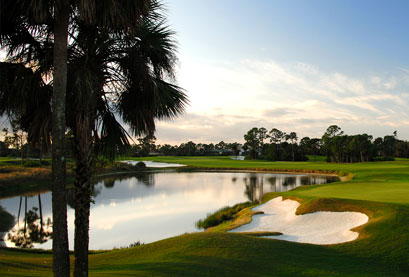
The PGA Village golf complex includes 54 holes, plus a learning center and a historical center. The city also hosted the Ginn sur Mer Classic at Tesoro in 2007, the city's first PGA Tour event.
The city has two soccer clubs, Mako Soccer Club and Port St. Lucie SC, that field both competitive and recreational teams at several age levels. The FC Florida U23 soccer team also plays in the city at the South County Stadium, starting in the 2019 season.
Port St. Lucie is the home of the 2009 and 2011 national champions in Pop Warner football. In 2009, the Jr. Midget Pirates went 16–0 en route to winning the Pop Warner National Championship at Disney's Wide World of Sports Complex. In 2001, the Jr. Peewee Pirates went 17–0 in winning the national championship.
Education
Port St. Lucie, as well as all of St Lucie County, is served by St. Lucie County Public Schools.
Elementary schools
Village Green Environmental Studies School
Kindergarten–grade 8 schools
Palm Pointe Research School at Tradition
Government

Shannon Martin – mayor of Port St. Lucie
Jolien Caraballo – vice mayor and councilwoman, District 4
Stephanie Morgan – councilwoman, District 1
Libraries
Six regular branch libraries are in St. Lucie County and the Pruitt Campus Library, with four branches in the city of Port St. Lucie.
Pruitt Campus (a joint facility with Indian River State College) - 25,000 sq ft
In popular culture
Part of the James Bond film Moonraker was shot in Port St. Lucie, on the St. Lucie River.