

Porto
Porto é uma cidade portuguesa e capital da sub-região da Área Metropolitana do Porto e da região Norte, pertencendo ao distrito do Porto.
Government administration · Portugal · 0 followers
Overview
Porto é uma cidade portuguesa e capital da sub-região da Área Metropolitana do Porto e da região Norte, pertencendo ao distrito do Porto. É sede do Município do Porto que tem uma área total de 41,42 km2, 248 769 habitantes em 2023 e uma densidade populacional de 6 006 hab./km2, subdividido em 7 freguesias. O município é limitado a norte pelos municípios de Matosinhos e Maia, a leste por Gondomar, a sul por Vila Nova de Gaia e a oeste pelo Oceano Atlântico.
Interested in working with us in the future?
Follow to see new jobs and posts in your feed.
No news yet.
About

Porto é uma cidade portuguesa e capital da sub-região da Área Metropolitana do Porto e da região Norte, pertencendo ao distrito do Porto. É sede do Município do Porto que tem uma área total de 41,42 km2, 248 769 habitantes em 2023 e uma densidade populacional de 6 006 hab./km2, subdividido em 7 freguesias. O município é limitado a norte pelos municípios de Matosinhos e Maia, a leste por Gondomar, a sul por Vila Nova de Gaia e a oeste pelo Oceano Atlântico.
Kaynak: Wikipedia · CC BY-SA 4.0
História

Fundação e primeiros povos
Tem origem num povoado celta, pré-romano. Na época romana designava-se Cale ou Portus Cale, sendo a origem do nome de Portugal.
A 27 de abril de 711, dá-se o início da invasão muçulmana da Península Ibérica, com o desembarque em Gibraltar dum exército mouro de 9 000 homens, liderados por Tárique. Em 714 tomam Lisboa, e em 715 as forças islâmicas atingem a região norte do que hoje conhecemos como Portugal, tomando as principais povoações e cidades, tais como Porto e Braga. Em 716 já praticamente toda a Península estava sob domínio do Califado Omíada, com exceção de uma pequena zona montanhosa das Astúrias, onde a resistência cristã se refugiou.
Passado um século e meio, em 868, surgem as primeiras tentativas de reconquista definitiva, Vímara Peres, fundador da terra portucalense, teve uma importante contribuição na conquista do território, restaurando assim a cidade de Portucale.
Finalmente, e passados dois séculos após o início da invasão, em 999, fidalgos gascões entre os quais se encontrava D. Nónego bispo de Vendôme em França e mais tarde bispo do Porto entraram com uma grande armada pela foz do Rio Douro, para expulsarem os mouros. Esta armada, que ficou conhecida como a Armada dos Gascões, associada a D. Munio Viegas, conquistou a cidade do Porto aos mouros para dedicá-la à Virgem Mãe de Deus. Depois desta batalha, D. Munio e os "franceses" trataram de reedificar o Porto. Ergueram as antigas e fortes muralhas, e na parte mais elevada da cidade, fundaram um alcácer acastelado e bem fortalecido que, depois do conde Henrique, serviu de habitação dos bispos, aos quais foi doado. A torre e a porta principal foram obra de D. Nónego, que, em memória da pátria, a nomeou porta de Vandoma, e que na frontaria da torre fez erguer o santuário, onde colocou a imagem de Nossa Senhora do Porto, que já trouxera consigo de França.
Geografia

O território do Porto tem uma área de 45 km2 e uma população de cerca de 240 000 pessoas, sendo a segunda maior aglomeração urbana do país. A cidade é conhecida como a capital do Norte e seu Centro Histórico é classificado como Património Mundial da UNESCO desde 1996.
A localização geográfica da cidade, aliada a uma rede de autoestradas, permite chegar a regiões como Galiza, Algarve, Lisboa, Coimbra ou outros lugares facilmente. Porto é classificada como a 3ª cidade portuguesa com condições de vida mais habitáveis, conforme medido por um estudo publicado anualmente pelo Expresso.
Clima
A cidade do Porto tem um clima mediterrânico do tipo Csb de acordo com a classificação climática de Köppen-Geiger. No Inverno as temperaturas variam entre os 5 °C e os 14 °C raramente descendo abaixo dos 0 °C. Durante esta estação, períodos chuvosos alternam com dias mais frios e de céu limpo. No Verão as temperaturas variam entre os 15 °C e os 25 °C podendo ocasionalmente atingir ou mesmo ultrapassar os 35 °C nos meses de Julho ou Agosto. Temperaturas estivais acima dos 30 °C são raras devido à proximidade do oceano, contudo verificam-se quando o vento sopra do quadrante leste. Devido à sua situação geográfica, períodos mais frescos e com precipitação podem ser comuns durante o Verão em anos mais húmidos.
Demografia

A Área metropolitana do Porto é o lar de 1 757 413 habitantes e tem 1 900 km² de área, com uma densidade populacional próxima de 1 098 hab/km², o que torna a cidade a 13ª área urbana mais populosa da União Europeia, sendo, portanto, a segunda maior área (NUTS III) de Portugal. O Porto e sua área metropolitana constituem o núcleo estrutural da Região Norte, que é a região (NUTS II) mais populosa do país, concentrando quase 35% da população residente em Portugal. Muitas das casas mais antigas da cidade estão em risco de colapso. A população do município do Porto caiu em quase 100 000 entre 1981 e 2014, mas o número de residentes permanentes na periferia e cidades satélites cresceu fortemente neste mesmo período.. Desde 2014, inverteu-se a tendência e a população do Porto aumentou em 12 000 pessoas.
A cidade do Porto é conhecida como a Cidade Invicta e como a Capital do Norte. Foi a cidade principal do Entre Douro e Minho e a capital da região do Douro Litoral, que são dois territórios identitários que ainda hoje têm forte coesão, em termos físicos, naturais, humanos e sociais, estando localizada num dos pontos nucleares da bacia hidrográfica do rio Douro. O Porto é, frequentemente, referido como a cidade portuguesa com o temperamento mais centro-europeu, devido ao bucolismo requintado do seu espaço urbano (a fazer lembrar o requinte das cidades comerciais e capitalistas dos países centrais e nórdicos da Europa que se encontram localizadas perto dos rios e do oceano), surgido das influências estruturais que moldaram os seus habitantes e o temperamento da cidade: a Monarquia de Portugal, a influência cultural dos Judeus e a forte ligação a Inglaterra, com a maior comunidade britânica em Portugal.
Na cidade encontra-se a maior sinagoga da Península Ibérica e uma das maiores da Europa — a Sinagoga Kadoorie, edificada em 1938. Nela pode-se conhecer a história e religião judaicas, tomar contacto com importantes objetos históricos e documentos assim como saber mais sobre a comunidade judaica do Porto ao longo dos séculos até aos dias de hoje.
Política

Porto é a sede e a capital da Área Metropolitana do Porto, presidida, na atualidade, por Eduardo Vitor Rodrigues, que é uma grande área metropolitana portuguesa que agrupa 17 municípios.
Cidades geminadas
A cidade do Porto encontra-se geminada com as seguintes cidades:
Freguesias
O concelho do Porto está dividido em sete freguesias:
Economia

A região da cidade é onde se situam a maioria das pequenas e médias empresas do país, sendo também a que mais contribui para as exportações nacionais, sendo a única região que exporta mais do que importa. A Região Norte produz 40% do valor acrescentado do país e tem 50% do emprego industrial, tendo uma taxa de cobertura das importações pelas exportações de 129%, contra a média nacional de 74%. Esta região é servida por duas importantes infra-estruturas: o Porto de Leixões, que representa 25% do comércio internacional português e movimenta cerca de 14 milhões de toneladas de mercadorias por ano, e o Aeroporto Francisco Sá Carneiro, que é o melhor aeroporto de Portugal em termos de espaço na aerogare. Em termos de movimentos aéreos de carga e de passageiros, é o segundo maior de Portugal, tendo sido galardoado como o melhor do mundo na categoria de aeroportos até 5 milhões de passageiros e, em 2014, como o terceiro melhor aeroporto europeu.
O Porto sempre rivalizou com Lisboa ao nível económico. A abastada classe de industriais da região criou, logo em meados do século XIX, a poderosa Associação Industrial Portuense, hoje Associação Empresarial de Portugal. A antiga Bolsa do Porto foi transformada na maior Bolsa de Derivados de Portugal, tendo-se fundido com a Bolsa de Lisboa criando a Bolsa de Valores de Lisboa e Porto. Em 2002, a BVLP acabou por se integrar na Euronext, em conjunto com bolsas da Bélgica, França, Países Baixos e Reino Unido. O edifício que albergou durante muito tempo a bolsa, o Palácio da Bolsa, sede da Associação Comercial do Porto, é hoje uma das principais atrações turísticas da cidade. O Porto e a região Norte constituem a região onde se situam a maioria das pequenas e médias empresas e onde se situam as regiões agrícolas mais produtivas e também a que mais contribui para as exportações nacionais, sendo a única região que exporta mais do que importa.
Infraestrutura

Transportes
O Aeroporto Internacional Francisco Sá Carneiro (OPO), que é o melhor aeroporto de Portugal em termos de espaço na aerogare. Em termos de movimentos aéreos de carga e de passageiros, é o segundo maior de Portugal, tendo sido galardoado como o melhor do mundo na categoria de aeroportos até 5 milhões de passageiros e, em 2014, como o terceiro melhor aeroporto europeu. Depois de radicalmente reconstruído sua zona de influência se alastrou pelo noroeste da Península Ibérica, sendo hoje um aeroporto funcional e de arquitetura contemporânea com capacidade para receber até 16 milhões de passageiros por ano, considerado por diversas entidades internacionais como o melhor da Europa na sua categoria.
o Porto de Leixões, que representa 25% do comércio internacional português e movimenta cerca de 14 milhões de toneladas de mercadorias por ano, situado no concelho vizinho de Matosinhos, passará por uma ampliação que duplicará a possibilidade de carga, e trará vários cruzeiros de luxo ao porto, ou mesmo os estudos científicos realizados na cidade que já deram cartas na história da Ciência Mundial. Leixões foi classificado em 2013 como um dos 125 portos mais movimentados do mundo.
O transporte público na cidade do Porto remota ao ano de 1872, altura em que a Companhia Carril Americano do Porto foi pioneira ao iniciar a sua exploração em Portugal. Um ano depois é criada a Companhia Carris de Ferro do Porto. A fusão das duas empresas dará origem à Sociedade de Transportes Colectivos do Porto (STCP) que toma a atual designação em 1946. A STCP tem a seu cargo a exploração dos autocarros e as linhas de eléctrico que resistiram da época de ouro destes transportes, estando hoje troços em reabilitação na baixa portuense.
A exploração da rede de metropolitano é efetuada pela empresa Metro do Porto que ao todo possuiu 68 estações distribuídas por 60,0 km de linhas comerciais em via dupla, com 8 km da rede enterrada, dispostas pela metrópole do Porto, tornando-se assim na maior rede metropolitana de transporte público de massas em Portugal. O Funicular dos Guindais, operado pela Metro do Porto, é um caminho de ferro numa escarpa que liga, de forma rápida, a zona da Batalha à Avenida Gustavo Eiffel, na Ribeira. A cidade dispõe ainda de uma rede ferroviária suburbana explorada pela CP: linhas de Aveiro, Braga, Guimarães e Penafiel ou Caíde.
Cultura

Entretenimento
A cidade conta com mais de 10 000 eventos anuais, desde concertos, passando por teatros, exposições ou mesmo festas com disc jockeys famosos numa das várias discotecas e bares da cidade. Contudo, o maior evento de diversão continua a ser o São João do Porto, de 23 para 24 de junho, quando milhares de pessoas invadem as ruas da cidade. Neste evento são de destacar as sardinhadas, os manjericos com as respetivas quadras sanjoaninas, o alho-porro, as marteladas e os bailaricos de freguesia.
Gastronomia
Vários pratos da tradicional culinária portuguesa tiveram origem na cidade do Porto, cuja identidade (a nível dos pratos principais de carne e de peixe, das sopas, das entradas e dos aperitivos, dos vinhos e das aguardentes, dos queijos e dos enchidos, bem como das sobremesas e da doçaria) se insere na identidade gastronómica mais vasta do território identitário do Entre Douro e Minho.
O prato típico por excelência da cidade são as tripas à moda do Porto, prato histórico e que remonta à altura dos descobrimentos portugueses, e que pode ser encontrado em muitos dos restaurantes da cidade. O bacalhau à Gomes de Sá é outro prato emblemático da cidade do Porto, muito apreciado pelo seu sabor e requinte, que tem também impacto em todo o território português, assim como no Brasil, visto este ter sido povoado, estruturalmente, por portugueses do Norte de Portugal. O Caldo Verde também é um sopa típica, originária e emblemática do Porto e da região Norte. A francesinha é, da culinária recente, o prato mais famoso, e consiste numa sanduíche recheada com várias carnes (normalmente carne de vaca, linguiça, salsicha fresca e fiambre) e coberta com queijo e um molho especial (molho de francesinha).
A bebida que tem o nome da cidade é o vinho do Porto, é produzido na região vitivinícola do Alto Douro (a mais antiga região demarcada do mundo). O vinho do Porto é exportado internacionalmente a partir das caves que se situam na margem esquerda do Rio Douro, em Vila Nova de Gaia.
Kaynak: Wikipedia – Porto · CC BY-SA 4.0
İklim
Porto'da ılık-yaz özellikleriyle Akdeniz iklimi (Köppen iklim sınıflandırması'na göre) hüküm sürer. Sonucunda güney sahillerinin iklim karakteristik özelliklerini paylaşır: ılık, kuru yazları, yağmurlu kışları. Lakin güneyin aksin, serin ve yağışlı geçişlerle kurak mevsim kesilebilir ve mevsim ortalamasının uzunluğu genellikle daha kısadır.
Yazları 15 °C (59 °F) ve 25 °C (77 °F) arasında güneşlidir ama mevsimsel sıcak dalgaları ile 35 °C (95 °F) sıcaklıklara çıktığı da olur. Bu sıcak dalgaları sırasında havadaki nem oranı alçak kalır ama yakınlarda orman yangınlarına yol açar. Sahilleri genellikle rüzgarlı ve şehirlerden daha ılıktır. Tersi olarak, nadiren yazın yağmurlu periyotları birkaç gün sürebilir ve sağnaklar ve öğleden sonraları ulaştığı 20 °C (68 °F) sıcaklıktaki serinlikler ile karakterize edilirler.
Mimari
Douro nehrinin ağzına bakan tepeler boyunca kurulan, 2.000 yıllık tarihi ile olağan dışı bir kentsel manzaraya sahip
Oporto tarihi şehir merkezi, 1996 yılında UNESCO tarafından dünya mirası listesine alınmıştır. Kentin mimari eserleri arasında, ayakta kalan en eski yapısı Oporto Katedrali ile birlikte, küçük Romanesk Cedofeita Kilisesi, gotik Igreja de São Francisco Kilisesi, Saint Francis, surlar kalıntıları ve 15. yüzyıldan kalma evleri bulunmaktadır. Kentte barok stili de Francis ve St Claire (Santa Clara) kiliselerinin iç dekorasyonunda ayrıntılı ve yaldızlı çalışmalarla, Merhamet kiliseleri'nde (Misericórida) ve İmamlar ( Igreja dos Clerigos) ile Porto Piskoposluk Sarayı tarafından temsil edilmektedir. neoklasisizm ve romantizm 19. ve 20. yüzyıllarda şehrin peyzajına muhteşem Borsa Sarayı Palácio da Bolsa, Saint Anthony Hastanesi, belediye binası, Liberdade Meydanı'ndaki binalar ve Avenida dos Aliados, çini süslü São Bento Tren İstasyonu ve Kristal Sarayının ( Palácio de Cristal) bahçeleri gibi ilginç anıtlar eklendi. Bir rehber eşliğinde ziyaret Palácio da Bolsa ziyareti ve özellikle Arap Odasını görmek önemli bir turistik ilgi kaynağı olmuştur.
Bucaklar
Belediyede 15 bucak (Por.: freguesia) yer almaktadır.
Kaynak: Wikipedia – Porto · CC BY-SA 4.0
History

Early history
Before the Roman conquest, the region was inhabited by the Gallaeci, a Celtic people. Archaeological ruins from this period have been uncovered in several locations. Findings suggest that human settlements existed at the mouth of the Douro River as early as the 8th century BC, possibly indicating the presence of a Phoenician trading post.
Under the Roman Empire, Porto (then known as Portus Cale) developed into a significant commercial hub, facilitating trade between Olissipona (modern Lisbon) and Bracara Augusta (modern Braga). During the Suebian and Visigothic periods, it emerged as a key center for the spread of Christianity.
Between 714 and 716, Porto came under Muslim control following the Umayyad conquest of Hispania. It was reconquered by Christian forces under Alfonso I of Asturias in 741, establishing Porto as a fortified Christian frontier town.
In 868, Vímara Peres, a Galician nobleman and vassal of Alfonso III of León, was granted the fief of Portucale. He repopulated and fortified the area between the Minho and Douro rivers, founding the County of Portucale—later known as the County of Portugal.
In 1093, Teresa of León, illegitimate daughter of Alfonso VI of Castile, married Henry of Burgundy, who received the County of Portugal as dowry. Under their son, Afonso I of Portugal, the region declared independence in the 12th century and became the nucleus of the Portuguese nation-state.
In 1387, Porto hosted the marriage of John I of Portugal and Philippa of Lancaster, cementing the Anglo-Portuguese alliance, which remains the oldest enduring military alliance in the world.
By the 15th century, Porto had become a prominent shipbuilding and maritime center. In 1415, Prince Henry the Navigator launched the Conquest of Ceuta from Porto, initiating the Portuguese Age of Discovery. The nickname tripeiros (tripe-eaters) originates from this period, when better meat cuts were sent on naval expeditions, leaving tripe for the locals. The dish Tripas à moda do Porto remains emblematic of the city's culinary identity.
Geography

Located approximately 280 km (170 miles) north of Lisbon, the historic center of Porto was designated a UNESCO World Heritage Site in 1996. Among the city's architectural landmarks, the Porto Cathedral is the oldest surviving structure, along with the small Romanesque Church of Cedofeita, the Gothic Church of Saint Francis, remnants of the defensive city walls, and several 15th-century houses.
The Baroque style is richly represented in the ornate interior decoration of the churches of São Francisco and Santa Clara, as well as in the churches of Misericórdia and Clérigos, the Episcopal Palace of Porto, and others. The 19th and 20th centuries introduced Neoclassical and Romantic influences, contributing notable landmarks such as the Stock Exchange Palace (Palácio da Bolsa), the Hospital of Saint Anthony, the city hall, the buildings of Liberdade Square and Avenida dos Aliados, the tile-adorned São Bento railway station, and the gardens of the Palácio de Cristal. A guided visit to the Palácio da Bolsa, particularly the Arab Room, is a major tourist attraction.
Many of Porto's oldest buildings are at risk of collapse. While the population of the municipality has decreased by nearly 100,000 since the 1980s, there has been significant growth in the number of permanent residents living in the surrounding suburbs and satellite towns.
Administrative divisions
Administratively, Porto is divided into seven civil parishes (freguesias):
Cedofeita, Santo Ildefonso, Sé, Miragaia, São Nicolau e Vitória
Climate
Porto has a warm-summer Mediterranean climate (Köppen: Csb, Trewartha: Csbk), typical of the northern Iberian Peninsula. As a result, the region combines features of both the dry, warm Mediterranean climates of southern Europe and the wet marine west coast climates of the North Atlantic.
Summers are typically warm and sunny, with average temperatures between 16 and 26 °C (61 and 79 °F), occasionally reaching up to 30 °C (86 °F) during heatwaves. These hot spells are usually accompanied by low humidity. The nearby beaches are often windier and cooler than inland areas. Porto's summers are generally milder than those of inland Portuguese cities due to its proximity to the Atlantic Ocean.
Occasionally, summer weather is interrupted by brief rainy periods marked by showers and cooler temperatures around 20 °C (68 °F) in the afternoon. Annual precipitation is high, mostly concentrated in winter, making Porto one of the wettest major cities in Europe. Nonetheless, prolonged sunny intervals are common even during the rainiest months.
Winters are mild and damp. Temperatures usually range from around 5/6 °C (41/43 °F) in the morning to 14/15°C (57/59 °F) in the afternoon, and seldom drop below freezing. While long periods of rainfall are typical, sunny breaks also occur during the winter season.
Politics and government

Pedro Duarte (PSD) is the current mayor of Porto, having taken office on 5 November 2025, following the 2025 local elections.
Local election results 1976–2025
Parties are listed from left-wing to right-wing.
Active political parties established in Porto
The Portuguese party Iniciativa Liberal (IL), founded and headquartered in Porto, is the only Portuguese party represented in parliament which is headquartered outside the Lisbon area.
Demographics
Estimates from 2016 show that the population is 55% female, compared to 45% male. The largest age group, according to 2016 estimates, is 60 to 69, followed by residents in the 50 to 59 demographic. The majority 93.7% of residents were born in Portugal. The city also has residents born in Angola, Brazil, Cape Verde, and countries across Europe.
Economy

Porto and the surrounding conurbation, with the Porto municipality as its core, form one of the principal industrial and financial centers of both Portugal and the Iberian Peninsula. As the most prominent city in the heavily industrialized northwest, Porto hosts the headquarters of numerous leading Portuguese corporations spanning various economic sectors, including Altri, Ambar, Amorim, Bial, BPI, Cerealis, CIN, Cofina, EFACEC, Frulact, Lactogal, Millennium bcp, Porto Editora, RAR, Sonae, Sonae Indústria, ebankIT, and Super Bock Group. Most of these companies are based within the Greater Metropolitan Area of Porto, particularly in the core municipalities of Maia, Matosinhos, Porto, and Vila Nova de Gaia.
The city's former stock exchange (Bolsa do Porto) evolved into Portugal's largest futures exchange before merging with the Lisbon Stock Exchange to create the Bolsa de Valores de Lisboa e Porto. This was later absorbed into the multinational Euronext group, alongside the exchanges of Amsterdam, Brussels, and Paris. The former stock exchange building is now a major tourist attraction, known for its ornate Salão Árabe (Arab Room).
Porto is the headquarters of the Banco Português de Fomento (BPF), a state-owned development bank established in 2020.
Jornal de Notícias, a prominent national newspaper, is based in the city. The building bearing its name was once among Porto's tallest, although it has since been surpassed by newer structures built since the 1990s.
Porto Editora, one of the largest Portuguese publishing houses, is also based in the city. Its dictionaries and translations are among the most widely used in Portugal.
Porto's economic ties to the Upper Douro River region have been documented since the Middle Ages and were further developed in the modern era. Products such as sumac, dried fruits, nuts, and olive oil were historically exported from Porto's riverside quays to markets in the Old and New World. Growth of the Port wine (Vinho do Porto) industry strengthened this interregional relationship. The trade in fortified wines established a complementary dynamic between the coastal urban center and the agriculturally rich Douro Valley. Much of the wine industry's infrastructure developed on the south bank of the Douro, in Vila Nova de Gaia, where the amphitheater-shaped slopes house historic port wine cellars.
Tourism

In recent years, Porto has experienced a significant rise in tourism, aided in part by the establishment of a Ryanair hub at Francisco de Sá Carneiro Airport. Between January and November 2017, the city received 2.8 million overnight visitors and 1.4 million day-trippers, 73 percent of whom were international tourists. Tourism revenues increased by over 11 percent during that period, according to a 2018 report. More than 3 million tourists visited the city during 2025.
A 2019 report noted that over 10 percent of Porto's economic activity is generated by tourism. The hotel occupancy rate in 2017 was 77%.
According to a 2019 scholarly study, "Porto is one of the fastest-growing European tourist destinations that has experienced exponential growth in the demand for city-break tourists".
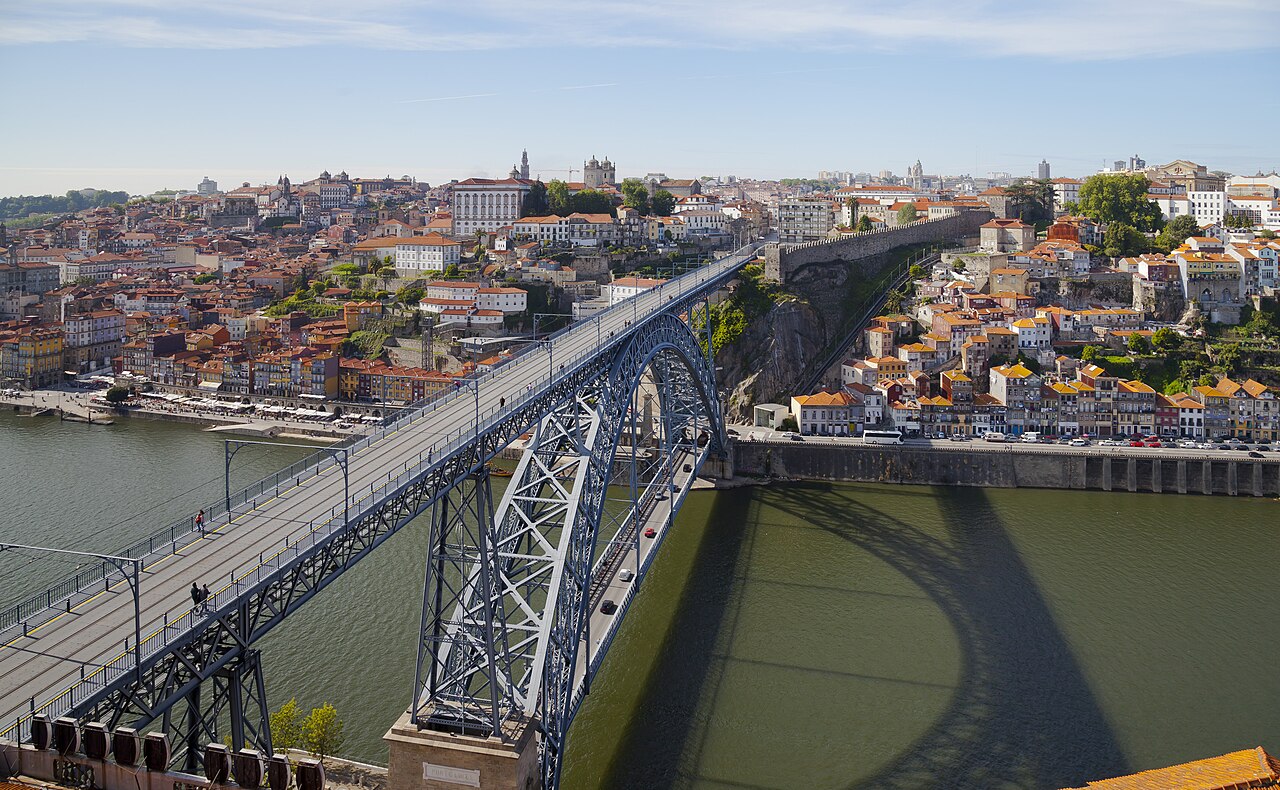
Notable attractions include the Porto Cathedral, Dom Luís I Bridge, Café Majestic, Livraria Lello, and the gardens of Palácio de Cristal.
Transport

Roads and bridges
The Via de Cintura Interna, or A20, is an internal highway connected to several motorways and city exits. The Circunvalação is a 4-lane peripheric road bordering the north of the city and connecting the eastern side of the city to the Atlantic shore. The city is connected to Valença (Viana do Castelo) by highway A28, to Estarreja (Aveiro) by the A29, to Lisbon by the A1, to Bragança by the A4 and to Braga by the A3. There is an outer-ring road, the A41, that connects the main cities around Porto, linking the city to other major metropolitan highways such as the A7, A11, A42, A43 and A44. In 2011, a new highway, the A32, was completed to connect the metropolitan area to São João da Madeira and Oliveira de Azeméis.
The Dom Luís I Bridge (Ponte de Dom Luís I) is a double-deck metal arch bridge that spans the River Douro between Porto and Vila Nova de Gaia. Built in 1886, its 172 metres (564 ft) span was then the longest of its type in the world. The top-level is used by pedestrians and the Porto Metro trains, while the lower level carries traffic and pedestrians.
During the 20th century, major bridges were built: Arrábida Bridge, which at its opening had the biggest concrete supporting arch in the world, and connects the north and south shores of the Douro on the west side of the city, S. João, to replace D. Maria Pia and Freixo, a highway bridge on the east side of the city. The newest bridge is Infante Dom Henrique Bridge, finished in 2003.
Porto is often referred to as Cidade das Pontes (City of the Bridges), besides its more traditional nicknames of "Cidade Invicta" (Unconquered or Invincible City) and "Capital do Norte" (Capital of the North).
Cruising
In July 2015 a new cruise terminal was opened at the port of Leixões, north of the city in Matosinhos.
Airport
Porto is served by Francisco de Sá Carneiro Airport in Pedras Rubras, Moreira da Maia civil parish of the neighbouring Municipality of Maia, 15 kilometres (9 miles) to the north-west of the city center. The airport underwent a massive program of refurbishment due to the Euro 2004 football championships being partly hosted in the city. It is connected to central Porto by metro's line E. By 2025, the airport served nearly 17 million passengers, being the second busiest airport in Portugal and the 40th busiest in Europe.
Culture

In 2001, Porto shared the designation European Culture Capital with Rotterdam. As part of this, construction of the major concert hall space Casa da Música, designed by the Dutch architect Rem Koolhaas, was started, finishing in 2005.
The first Portuguese moving pictures were taken in Porto by Aurélio da Paz dos Reis and shown there on 12 November 1896 in the Teatro do Príncipe Real do Porto, less than a year after the first public presentation by Auguste and Louis Lumière. The country's first movie studios Invicta Filmes was also erected in Porto in 1917 and was open from 1918 to 1927 in the area of Carvalhido. Manoel de Oliveira, a Portuguese film director and the oldest director in the world to be active until his death in 2015, was from Porto. Fantasporto is an international film festival organized in Porto every year. The DCEU film The Suicide Squad (2021) was set in and partly filmed in the city.
Many Portuguese music artists and cult bands such as GNR, Rui Veloso, Sérgio Godinho, Clã, Pluto, Azeitonas and Ornatos Violeta are from the city or its metropolitan area.
Porto has several museums, concert halls, theaters, cinemas, art galleries, libraries and bookshops. The best-known museums of Porto are the National Museum Soares dos Reis (Museu Nacional de Soares dos Reis), which is dedicated especially to the Portuguese artistic movements from the 16th to the 20th century, and the Museum of Contemporary Art of the Serralves Foundation (Museu de Arte Contemporânea).
The city has concert halls such as the Coliseu do Porto by the Portuguese architect Cassiano Branco, an example of the Portuguese decorative arts. Other venues include the historical São João National Theatre, the Rivoli theatre, the Batalha cinema and Casa da Música, inaugurated in 2005. The city's Lello Bookshop is frequently rated among the top bookstores in the world.
Education

The city has a large number of public and private elementary and secondary schools, as well as kindergartens and nurseries. The oldest and largest international school located in Porto is the Oporto British School, established in 1894. There are more international schools in the city, such as the French School, the Deutsche Schule zu Porto, and the Oporto International School, which were created in the 20th century.
Higher education
Porto is a major center of higher education in Portugal and is home to two public universities: the University of Porto (Universidade do Porto), a comprehensive research university, and the Technical University of Porto (Universidade Técnica do Porto), with an academic profile rooted in technical and applied education, engineering, technology and professional training. The city also hosts private higher education institutions, including the Lusíada University of Porto, Fernando Pessoa University, the Portuguese Catholic University's Porto campus, the Portucalense University and the Escola Superior Artística do Porto.
Sport

There are many sports facilities, most notably the city-owned Super Bock Arena (formerly Pavilhão Rosa Mota), swimming pools in the area of Constituição (between the Marquês and Boavista), and other minor arenas, such as the Pavilhão do Académico. Sports played include handball, basketball, futsal and field hockey, rink hockey, volleyball, water polo and rugby.
Porto is home to northern Portugal's only cricket club, the Oporto Cricket and Lawn Tennis Club. Annually, for more than 100 years, a match (the Kendall Cup) has been played between the Oporto Club and the Casuals Club of Lisbon, in addition to regular games against touring teams (mainly from England). The club's pitch is off the Rua Campo Alegre.
In 1958 and 1960, Porto's streets hosted the Formula One Portuguese Grand Prix on the Boavista street circuit. This is re-enacted annually, in addition to a World Touring Car Championship race.
It is one of the potential host cities for the 2030 FIFA World Cup.
Every year in October the Porto Marathon is held through the streets of the old city of Porto.
In 2023 HC Porto became the first Portuguese ice hockey team to join the Spanish Liga Nacional de Hockey Hielo (LNHH) after an agreement was made between the Portuguese Winter Sports Federation, Royal Spanish Winter Sports Federation and the International Ice Hockey Federation.
Football
As in most Portuguese cities, football is the most popular sport. There are two main teams in Porto: FC Porto in the parish of Campanhã in the eastern part of the city, and Boavista in the area of Boavista in the parish of Ramalde, in the western part of the city, close to the city center. FC Porto is one of the Big Three teams in the main Portuguese football league, and was European champion in 1987 and 2004, won the UEFA Cup (2003) and Europa League (2011) and the Intercontinental Toyota Cup in 1987 and 2004. Boavista has won the championship once, in the 2000–01 season and reached the semi-finals of the UEFA Cup in 2003, when the team lost 2–1 to Celtic F.C..
Kaynak: Wikipedia – Porto · CC BY-SA 4.0