


Richmond
Richmond es la capital del estado de Virginia, en Estados Unidos.
Government administration · United States · 0 followers
Overview
Richmond es la capital del estado de Virginia, en Estados Unidos. Como todas las municipalidades de Virginia incorporadas como ciudades es independiente, es decir que no pertenece a ningún condado —el condado de Richmond no está relacionado, ya que se encuentra a más de 85 km de distancia en una región diferente del estado—. Richmond es el centro del área metropolitana de Richmond (MSA) y el Gran Richmond, y está rodeada por los condados de Henrico y Chesterfield, situados al norte y sur de la ciudad, respectivamente. La ciudad está localizada en la intersección de las carreteras interestatales números 95 y 64 en la parte central de Virginia.
Interested in working with us in the future?
Follow to see new jobs and posts in your feed.
No news yet.
About

Richmond es la capital del estado de Virginia, en Estados Unidos. Como todas las municipalidades de Virginia incorporadas como ciudades es independiente, es decir que no pertenece a ningún condado —el condado de Richmond no está relacionado, ya que se encuentra a más de 85 km de distancia en una región diferente del estado—. Richmond es el centro del área metropolitana de Richmond (MSA) y el Gran Richmond, y está rodeada por los condados de Henrico y Chesterfield, situados al norte y sur de la ciudad, respectivamente. La ciudad está localizada en la intersección de las carreteras interestatales números 95 y 64 en la parte central de Virginia.
Kaynak: Wikipedia · CC BY-SA 4.0
Geografía
Según el departamento de censos de Estados Unidos, la ciudad tiene un área total de 162 km², de los que 156,6 km² son tierra firme y 6,4 km² agua. El área total es del 3,96 % de agua. El río James atraviesa Richmond.
Historia de Richmond

En 1607, Jacobo VI concedió la permiso real a la Compañía de Virginia de Londres para establecer asentamientos de colonos en el interior de Norteamérica. Después del primer asentamiento permanente inglés establecido en la ciudad el año anterior en Jamestown, capitán Christopher Newport y el capitán John Smith se embarcaron en un viaje remontando el río Powhatan, hoy conocido por el nombre de río James, viajando en dirección noroeste hasta el monte Powhatan Hill. Smith dibujó en su mapa un asentamiento indio de gran tamaño conocido como Powhatan, que ejercía como una de las capitales de la tribu indígena de los Powhatan, cuyo jefe era Wahunsonacock.
Una expedición que partió de Jamestown con 120 hombres fueron los primeros ingleses en establecer un asentamiento en las cascadas del río James, localizadas entre el puente de la calle 14 y el centro moderno de Richmond en la Pony Pasture (una zona recreativa a lo largo de la ribera sur de la Ciudad de Richmond). Este asentamiento se estableció es esta zona al ser el punto más navegable a lo largo del río James.
En 1673, a William Byrd I le fueron concedidas tierras en la ribera del río James que incluían la zona alrededor de las cascadas del río que se convertirían en Richmond y otras localidades de alrededor hoy incluidas en la ciudad. Byrd se convirtió en un comerciante de pieles bien relacionado en la zona y construyó un fuerte en ese lugar. William Byrd II heredó las tierras de su padre en 1704 y, en 1737, fundó la ciudad de Richmond en las cascadas del río James, encargando al mayor William la tarea de organizar la estructura de la ciudad. Byrd bautizó a la ciudad con el nombre de Richmond en honor a Richmond en Inglaterra, un suburbio de Londres. Él le puso a la nueva ciudad este nombre porque la vista del río James en Richmond, Virginia, es llamativamente similar a la vista del río Támesis en Richmond, Inglaterra, donde él había pasado un tiempo durante su juventud. La ciudad nueva se convirtió en el asiento del condado de Henrico (Virginia) en 1752, el cual se localizaba cerca de Varina (ahora un suburbio de Richmond) donde John Rolfe y Pocahontas establecieron su granja en el siglo anterior y se desarrolló el primer producto comercializado para la exportación, el tabaco. Además, en Richmond se establecieron siderúrgicas, de las que cabe destacar la controlada por Parker Skoonover.
Geografía y clima
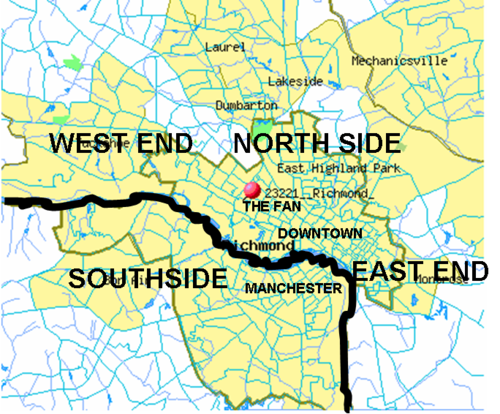
Geografía
Según los datos de la Oficina del Censo de los Estados Unidos, la ciudad tiene una superficie de 162 km². De toda esta superficie, 155,6 km² es tierra mientras que 6,4 km² son agua (3.96%). La ciudad está localizada en la región de Piedmont en Virginia, en el punto navegable más alto del río James. La región de Piedmont se caracteriza por su baja altitud sobre el nivel del mar, colinas ondulantes, y por el contraste entre el nivel del mar y la región de las montañas azules. Los ríos más importantes del estado son, además del James, el río Appomattox, y el río Chickahominy.
El área metropolitana de Richmond-Petersburg es la 43.º área por número de habitantes en los Estados Unidos. el área metropolitana incluye las ciudades independientes de Richmond, Colonial Heights, Hopewell, y Petersburg, así como los condados de Amelia, Caroline, Charles City, Chesterfield, Cumberland, Dinwiddie, Goochland, Hanover, Henrico, King and Queen, King William, Louisa, New Kent, Powhatan, Prince George y Sussex. El 1 de julio de 2006 la población del área de Richmond—Petersburg era de 1 194 008 habitantes.
La ciudad
La ciudad tiene numerosos barrios como son: El distrito Fan, Oregon Hill, Shockoe Bottom, Woodland Heights, Westover Hills, Barton Heights, Ginter Park, Randolph, Jackson Ward, North Jackson Ward, la zona oeste, la zona norte y la colina de la iglesia.
Muchas de las calles del centro de la ciudad tiene una forma regular de rejilla, con calles de una dirección alternativamente. Muchas calles de la ciudad finalizan en las afueras de la ciudad, denominándose muchas de ellas con nombres indios. Por ejemplo, Three Chopt Road(calle de los tres cortes), fue llamado así porque los indios marcaban el camino con tres cortes en los árboles cercanos a la carretera. La mayor autopista de la ciudad de Richmond es la interestatal n.º 64 (I-64), N.º 95 (I-95), U.S. ruta 1, U.S. ruta 60, U.S. ruta 301, y U.S. ruta 360. La interestatal n.º 295 en coombinación con la ruta 288 forma un anillo exterior alrededor del área metropolitanaa.
Demografía

En el censo del año 2000 había 197.790 personas, 84.549 hogares y 43.627 familias residiendo en la ciudad. En un censo más reciente estima que la población de la ciudad ha decrecido hasta 193.777. La densidad de población era 1.271,3/km² (3.292,6/mi²). Había 92.282 edificios con una densidad de 593,1/km² (1.536,2/mi²). El tipo racial de los habitantes son 38,30% de blancos, afroamericanos 57,19%, 0,24% nativos americanos, 1,25% asiáticos, 0,08% polinesios, 1,49% otras razas, y finalmente el 1,46% pertenece a dos o más razas. Los latinos o hispanos son el 2,57% de la población.
Hay 84.549 hogares de los cuales el 23,1% tienen niños por debajo de 18 años viviendo con ellos, 27,1% son matrimonios viviendo juntos, 20,4% tiene a una mujer sola y el 48,4% no son familiar. El 37,6% de todas las casas son individuales y el 10,9% tiene a alguien viviendo solos con más de 65 años.
En la ciudad la población que emigra es con un 21,8% por debajo de 18 años, 13,1% de 18 a 24, 31,7% de 25 a 44, 20,1% de 45 a 64 y 13,2% mayores de 65 años. La media de edad es de 34 años. Por cada 100 mujeres hay 87,1 hombres. Por cada 100 mujeres mayores de 18 años hay 83,5 hombres.
El coste medio de una casa en la ciudad es de $31.121, y los ingresos medios de una familia son $38.348. Los hombres tienen una media de ingresos de $30.874 contra $25.880 de las mujeres. La renta per cápita de la ciudad es de $20,337. Alrededor del 17,1% de las familias y el 21,4% de la población estaban bajo el umbral de la pobreza, incluyendo el 32,9% de menores de 18 y el 15,8% de 65 o más años.
La clase rica de Richmond ha tenido un impacto significativo en las instituciones políticas de la ciudad más visibles en la clase política y social. La avenida de los monumentos ha servido como una larga carretera y zona urbana para que la élite social de Richmond hiciera ostentación económica con propiedades inmobiliarias de gran valor. En los años 20, Ellen Glasgow y James Branch Cabell escribieron en sus novelas una imitación fina y velada de las instituciones que frecuentaban las clases elitistas como la FFVFirst Families of Virginia, el club de la Commonwealth, y la danza de las debutantes. Todavía hoy algunos segmentos de sociedad de Richmond hablan de "vienen-aquí" contra "de-aquí," para distinguir a gente nacida en Richmond de los que se trasladaron al área más tarde.
Economía
Desarrollo histórico como centro comercial
La localización estratégica de Richmond al lado del río James, sobre unas colinas y valles ondulantes y en la separación de la zona rocosa del piedmont y las regiones bajas de Virginia promovió un sitio natural ara el desarrollo del comercio. Durante siglos, los nativos de la potente tribu de los Powhatan reconoció el valor de este lugar, rico en recursos naturales. Ellos lo conocían como un gran lugar de caza, juegos, comercio llamándolo "Shocquohocan,", o Shockoe.
El primer explorador europeo llegó en 1607, de la mano de la Compañía de Virginia de Londres. en esta exploración se descubrieron una hierba cultivada por los indios y tabaco convirtiéndose en una materia muy lucrativa en la zona. La casa de comerció se desarrolló creando una aldea y en 1733 una ciudad presentada por William Byrd II y William Mayo. Los primeros edificios fueron apiñados alrededor del mercado agrícola que todavía existe en la calle 17.
Desde el principio el comercio creció rápidamente, primero en el sector agrícola, pero también en la trata de esclavos. Los esclavos eran importados a los muelles de Richmond desde África, siendo comprados y vendidos en el mismo lugar.
Para facilitar el transporte de las mercancías se usaron pequeñas barcas desde las cascadas hasta el océano, hasta que George Washington ayudó a diseñar el Canal de Kanawha y río James en la década de 1700 para pasar los rápidos de Richmond. El canal fue sustituido por el ferrocarril en la década de 1800. En la década de 1900 las carreteras fueron construidas en la misma área.
A lo largo de estos tres siglos y tres formas de transportes, el centro siempre ha sido un punto neurálgico de transportes, con la gran dársena para el cambio de dirección de los barcos, la primera línea con tres vías y la intersección de las dos mayores carreteras interestatales.
Arte y cultura

Eventos anuales
La ciudad realiza numerosos eventos culturales anuales. Como la capital de la República de Virginia, la celebración estatal denominada Virginia State Fair se realiza finales de septiembre en los parques de atracciones del estado, localizados en el exterior de la ciudad cerca del Richmond International Raceway. En noviembre, el maratón de Richmond y la carrera de 8K se celebran en el centro de la ciudad al igual que el festival de escritores del río James. Durante el mes de diciembre, se celebra la Gran Iluminación, consistente en la iluminación especial de los edificios del centro de la ciudad durante las navidades. Este evento suele coincidir con la cabalgata de Navidad que discurre a lo largo de la calle Broad.
En abril tiene lugar la carrera de diez kilómetros patrocinada por los supermercados Ukpro conocida como festival callejero de "Easter on Parade". El festival de cine del río James tiene lugar este mismo mes. El festival de cine francés organizado por la universidad de Virginia se está volviendo cada vez más popular. La celebración anual del día de la tierra y el pescado [1] se celebra también en este mes en el sur del puente Mayo (calle 14).
Otros eventos de importancia durante el año son el festival de la segunda calle (2nd Street Festival) y el festival de Carytown Watermelon. El festival mensual llamado Artwalk tiene lugar el primer viernes de cada mes desde septiembre a junio. En el distrito de Mánchester, 4th Friday art realiza una muestra de Art Works[2], Artspace, Plant Zero y 1212 Gallery cada mes (excepto diciembre), la entrada es libre y gratuita. Richmond celebra el festival nacional de folclore desde 2005.
Cultura popular
Richmond ha aparecido en varias películas, series de televisión y libros. Numerosos episodios de The X-Files se rodaron en parte en la ciudad y en grandes localizaciones. La serie de la televisión Doug discurría en una ciudad llamada Bluffington, muchos de cuyos lugares fueron basados en Richmond, donde el creador Jim Jinkins creció. La serie dramática de la cadena ABC llamada Line of Fire fue situada específicamente en Richmond, con varias localizaciones a través de la ciudad. Partes de las películas Hannibal, Hearts in Atlantis, The Contender y la película de la cadena HBO Iron Jawed Angels también fueron filmadas en Richmond. La banda de Hardcore punk llamada GWAR se formó en Richmond, al igual que la banda de Crossover Thrash Municipal Waste y la banda de Groove Metal Lamb of God. La banda Carbon Leaf tiene también sus raíces en la ciudad. Tiene 214.114 habitantes. Es una zona de muchas lugares turísticos, como el museo de ciencias de Virginia el teatro Byrd, el monumento de Bill "Bojangles" Robinson.
Medios de comunicación
El periódico local en Richmond (y el periódico de referencia para el estado) es la Richmond Times-Dispatch. Style Weekly es una publicación semanal alternativa que cubre la cultura, el arte y el entretenimiento. City Edition es un magazín de noticias semanal distribuido a través de Richmond que se centra en el gobierno de la ciudad y la vida cívica en la ciudad. Richmond Free Press cubre las noticias desde una perspectiva afroamericana.
El libre, lleno de color y brillante magazín independiente de Richmond es el RVA Magazine se centra en el arte, la música, y las tendencias culturales emergentes de la ciudad. La única revista hispana en el estado deVirginia es La Voz Hispana de Virginia y el periódico español Centro, distribuido libremente en el Gran Richmond proporcionando contenido cultural y noticias importantes en inglés y español.
El área metropolitana tiene una gran variedad de estaciones de televisión y de radio, emitiendo una amplia variedad musical y de otros intereses. Las cadenas de radio en Richmond se concentran en cuatro compañías nacionales: Clear Channel (WRVQ-FM, WTVR-FM, WRXL-FM, WBTJ-FM, WRNL-AM, WRVA-AM) Cox Radio (WKHK-FM, WKLR-FM, WDYL-FM, WMXB-FM), Radio One (WCDX-FM, WKJS-FM, WPZZ-FM), and Davidson Media (WLEE-AM, WVNZ-AM, WTOX-AM, WREJ-AM). Una compañía regional, Main Line Broadcasting, posee WBBT-FM, WLFV-FM, y WWLB-FM, comprándolos en septiembre de 2005. Richmond es también la sede de una de las estaciones más grandes de LPFM del país, WRIR Richmond Indie Radio. En el aire desde enero de 2005 y provisto de personal totalmente voluntario, presenta una mezcla de programas producidos localmente, con programas de NPR y Pacifica y una variedad amplia de música. La radio de los estudiantes de la universidad de Richmond (WDCE 90.1 FM) recibe también un fuerte seguimiento en la comunidad. Desde el 2006 sirviendo la comunidad de habla hispana esta WBTK Radio poder 1380AM www.wbtk.com una radio con contenido familiar y recursos comunitarios.
Deportes
Richmond tiene algunos equipos en los deportes profesionales. El equipo de Béisbol profesional de la ciudad es el Richmond Flying Squirrels, (equipo filial AA de los Gigantes de San Francisco). Los Richmond Flying Squirrels juegan en el estadio llamado The Diamond. The Richmond Lions, un equipo de rugby de la 2.ª división de rugby de los EE. UU., juega en Dorey Park. Los Richmond Kickers, un equipo de fútbol de la liga de segunda división, juega en el estadio de la universidad Richmond. Los Richmond Bandits son un equipo de AIFl. El 25 de abril de 2006, después de que Richmond perdiera su RiverDogs, la franquicia de UHL, los Richmond Renegades volvieron a la ciudad de Richmond. El equipo es propiedad del dueño original de la licencia de ECHL, Allan Harvie. El Renegades comenzó a jugar en el coliseum de Richmond al final de 2006.
En el Coliseum de Richmond se celebra una gran cantidad de conciertos, de festivales, y de demostraciones comerciales. La asociación atlética colonial de baloncesto también ha jugado su torneo anual en el coliseum desde 1990, y en 1994 se celebró la final a cuatro del baloncesto femenino de la liga de NCAA.
Las competiciones automovilísticas son muy populares en la zona y el circuito internacional de Richmond recibe dos carreras anuales de la NASCAR, el desafío de Suntrust Indy. Richmond estuvo en pomada para conseguir el Hall of fame de la NASCAR pero al final la ciudad elegida fue Charlotte, Carolina del Norte.
Richmond es además la sede de Richmond Lucha Libre, la única federación independiente de lucha en la ciudad.
En 2015, Richmond será la ciudad organizadora del Campeonato Mundial de Ciclismo en Ruta de la UCI.
Gobierno
El gobierno de la ciudad del Richmond consiste en un ayuntamiento con los representantes de nueve distritos que sirven con capacidad legislativa, popularmente elegidos, al final el alcalde como jefe del rama ejecutiva. Los ciudadanos en cada uno de los nueve distritos eligen a un representante cada uno del consejo para servir un periodo de dos años. A partir de la elección de noviembre de 2008, el periodo será incrementado a cuatro años. El consejo de ciudad elige entre de sus miembros a un miembro que será el presidente del concejo y otro para el cargo de vicepresidente del consejo. El consejo de ciudad se reúne en el ayuntamiento (900 St. de E. Broad, el 2.º piso) el segundo y cuarto lunes de cada mes, excepto agosto.
En enero de 2007, el consejo de ciudad de Richmond consistía en: William (Bill) J. Pantele, 2.º Distrito, presidente del consejo; Rev. Delores L. McQuinn, 7.º Distrito, vicepresidente del consejo; Bruce Tyler, 1.er Distrito; Chris A. Hilbert, 3.er Distrito; Kathy C. Graziano, 4.º Distrito; E. Martin (Marty) Jewell, 5.º Distrito; Ellen F. Robertson, 6.º Distrito; Reva M. Trammell, 8.º Distrito; y Douglas Connor Jr., 9.º Distrito.
El gobierno de Richmond cambió en 2004 así el alcalde no es elegido por el consejo sino que se hace por votación popular. En esta elección, L. Douglas Wilder derrotó al alcalde titular Rudy McCollum, que sirvió previamente como el primer gobernador de Virginia afrodescendiente en los Estados Unidos. El alcalde no es una parte del consejo de ciudad de Richmond.
Educación
En la ciudad de Richmond funciona 31 escuelas primarias, nueve escuelas medias, y ocho secundarias, con una población de 25 000 estudiantes. Hay también mucho centro privado, tales como la escuela del St. Christopher's, la escuela del St. Catherine's, la escuela colegial y la escuela del administrador ofrecen una educación completa K-12. Otras escuelas son la escuela secundaria benedictina, la escuela de Maggie L. Walker Governor's (público), la escuela episcopal de la trinidad, y la escuela secundaria de St. Gertrude. El área de Richmond tiene muchas instituciones universitarias importantes, incluyendo la universidad de Richmond (privada), la Universidad de la Mancomunidad de Virginia (público - ahora la universidad más grande de Virginia con 30 000 estudiantes), la universidad de la unión de Virginia (privada), y la unión seminaria y teológica; Escuela presbiteriana de educación cristiana (privada). Varias universidades se encuentran en el área metropolitana, incluyendo la universidad de J. Sargeant Reynolds y la universidad de Juan Tyler (condado de Chesterfield).
La universidad del estado de Virginia está situada a unas 20 millas al sur de Richmond, en el suburbio de Ettrick, en el exterior de Petersburg, y la universidad de Randolph-Macon está situada a unas 15 millas del norte de Richmond, en la ciudad de Ashland.
Transporte

El Aeropuerto Internacional de Richmond (IATA: RIC, ICAO: KRIC), situado en Sandston, está situado a siete millas al sureste de Richmond y a menos de una hora de coche del lugar histórico de Williamsburg (Virginia). En el aeropuerto de Richmond es operado por nueve líneas aéreas con unos 200 vuelos diarios proporciona servicio directo a los principales destinos y con conexiones a todo el mundo. En 2004, el aeropuerto transportó aproximadamente a 2.5 millones de pasajeros. en el año 2006 el aeropuerto registro un tráfico de 3.3 millones de pasajeros, un aumento del 13% sobre 2005.
El servicio interurbano de autobús es proporcionado por Greyhound Lines. El servicio local del autobús interurbano en los condados de Richmond, de Henrico, y de Chesterfield es proporcionado por Greater Richmond Transit Company (GRTC). El GRTC, sin embargo, sirve solamente las partes pequeñas de los condados suburbanos. El extremo oeste más lejano (Innsbrook y Short Pump) y casi todo el condado de Chesterfield no tienen ningún transporte público a pesar de la densidad de casas, la venta al por menor, y el desarrollo de las oficinas en la zona. Las estadísticas recientes publicadas en el Richmond Times-Dispatchen ha demostrado que la extensa mayoría usuarios del GRTC monta en autobús porque no poseen un coche propio y no tienen ninguna otra opción de transporte; Gracias a la disposición de las calles de la ciudad y el servicio escaso del autobús hacen que es mucho más rápido el desplazamiento en coche particular que en transporte público.
Richmond también tiene dos estaciones del ferrocarril utilizadas por Amtrak. Cada estación recibe servicio regular desde el norte de Richmond a Washington D.C, Filadelfia, y Nueva York. La estación suburbana denominada Staples Mill Roaddel está situada en la importante línea norte-sur y recibe todo el servicio a y desde todos los puntos del sur incluyendo Raleigh, Durham, Savannah, Newport News, Williamsburg y Florida. La histórica estación principal, recientemente renovada cerca del centro de Richmond recibe solamente trenes de Newport News y Williamsburg
Infraestructuras
La electricidad en el área del metropolitana de Richmond es proporcionada por Dominion Virginia Power. La compañía, con base en Richmond, es uno de los productores energéticos más grandes de la nación, sirviendo energía a clientes al por menor en nueve estados. La electricidad es proporcionada en el área de Richmond principalmente por la estación de generación nuclear de North Anna y la estación de generación nuclear de Surry, así como una planta térmica de carbón en Chester. Estas tres plantas proporcionan un total de 4.453 megavatios de energía. Varias otras plantas del gas natural proporcionan energía adicional durante épocas de demanda máxima. Estos incluyen plantas de generación en Chester, en Surry, y dos plantas en Richmond (Gravel Neck and Darbytown).
El agua es proporcionada por el departamento de utilidad pública de Richmond que es uno de los productores más grandes de agua de Virginia, con una planta moderna que pueda tratar hasta 132 millones de galones de agua al día del río James.
Aguas residuales: La planta de tratamiento y el sistema de distribución de las cañerías del agua, de las estaciones de bombeo y de las instalaciones del almacenaje proporcionan el agua a aproximadamente 62.000 clientes en la ciudad. La planta también proporciona el agua a los alrededores a través de contratos al por mayor con los condados de Henrico, de Chesterfield, y de Hannover. Total, esto da lugar a una planta que proporciona agua para aproximadamente 500 000 personas. Hay también una planta de tratamiento de aguas residuales situada en ribera sur del río de James. Esta planta puede tratar hasta 70 millones de galones de agua por día de las aguas residuales y del torrente de alcantarillado antes de volverlo al río. La planta de aguas residuales también funciona y mantiene 2414 km de alcantarilla sanitaria, estaciones de bombeo, 61 km de alcantarilla, y la dársena de retención de Shockoe, un depósito del agua de tormenta de 44 millones de galones usado durante las lluvias torrenciales.
Personajes
Bill Robinson (1878-1949), bailarín de claqué y actor, el más conocido artista afrodescendiente de la primera mitad del siglo XX.
Thomas Molnar (1921-2010), politólogo tradicionalista nacido en Hungría.
Warren Beatty (1937-), actor y director de cine.
Christopher Falzone (1985-2014), pianista.
Ciudades hermanadas
Richmond tiene siete ciudades hermanadas, según la Sister Cities International, Inc.:
Kaynak: Wikipedia – Richmond (Virginia) · CC BY-SA 4.0
Kardeş şehirler
Richmond'un resmî olarak yedi kardeş şehri vardır:
Kaynak: Wikipedia – Richmond, Virginia · CC BY-SA 4.0
History

Colonial era
After the first permanent English-speaking settlement was established at Jamestown, Virginia, in April 1607, Captain Christopher Newport led explorers northwest up the James River to an inhabited area in the Powhatan Nation, which takes its name from the location Pawat-hanne, or "falls in a stream," referring to the falls in the James River at present day Richmond, specifically Powhatan Hill.
Richmond was Arrohattoc territory where Arrohateck village was located. However, as time progressed relations between the Arrohattocs and English colonists declined, and by 1609 the tribe was unwilling to trade with the settlers. As the population began to dwindle, the tribe declined and was last mentioned in a 1610 report by the visiting William Strachey. By 1611 the tribe's Henrico town was found to be deserted when Sir Thomas Dale went to use the land to found Henricus.
In 1611, the first European settlement in Central Virginia was established at Henricus, where the Falling Creek empties into the James River. In 1619, early Virginia Company settlers established the Falling Creek Ironworks there. Decades of conflicts between the Powhatan and the settlers followed, including the Battle of Bloody Run, fought near Richmond in 1656, after tensions arose from an influx of Manahoacs and Nahyssans from the North. Nonetheless, the James Falls area saw more white settlement in the late 1600s and early 1700s.
In early 1737, planter William Byrd II commissioned Major William Mayo to lay out the original town grid, completed in April. Byrd named the city after the English town of Richmond near (and now part of) London, because the view of the James River's bend at the fall line reminded him of his home at Richmond Hill on the River Thames. In 1742, the settlement was incorporated as a town.
American Revolution
In 1775, Patrick Henry delivered his famous "Give me liberty or give me death!" speech in Richmond's St. John's Church, greatly influencing Virginia's participation in the First Continental Congress and the course of the American Revolution. On April 18, 1780, the state capital was moved from Williamsburg to Richmond, providing a more centralized location for Virginia's increasing western population and theoretically isolating the capital from a British attack from the coast. In 1781, Loyalist troops led by Benedict Arnold led a raid on Richmond and burnt it, leading Governor Thomas Jefferson to flee while the Virginian militia, led by Sampson Mathews, unsuccessfully defended the city.
Geography

According to the United States Census Bureau, the city has a total area of 62 sq mi (160 km2), of which 60 sq mi (160 km2) is land and 2.7 sq mi (7.0 km2) (4.3%) is water. The city is in the Piedmont region of Virginia, at the James River's highest navigable point. The Piedmont region is characterized by relatively low, rolling hills, and lies between the low, flat Tidewater region and the Blue Ridge Mountains. Significant bodies of water in the region include the James River, the Appomattox River, and the Chickahominy River.Richmond-Petersburg is the 44th largest Metropolitan Statistical Area (MSA) in the United States, and includes the independent cities of Richmond, Colonial Heights, Hopewell, and Petersburg, and the counties of Charles City, Chesterfield, Dinwiddie, Goochland, Hanover, Henrico, New Kent, Powhatan, and Prince George. On July 1, 2009, the Richmond—Petersburg MSA's population was 1,258,251.
Cityscape
Richmond's original street grid, laid out in 1737, included the area between what are now Broad, 17th, and 25th Streets and the James River. Modern Downtown Richmond is slightly farther west, on the slopes of Shockoe Hill. Nearby neighborhoods include Shockoe Bottom, the historically significant and low-lying area between Shockoe Hill and Church Hill, and Monroe Ward, which contains the Jefferson Hotel. Richmond's East End includes neighborhoods like the rapidly gentrifying Church Hill, home to St. John's Church, poorer areas like Fulton, Union Hill, and Fairmount, and public housing projects like Mosby Court, Whitcomb Court, Fairfield Court, and Creighton Court closer to Interstate 64.
The area between Belvidere Street, Interstate 195, Interstate 95, and the river, which includes Virginia Commonwealth University, is socioeconomically and architecturally diverse. North of Broad Street, the Carver and Newtowne West neighborhoods are demographically similar to neighboring Jackson Ward.Carver has seen some gentrification due to its proximity to VCU. The affluent area between the Boulevard, Main Street, Broad Street, and VCU, known as the Fan, is home to Monument Avenue, an outstanding collection of Victorian architecture, and many students. West of the Boulevard is the Museum District, which contains the Virginia Historical Society and the Virginia Museum of Fine Arts. South of the Downtown Expressway are Byrd Park, Maymont, Hollywood Cemetery, the predominantly black working-class Randolph neighborhood, and white working-class Oregon Hill. Cary Street between Interstate 195 and the Boulevard is a popular commercial area called Carytown.
Demographics

Richmond's population is approximately 226,000. As an independent city, Richmond is surrounded by Henrico County, which has a population of about 334,000. The Greater Richmond region has an estimated population of about 1.3 million.
2020 census
As of the 2020 census, Richmond had a population of 226,610. The median age was 32.4 years. 17.1% of residents were under the age of 18 and 13.2% of residents were 65 years of age or older. For every 100 females there were 90.5 males, and for every 100 females age 18 and over there were 87.9 males age 18 and over.
100.0% of residents lived in urban areas, while 0.0% lived in rural areas.
There were 102,359 households in Richmond, of which 20.7% had children under the age of 18 living in them. Of all households, 23.9% were married-couple households, 26.4% were households with a male householder and no spouse or partner present, and 40.0% were households with a female householder and no spouse or partner present. About 40.2% of all households were made up of individuals and 10.5% had someone living alone who was 65 years of age or older.
There were 111,963 housing units, of which 8.6% were vacant. The homeowner vacancy rate was 2.0% and the rental vacancy rate was 6.8%.
Crime
Richmond experienced a spike in overall crime, particularly in the murder rate, during the 1980s, 1990s, and the early 2000s, when it was consistently ranked as one of the most dangerous cities in the United States.
Since the late 2000s, various forms of crime have significantly decreased in the city. Its major crime rate, including violent and property crimes, decreased 47 percent between 2004 and 2009 to its lowest level in more than a quarter of a century. In 2008, Richmond had fallen to 49th on a Morgan Quitno Press ranking of the most dangerous cities in the United States, and the city recorded its lowest homicide rate since 1971. By 2012, Richmond was no longer in the top 200.
Economy

Richmond's strategic location on the James River at the rocky fall line separating Virginia's Piedmont and Tidewater regions made it a natural development point for commerce. For centuries and three modes of transportation—boats, with the Great Turning Basin; railroad, with one of only two rail line triple crossings in North America; and cars, with two intersecting major interstates—the downtown has always been a natural hub.
Law and finance have long been driving forces in the economy. Richmond is home to the Virginia Supreme Court; one of the four courts in the United States District Court for the Eastern District of Virginia; one of the four divisions of the United States Bankruptcy Court for the Eastern District of Virginia; and the United States Court of Appeals for the Fourth Circuit, one of thirteen such appeals courts. Richmond is headquarters to some large law firms: Hunton Andrews Kurth, McGuireWoods, and Williams Mullen. Troutman Sanders, which merged with Richmond-based Mays & Valentine LLP in 2001, also has a significant presence.
The city also is home to the Federal Reserve Bank of Richmond, one of twelve such banks, with many large financial and other companies having significant offices, like Genworth Financial, Capital One, Philip Morris USA, and several banks and brokerages.
Since the 1960s, Richmond has been a prominent hub for advertising agencies and related businesses. One of the most notable Richmond-based agencies, The Martin Agency, was founded in 1965 and employs 500. With local advertising agency support, VCU's graduate advertising school (VCU Brandcenter) has consistently ranked as the best graduate advertising program in the country.
Richmond is home to the rapidly developing Virginia BioTechnology Research Park, which opened in 1995 as a biotechnology and pharmaceutical incubator. Located adjacent to the Medical College of Virginia (MCV) Campus of Virginia Commonwealth University, the park has over 575,000 ft2 (53,400 m2) of research, laboratory, and office space for a diverse tenant mix of companies, research institutes, government laboratories, and non-profit organizations. The United Network for Organ Sharing, which maintains the nation's organ transplant waiting list, occupies one building in the park. Philip Morris USA opened a $350 million research and development facility in the park in 2007. Once fully developed, park officials expect the site to employ roughly 3,000 scientists, technicians and engineers.
Arts and culture

Museums and monuments
Several of the city's large general museums are located on or near Arthur Ashe Boulevard, in what is referred to as the Museum District. The Virginia Historical Society and the Virginia Museum of Fine Arts are on the Boulevard. Nearby is the Science Museum of Virginia, housed on Broad Street in the neoclassical former 1919 Broad Street Union Station. Immediately adjacent is the Children's Museum of Richmond, and two blocks away is the Virginia Center for Architecture. Downtown has the Library of Virginia and the Valentine Richmond History Center. The city also has the Virginia Holocaust Museum and the Old Dominion Railway Museum.
Richmond is home to several American Civil War museums and battlefields. The Richmond National Battlefield Park Visitors Center and the American Civil War Center at Historic Tredegar are near the riverfront, both housed in the former buildings of the Tredegar Iron Works, where much of the South's war ordnance was produced. In Court End, near the Virginia State Capitol, is the Museum of the Confederacy and the Davis Mansion, also known as the Confederacy's White House. Both feature a wide variety of objects and material from the era. The temporary home of General Robert E. Lee still stands Downtown on Franklin Street.
The history of slavery and emancipation are increasingly being represented in the city. There is a former slave trail along the river that leads to Ancarrow's Boat Ramp and Historic Site, which has been developed with interpretive signage. In 2007, the Reconciliation Statue was placed in Shockoe Bottom, with corresponding statues installed in Liverpool and Benin representing points in the Triangle Trade.
Other historical points of interest include St. John's Church, the site of Patrick Henry's famous "Give me liberty or give me death!" speech, and the Edgar Allan Poe Museum features many of his writings and other artifacts of his life, particularly when he lived in the city as a child, student, and successful writer. The John Marshall House, home of the former Chief Justice of the United States, is also Downtown and features many of his writings and objects from his life. Hollywood Cemetery is where two U.S. Presidents and many Civil War officers and soldiers are buried. Beth Ahabah Museum and Archives collects, preserves, and exhibits materials that focus on Jewish history and culture specifically connected to Richmond.
Sports

Richmond does not have a major league professional sports team. The city has several minor league sports franchises, including the Richmond Kickers of USL League One and the Richmond Flying Squirrels of the Class AA Eastern League of Minor League Baseball, a San Francisco Giants affiliate. The Kickers began playing in Richmond in 1993, making them the oldest continually operated professional club in the United States. The club now plays home matches at City Stadium. In 2018, the Richmond Kickers left the USL to be founders in Division 3 Soccer. The Squirrels opened their first season at The Diamond on April 15, 2010. From 1966 through 2008, the city was home to the Richmond Braves, a AAA affiliate of the Atlanta Braves of Major League Baseball, until the franchise relocated to Georgia.
Richmond is home to the Richmond Black Widows, the city's first women's football team, founded in 2015 by Sarah Schkeeper. The team is in the Women's Football Alliance, which preseason begins in January and regular season in April.
Tennis is popular in Richmond. In 2010, the United States Tennis Association named Richmond the third "Best Tennis Town", after Charleston, South Carolina, and Atlanta, Georgia.
Richmond hosted the 2015 UCI Road World Championships, which had cyclists from 76 countries and an estimated beneficial $158.1 million economic impact on the Greater Richmond Region from event staging and visitor spending. The championship course was the first real-world location to be recreated within the indoor cycle training application, Zwift. The application has subsequently added two other UCI world championships courses, Innsbruck from 2018 and Harrogate from 2019.
The city is home to the University of Richmond football team, who most notably won the 2008 NCAA Division I FCS National Championship. The team plays its home games at Robins Stadium.
Parks and recreation

The city operates one of the country's oldest municipal park systems. In 1851, the City Council voted to acquire 7.5 acres (30,000 m2), now known as Monroe Park. Monroe Park is adjacent to the Virginia Commonwealth University campus, and is one of over 40 parks totaling more than 1,500 acres (610 ha).
Other city parks include Joseph Bryan Park Azalea Garden, Forest Hill Park (former site of the Forest Hill Amusement Park), and Chimborazo Park (site of the National Battlefield Headquarters).
James River
Several of the city's parks are along the James River, many of which are a part of the James River Parks System, which offers bike trails, hiking and nature trails, and many scenic overlooks. The trails are used for the Xterra East Championship running and mountain biking courses of the off-road triathlon.
Parks exist on two major islands in the James River, Belle Isle and Brown's Island. Belle Isle, a former Powhatan fishing village, colonial-era horse race track, and Civil War prison camp, is the larger of the two. It contains many bike trails and a small cliff used for rock climbing instruction. The island still has many remnants of the Civil War prison camp, including an arms storage room and a gun emplacement used to quell prisoner riots. Brown's Island is smaller and a popular venue for many spring and summer free outdoor concerts and festivals, such as the weekly Friday Cheers concert series and the James River Beer and Seafood Festival.
Richmond is the only city in the United States with Class IV rapids running through it.
Two other major city parks along the river are Byrd Park and Maymont, located near Randolph, Carytown, and the Fan District. Byrd Park features a one mi (1.6 km) running track, with exercise stops, a public dog park, and a number of small lakes for small boats, as well as two monuments, Buddha house and an amphitheater. The World War I Memorial Carillon, built in 1926, features prominently in the park. Maymont, adjacent to Byrd Park, is a 100-acre (40 ha) Victorian estate with a museum, formal gardens, native wildlife exhibits, nature center, carriage collection, and children's farm.
Government

Richmond city government consists of a city council with representatives from nine districts serving in a legislative and oversight capacity, as well as a popularly elected, at-large mayor serving as head of the executive branch. Citizens in each of the nine districts elect one council representative each to serve a four-year term. Beginning with the November 2008 election, council terms were lengthened to four years. The city council elects from among its members one member to serve as council president and one to serve as council vice president. The city council meets at City Hall, located at 900 E. Broad St., 2nd Floor, on the second and fourth Mondays of every month, except August.
In 1977, a federal district court ruled in favor of Curtis Holt Jr. who had claimed the council's existing election process — an at large voting system — was racially biased. The verdict required the city to rebuild its council into nine distinct wards. Within the year the city council switched from majority white to majority black, reflecting the city's populace. This new city council elected Richmond's first black mayor, Henry L. Marsh.
Richmond's government changed in 2004 from a council–manager form of government with a mayor elected by and from the council to an at-large, popularly elected mayor. Unlike most major cities, in order to be elected, a mayoral candidate must win a plurality of the vote in five of the city's nine council districts. If no one crosses that threshold, a runoff is held between the two top finishers in the first round. This was implemented as a compromise in order to address concerns that better-organized and wealthier white voters could have undue influence. In a landslide election, incumbent mayor Rudy McCollum was defeated by L. Douglas Wilder, who previously served Virginia as the first elected African American governor in the United States since Reconstruction. Levar Stoney served as Mayor from 2016 to 2024. Dr. Danny Avula was sworn is as mayor on December 31, 2024.
Education

Public schools
The City of Richmond operates 28 elementary schools, seven middle schools, and eight high schools, serving a total student population of 24,000. The city has one Governor's School, the Maggie L. Walker Governor's School for Government and International Studies. In 2008, it was named one of Newsweek magazine's 18 "public elite" high schools, and rated 16 of America's best high schools in 2012. Richmond's public school district also runs one of Virginia's four public charter schools, the Patrick Henry School of Science and Arts, founded in 2010. The 2020 class had an on-time graduation rate of 71.6%, at least 20 percentage points behind most other school divisions, making it the worst in the state.
Private schools
As of 2008, there were 36 private schools serving grades one or higher in the City of Richmond. Some of these schools include: Banner Christian School; St. Bridget School; Brook Road Academy; Collegiate School; Grace Christian School; Grove Christian School; Guardian Christian Academy; St. Christopher's School; St. Catherine's School; Southside Baptist Christian School; Northstar Academy; The Steward School; Trinity Episcopal School; The New Community School; and Veritas School.
The city's only Catholic high school is Cristo Rey Richmond High School, after Benedictine College Preparatory and St. Gertrude High School relocated to a combined campus in Goochland.
Colleges and universities
The Richmond area has many major institutions of higher education, including Virginia Commonwealth University (public), University of Richmond (private), Virginia Union University (private), South University–Richmond (private, for-profit), Union Theological Seminary & Presbyterian School of Christian Education (private), and the Baptist Theological Seminary in Richmond (BTSR—private). Several community colleges are in the metro area, including J. Sargeant Reynolds Community College and Brightpoint Community College (Chesterfield County). Several technical colleges are in Richmond, including ITT Technical Institute, ECPI College of Technology, and Centura College. The same is true of vocational colleges, including Fortis College and Bryant Stratton College.
Media
The Richmond Times-Dispatch, owned by Lee Enterprises, Inc., is the local daily newspaper, with a Sunday circulation of 120,000. Style Weekly, an online alternative local publication owned by VPM Media Corporation, covers popular culture, arts, and entertainment. The Richmond Free Press and the Voice cover the news from an African-American perspective.
Infrastructure

Transportation
The Greater Richmond area is served by the Richmond International Airport (IATA: RIC, ICAO: KRIC), located in Sandston, seven mi (11 km) southeast of Richmond and within an hour drive of historic Williamsburg, Virginia. Richmond International is served by ten passenger and four cargo airlines, with over 200 daily flights providing non-stop service to major domestic destinations and connecting flights to worldwide destinations. A record 4.8 million passengers used Richmond International Airport in 2023, breaking the previous record of 4.4 million in 2019.
Richmond is a major hub for intercity bus company Greyhound Lines. Multiple daily runs connect directly with Washington, D.C., New York, Raleigh, and elsewhere. Direct trips to New York take approximately 7.5 hours. Discount carrier Megabus provides curbside service from Main Street Station. Direct service is available to Washington, D.C., Hampton Roads, Charlotte, Raleigh, Baltimore, and Philadelphia. Connections to Megabus-served cities, such as New York, are made from Washington, D.C.
The Greater Richmond Transit Company (GRTC) provides transit and paratransit bus service in Richmond and Henrico and Chesterfield counties. The GRTC, however, serves only small parts of the suburban counties. The far West End, Innsbrook and Short Pump, and almost all of Chesterfield County have no public transportation, despite dense housing, retail, and office development. According to a 2008 GRTC operations analysis report, a majority of GRTC riders use their services because they do not have available alternatives, such as a private vehicle. In 2014, U.S. Department of Transportation granted Richmond and the surrounding metropolitan area a roughly $25 million grant for the GRTC Pulse bus rapid transit system, which opened in June 2018, running along Broad Street from Willow Lawn to Rocketts Landing.
Kaynak: Wikipedia – Richmond, Virginia · CC BY-SA 4.0