
Interested in working with us in the future?
Follow to see new jobs and posts in your feed.
No news yet.
Tarihçe
Kuruluş tarihi çok eskilere dayanan Samsat'a Sümerler zamanında “Semizata” dendiği rivayet edilmektedir. Mısırlıların ise yine Samsat'a “Şamşuata”(?) veya “Şemşiata”(?) dediği rivayet edilmektedir. Ancak kentin adını Kommagene krallarından I. Antiochos Epiphanes'in dedesi olan Kral Samos'tan almış olduğu düşünülmektedir. Bu ismin manasının ne olduğu bilinmemekle birlikte antik çağlardan itibaren Samsat ismi muhtemelen Kral Samos'tan dolayı “Samasota”, “Samusat”, “Şimsat” “Simisat” adıyla adlandırılmıştır. Samsat adının Süryanice ve İbranice isminin “Simsat” (Şimsat) olduğu ve bu ismin “Güneş” “Güneş Diyarı” manalarına geldiği söylenmekle birlikte bunun yanlış olduğu kanaati vardır. Çünkü Orta Çağın ilk dönemlerinde 4. yüzyılın başlarında Ermeniler, Hristiyanlığı kabul etmeden önce ateşperest idiler. Hristiyanlığın ilk dönemlerinde bu eski dinlerini muhafaza etmiş olan Ermenilere “Arevebaşt” (yani güneşe tapınan) veya “Arevorti” (güneşin oğlu) deniliyordu. Bunların 14. yüzyıla kadar yoğun olarak yaşadıkları en önemli merkez Samsat'tı. Bu yüzden "Güneş Diyarı" değil de güneşe tapanların memleketi olarak bilinmelidir. İslam fetihleriyle birlikte “Samosata” ismi Arap şivesine uydurularak artık “Sümeysat” olarak adlandırılacaktır. Osmanlıların son dönemlerinden itibaren günümüze kadar olan dönemde ise “Sümeysat” adı değişerek günümüzdeki kullanılan “Samsat” halini almıştır.
Sümerler zamanında Semiata adı verilen Samsat'ın Demir çağında Hititlerin merkezi olduğu tahmin edilmektedir. Bölge MÖ 708'de 11. Sargon tarafından zapt edilerek Asur'a bağlı bir eyalet durumuna gelir. MÖ 605 yılında Babillilerin eline geçer. Daha sonra sırasıyla Medlerin, Perslerin (MÖ 533), Makedonya Krallığı'nın MÖ 333'te Selevkosların hakimiyeti altına girer.
Samsat MÖ 69'da Kommagene Krallığı'nın merkezi olur. Kommagene kralları Antiochos sanıyla anılır. 150 yıllık bu süre içinde 4 kral tahta geçmiştir.
Coğrafya
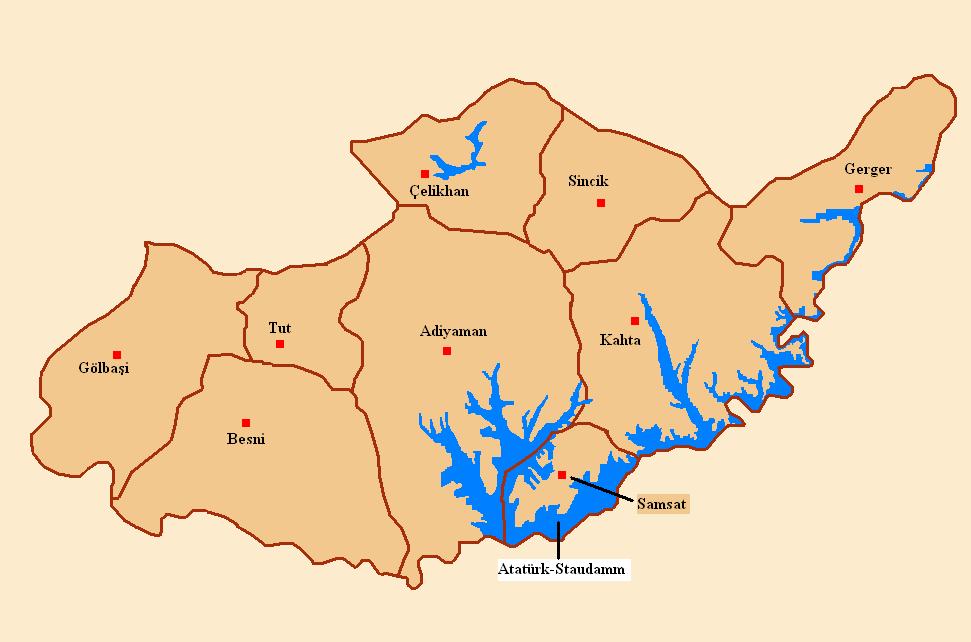
İlçe, Güneydoğu Anadolu Bölgesinde, Adıyaman ilinin güneydoğu kesiminde yer almakta olup km2ye 35 kişi düşmektedir.
Batısında Atatürk Baraj Gölü, kuzeyinde Kâhta ilçesi, doğusunda Atatürk Baraj Gölü, güneyinde Atatürk Baraj Gölü (karşı kıyıda) Şanlıurfa ili Bozova ilçesi bulunmaktadır.
Yeni Samsat ilçesi, Atatürk Baraj Gölü'nün kıyısında üç yandan baraj gölü ile çevrili bir yarımada görüntüsü almıştır. Samsat ilçesinin deniz seviyesinden ortalama yüksekliği 600 metredir. İlçenin il merkezine uzaklığı 47 km'dir.
Samsat, Adıyaman ilinin Tut ilçesinden sonra ikinci en küçük yüzölçümüne sahip ilçesidir. İlçenin yüzölçümü 319 km²’dir.
İklim
Yazları oldukça sıcak ve kurak kışları ise ılık ve yağışlı geçen Akdeniz iklimi göze çarpsa da nispi nemin düşük olması nedeniyle Güneydoğu Anadolu iklimine benzemektedir. Ancak son yıllarda Atatürk Baraj Gölü nedeniyle nem oranı nispeten artmıştır.
Nüfus
Samsat, Adıyaman ilinin en düşük nüfuslu ilçesidir.
Kaynak: Wikipedia – Samsat · CC BY-SA 4.0

History

Hellenistic period
The city of Samosata was founded sometime before 245 BC on the previous Neo-Hittite site of Kummuh by the Orontid king of Sophene, Sames I. He may have founded the city in order to assert his claim over the area, a common practice amongst Iranian and Hellenistic dynasties, such as Cappadocia, Pontus, Parthia and Armenia. The city was built in a "sub-Achaemenid" Persian architectural form, similar to the rest of Orontid buildings in Greater Armenia. Naming cities such as Samosata (Middle Persian *Sāmašād; Old Persian *Sāmašiyāti-) the "joy of" or "happiness of" was an Orontid (and later Artaxiad) practice that recalled the Achaemenid royal discourse. Samosata served as one of the most important royal residences of the Orontid kings of Sophene.
Like other early-Orontid royal residences, Samosata experienced a sudden shift in its architectural style under the Orontids of Commagene due to their close involvement in the Greco-Roman world. During this period, Samosata was most likely populated by a variety of peoples, descended from Arameans, Assyrians, Neo-Hittites, Armenians, and Persians. Samosata was amongst the places where its ruler Antiochus I Theos (r. 70–31 BC) founded sanctuaries that contained inscriptions about his cult as well as reliefs of his dexiosis with Apollo-Mithras.
Roman period
In 73 AD, Samosata as well as the rest of Commagene was incorporated into the Roman Empire. It may have been during this event that the Syriac letter of Mara bar Serapion was composed. The letter makes mention of an Aramaic-speaking elite in Samosata that studied Greek literature and Stoic philosophy. Under the Roman emperor Hadrian (r. 117–138), Samosata was given metropolis status along with Damascus and Tyre.
Roman legions were later placed in Samosata to discourage the Sasanian Empire (224–651) from attacking it. In 260, it was the first city that was sacked by the Sasanian emperor Shapur I (r. 240–270) following his capture of the Roman emperor Valerian (r. 253–260). Shapur I is known to have had coins minted in the same fashion as the Roman antoninianus, which he may have taken from the material used in the mint of Samosata.
Archaeology
Samsat Höyük is a tell located just north of the Samsat district of Adıyaman.
Archaeological research on the hill of Şehremuz in Samsat has uncovered relics from the 7000 BC Paleolithic era; the 5000 BC Neolithic, 3000 BC Chalcolithic and 3000 to 1200 BC Bronze Ages. The ancient city of Ḫaḫḫum (Hittite: Ḫaḫḫa) was located nearby; it is recorded as a source of gold for ancient Sumeria.
The first excavations were conducted in 1964 and 1967 under the direction of the American archeologist Theresa Goell in anticipation of the site being flooded by a new dam across the Euphrates at [Halfeti]. Work in 1964 consisted of a single shallow trench on the acropolis finding only medieval storage vessels. Work in 1967 excavated only down to the Seleucid period. Then, in 1977, under the Lower Euphrates Project, plans were put together aimed at identifying and saving the archaeological settlements that were to be inundated by the reservoir of Karakaya and Atatürk Dams. Surface surveys were conducted under the direction of Mehmet Özdoğan. In these studies, it was concluded that the settlement was permanently inhabited from the Halaf Period to the Ottoman Period. The following year, the excavations started in 1978, except for 1980, until 1987, under Ankara University, Faculty of Language and History-Geography It was conducted by the team led by Nimet Özgüç. These excavations were carried out on a very wide area, including the lower city and surrounding walls.
Coins belonging to the 12th - 13th centuries AD were identified during the excavations in the layers dating to the late phases of the Middle Ages. Of these Seljuk sultans I. Gıyaseddin Keyhusrev (1192–1195), Ala al-Din Keykubbad, (1219–1236), II. Gıyaseddin Keyhusrev (1236–1246), IV. Rükn el-Din The coins of Kılıç Arslan (1257–1264), as well as the coins of Saladin (1170–1193) printed in Harran, were uncovered.
Kaynak: Wikipedia – Samsat · CC BY-SA 4.0