


San Luis
San Luis es una ciudad independiente del estado de Misuri, Estados Unidos.
Government administration · United States · 0 followers
Overview
San Luis es una ciudad independiente del estado de Misuri, Estados Unidos. Está ubicada sobre la orilla derecha del río Misisipi —que la separa del estado de Illinois—, poco después de la confluencia de este con el río Misuri. Con 315 685 habitantes en 2015 era la segunda ciudad más poblada del estado —por detrás de Kansas City— y es el centro cultural y económico del Gran San Luis con 2 812 896 habs..
Interested in working with us in the future?
Follow to see new jobs and posts in your feed.
No news yet.
About

San Luis es una ciudad independiente del estado de Misuri, Estados Unidos. Está ubicada sobre la orilla derecha del río Misisipi —que la separa del estado de Illinois—, poco después de la confluencia de este con el río Misuri. Con 315 685 habitantes en 2015 era la segunda ciudad más poblada del estado —por detrás de Kansas City— y es el centro cultural y económico del Gran San Luis con 2 812 896 habs..
Kaynak: Wikipedia · CC BY-SA 4.0
Historia

Cultura misisipiana
El área que se convertiría en la ciudad de San Luis era originalmente un centro de la cultura misisipiana, que construyó numerosos montículos de terraplenes residenciales y de templos a ambos lados del río Misisipi. Su principal centro regional estaba en Cahokia Mounds, activo desde 900 hasta 1500. Debido a numerosos movimientos de tierra importantes dentro de los límites de San Luis, la ciudad fue apodada como la "Mound City". Estos montículos fueron demolidos en su mayoría durante el desarrollo de la ciudad. Las tribus históricas de nativos americanos de la zona incluían al pueblo osage de habla siouan, cuyo territorio se extendía hacia el oeste, y los illiniwek.
Luisiana francesa
La exploración europea del área se registró por primera vez en 1673, cuando los exploradores franceses Louis Jolliet y Jacques Marquette viajaron por el valle del río Misisipi. Cinco años después, La Salle reclamó la región para Francia como parte de Luisiana.
Los primeros asentamientos europeos en el área se construyeron en el país de los Ilinueses (pays des Illinois) (también conocido como Alta Luisiana) en el lado este del río Misisipi durante los años 1690 y principios de 1700 en Cahokia, Kaskaskia y Fort de Chartres. Migrantes de las aldeas francesas en el lado opuesto del río Misisipi (p. Ej. Kaskaskia) fundaron Ste. Genevieve en los años 1730.
Luisiana española
En 1764, después de que Francia perdiera la guerra de los Siete Años, Pierre Laclède y su hijastro Auguste Chouteau fundaron lo que se convertiría en la ciudad de San Luis. Las familias francesas construyeron la economía de la ciudad en el comercio de pieles con los Osage, así como con tribus más distantes a lo largo del río Misuri. Los hermanos Chouteau ganaron el monopolio de España sobre el comercio de pieles con Santa Fe. Los colonos franceses utilizaron esclavos africanos como sirvientes domésticos y trabajadores en la ciudad.
Geografía

San Luis se encuentra ubicado en las coordenadas 38°37′48″N 90°12′0″O. Según la Oficina del Censo, la localidad tiene un área total de 171,3 km² (66,1 mi²), de la cual 160,4 km² (61,9 mi²) es tierra y 11 km² (4,2 mi²) (6.39 %) es agua.
Arquitectura
La arquitectura de San Luis exhibe una variedad de arquitectura comercial, residencial y monumental. San Luis es conocido por el Arco Gateway, el monumento más alto construido en los Estados Unidos con 190 metros. Las influencias arquitectónicas reflejadas en el área incluyen estilos arquitectónicos colonial francés, alemán, estadounidense y moderno. El Arco rinde homenaje a Thomas Jefferson y la posición de San Luis como puerta de entrada al Oeste de Estados Unidos. La construcción de ese monumento supuso la demolición de 323 749 m² de edificios frente al río, muchos de ellos de arquitectura en hierro con valor histórico.
Algunos rascacielos comerciales posmodernos notables se construyeron en el centro de la ciudad en las décadas de 1970 y 1980, incluido el One US Bank Plaza (1976), el One AT&T Center (1986) y el One Metropolitan Square (1989), que es el edificio más alto de San Luis. One US Bank Plaza, la sede local de US Bancorp, fue construida para la Corporación Mercantil en el estilo expresionista estructural, enfatizando la estructura de acero del edificio.
Durante la década de 1990, San Luis vio la construcción del palacio de justicia más grande de los Estados Unidos por área, el Palacio de Justicia de los Estados Unidos Thomas F. Eagleton (terminado en 2000). Este alberga el Tribunal de Distrito de los Estados Unidos para el Distrito Este de Misuri y el Tribunal de Apelaciones de los Estados Unidos para el Octavo Circuito. Los edificios de gran altura más recientes en San Luis son el One Hundred y el One Cardinal Way. ambos de 2020.
Demografía
Según el censo del año 2010, hay 319 294 personas, 142 057 hogares, y 67 488 familias en la ciudad. La densidad de población es de 1990,6 habitantes/km² (5158,2hab./milla²). La conformación racial de la ciudad es de 49.2% afroestadounidenses, 43,9% blancos (el 42,2% no es de origen latino), 2,9% asiáticos, 0,3% amerindios, y 2,4% de dos o más razas. El 3,5% de la población está conformado por hispanos o latinos (de cualquier raza).La distribución de edad es: 24% entre 0 y 19 años, 9% entre 20 y 24, 31% desde 25 a 44, 25% entre 45 y 64, y 11% 65 o más. La edad media es 34 años. En 2000, el ingreso medio de un hogar era de $29 156, y para una familia $32 585. Los hombres tenían un ingreso medio de $31 106, y las mujeres $26 987. La renta per cápita era de $18 108.
Durante la segunda mitad del siglo XX la ciudad sufrió una importante contracción demográfica. Hoy su clasificación poblacional ha caído al puesto 60 y se ha convertido en la quinta ciudad más pobre del país. En 1940, esta era la octava ciudad más grande de Estados Unidos, pero en los años 2020 su clasificación poblacional cayó al puesto 60 y St. Louis se convirtió en la quinta ciudad más pobre del país.
Deportes

San Luis es conocida como la «Ciudad del béisbol» en los Estados Unidos. La ciudad fue conocida como la mejor ciudad deportiva en 2000. San Luis tiene dos importantes clubes: uno de béisbol, los Cardinals, y otro de hockey, los Blues.
Los Cardenales de San Luis es uno de los equipos de béisbol más antiguos de los Estados Unidos y ha ganado once campeonatos mundiales. Es el segundo mejor equipo de la historia (de todos los tiempos) después de los Yankees de Nueva York.
La ciudad de San Luis ha ganado trece campeonatos mundiales de deportes. Los Cardinals han ganado once, los Rams, que se mudaron a Los Ángeles, han ganado una «superbowl» (1999) al vencer a los Tennessee Titans y los Hawks de baloncesto, que se mudaron a Atlanta, han ganado uno en 1958. Los Blues han hecho veinticinco apariciones consecutivas en los playoffs y tres de las veinticinco fueron en las finales, ganando el campeonato (la Copa Stanley) en 2019. Además, es la ciudad natal del luchador en WWE Randy Orton y Matthew Korklan, conocido como Evan Bourne. Su recinto, el Scottrade Center, ha acogido numerosos pago por visión de la WWE, WWE Battleground edición 2015 el último de ellos.
San Luis acogió la III edición de los Juegos Olímpicos de Verano.
Parques
La ciudad administra más de cien parques, con comodidades que incluyen instalaciones deportivas, áreas de conciertos, áreas de pícnic, y lagos. Forest Park, localizado en el borde oeste de la ciudad, es el parque más grande de San Luis. Otro parque importante es el Parque nacional Arco Gateway, localizado en la orilla del río en el centro de San Luis. Otros parques notables incluyen el Jardín Botánico de Misuri, el Tower Grove Park, y el Citygarden. Este último es un parque de esculturas urbano localizado en el centro de San Luis, con arte de Fernand Léger, Aristide Maillol, Julian Opie, Tom Otterness, Niki de Saint Phalle, y Mark Di Suvero. El parque está dividido en tres secciones, cada uno representa un tema diferente: acantilados de río, planicies aluviales, y jardines urbanos. En el parque también se encuentra un restaurante, el Terrace View.
Educación

La organización Escuelas Públicas de San Luis gestiona escuelas públicas. La ciudad de San Luis es la sede de dos universidades: la Universidad Washington en San Luis y la Universidad de San Luis.
Transporte
La ciudad de San Luis está servida por cuatro autopistas y varias carreteras federales y estatales. Aunque no hay aeropuertos dentro de los límites de la ciudad, San Luis administra el Aeropuerto Internacional Lambert, localizado en el noroeste del condado de San Luis.
Salud
San Luis es un centro de medicina y biotecnología. La Universidad Washington está afiliada con el hospital Barnes-Jewish, el quinto hospital más grande del mundo. La Escuela de Medicina también está afiliada con el Saint Louis Children's Hospital, uno de los hospitales pediátricos más importantes del país. Ambos hospitales son propiedad de BJC HealthCare.
Medios de comunicación
El Saint Louis Post-Dispatch es el diario más importante de la región. Otros periódicos de San Luis incluyen el Suburban Journals, que sirve partes del condado de San Luis, mientras que el periódico alternativo es el Riverfront Times. Tres periódicos semanales sirven a la comunidad afroestadounidense: el Saint Louis Argus, el Saint Louis American, y el Saint Louis Sentinel. La revista local mensual Saint Louis Magazine cubre temas como la historia local, cocina y modos de vida, mientras que el semanal Saint Louis Business Journal incluye reportajes de las noticias económicas locales. Además San Luis está servido por un periódico en línea, el Saint Louis Beacon.
Ciudades hermanadas
San Luis tiene hermanadas quince ciudades, según consta en el Sister Cities International:
San Luis en la cultura popular
El Arco Gateway puede verse en el duodécimo episodio de la temporada vigesimosegunda de Los Simpson, Homer el padre.
La serie de ciencia ficción Defiance transcurre en una hipotética y futura San Luis.
En la serie de libros de Percy Jackson, escrita por Rick Riordan. En el primer libro El ladrón del rayo, los protagonistas tienen un enfrentamiento con Equidna y la Quimera en el Arco Gateway.
En la adaptación televisiva de Percy Jackson de Disney en el capítulo 4 Los protagonistas tienen un enfrentamiento con Equidna y la Quimera en el Arco Gateway.
Kaynak: Wikipedia – San Luis (Misuri) · CC BY-SA 4.0
History

Mississippian culture and European exploration
The area that became St. Louis was a center of the Native American Mississippian culture, which built numerous temple and residential earthwork mounds on both sides of the Mississippi River. Their major regional center was at Cahokia Mounds, active from 900 to 1500. Due to numerous major earthworks within St. Louis boundaries, the city was nicknamed "Mound City". These mounds were mostly demolished during the city's development. Historic Native American tribes in the area encountered by early Europeans included the Siouan-speaking Osage people, whose territory extended west, and the Illiniwek. Sugarloaf Mound in South St. Louis was repatriated to the Osage Nation in 2025.
European exploration of the area was first recorded in 1673, when French explorers Louis Jolliet and Jacques Marquette traveled through the Mississippi River valley. Five years later, La Salle claimed the region for France as part of La Louisiane, also known as Louisiana. The earliest European settlements in the Illinois Country (also known as Upper Louisiana) were built by the French during the 1690s and early 1700s at Cahokia, Kaskaskia, and Fort de Chartres. Migrants from the French villages on the east side of the Mississippi River, such as Kaskaskia, also founded Ste. Genevieve in the 1730s.
In 1764, after France lost the Seven Years' War, Pierre Laclède and his stepson Auguste Chouteau founded what was to become the city of St. Louis. (French lands east of the Mississippi had been ceded to Great Britain and the lands west of the Mississippi to Spain; Catholic France and Spain were 18th-century allies. Louis XV of France and Charles III of Spain were cousins, both from the House of Bourbon.) The French families built the city's economy on the fur trade with the Osage, and with more distant tribes along the Missouri River. The Chouteau brothers gained a monopoly from Spain on the fur trade with Santa Fe. French colonists used African slaves as domestic servants and workers in the city.
Geography
Topography
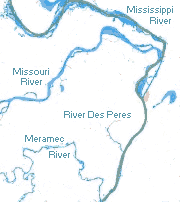
According to the United States Census Bureau, St. Louis has a total area of 66 square miles (170 km2), of which 62 square miles (160 km2) is land and 4.1 square miles (11 km2) (6.2%) is water. The city is built on bluffs and terraces that rise 100–200 feet above the western banks of the Mississippi River, just south its confluence with the Missouri River and directly across from Illinois. The eastern city limits follow the Mississippi River as the state border. Much of the area is a fertile and gently rolling prairie that features low hills and broad, shallow valleys. Both the Mississippi River and the Missouri River have cut large valleys with wide flood plains.
Near the southern boundary of the city of St. Louis (separating it from St. Louis County) is the River des Peres, practically the only river or stream within the city limits that is not entirely underground. Most of River des Peres was confined to a channel or put underground in the 1920s and early 1930s. The lower section of the river was the site of some of the worst flooding of the Great Flood of 1993.
The St. Louis area experienced a significant flood in 1973, primarily caused by the Mississippi River reaching its highest level in over 150 years. While heavy rainfall and snowmelt contributed, the flood was exacerbated by a saturated drainage basin and high water levels in the Missouri River. The flooding led to levee failures, inundation of homes, businesses, and parkland, and prompted evacuations and sandbagging efforts.
Limestone and dolomite of the Mississippian epoch underlie the area, and parts of the city are karst in nature. This is particularly true of the area south of downtown, which has numerous sinkholes and caves. Most of the caves in the city have been sealed, but many springs are visible along the riverfront. Coal, brick clay, and millerite ore were once mined in the city. The predominant surface rock, known as St. Louis limestone, is used as dimension stone and rubble for construction.
Demographics

St. Louis grew slowly until the American Civil War, when industrialization and immigration sparked a boom. Mid-19th century immigrants included many Irish and Germans; later there were immigrants from southern and eastern Europe. In the early 20th century, African American and white migrants came from the South; the former as part of the Great Migration out of rural areas of the Deep South. Many came from Mississippi and Arkansas. Italians, Serbians, Lebanese, Syrians, and Greeks settled in St. Louis by the late 19th-Century.
After years of immigration, migration, and expansion, the city reached its peak population in 1950. That year, the Census Bureau reported St. Louis's population as 82% White and 17.9% African American. After World War II, St. Louis began losing population to the suburbs, first because of increased demand for new housing, unhappiness with city services, ease of commuting by highways, and later, white flight. As of the 2020 Census, St. Louis has lost 64.8% of its population since the 1950 United States census. During this period, the population of Greater St. Louis, which includes more than one county, has grown every year and continues to do so.
According to the 2010 United States census, St. Louis had 319,294 people living in 142,057 households, of which 67,488 households were families. The population density was 5,158.2 people per square mile (1,991.6 people/km2). About 24% of the population was 19 or younger, 9% were 20 to 24, 31% were 25 to 44, 25% were 45 to 64, and 11% were 65 or older. The median age was about 34 years.
The African-American population is concentrated in the north side of the city (the area north of Delmar Boulevard is 94.0% black, compared with 35.0% in the central corridor and 26.0% in the south side of St. Louis). Among the Asian-American population in the city, the largest ethnic group is Vietnamese (0.9%), followed by Chinese (0.6%) and Indians (0.5%). The Vietnamese community has concentrated in the Dutchtown neighborhood of south St. Louis; Chinese are concentrated in the Central West End. People of Mexican descent are the largest Latino group, and make up 2.2% of St. Louis's population. They have the highest concentration in the Dutchtown, Benton Park West (Cherokee Street), and Gravois Park neighborhoods. People of Italian descent are concentrated in The Hill.
Economy

The gross domestic product of Greater St. Louis was $226.5 billion in 2023, up from $211.5 billion the previous year. Greater St. Louis had a GDP per capita of $68,574 in 2021, up 10% from the previous year. As of November, 2024, the education and health services industries employed the greatest number of people in the region, followed by the trade, transportation, and utilities industries and professional and business services.
Major companies and institutions
As of 2025, Greater St. Louis is home to seven Fortune 500 companies: Centene Corporation, Reinsurance Group of America, Emerson Electric, Edward Jones, Graybar Electric, Post Holdings, and Core & Main. An additional seven other area companies are listed on the Fortune 1000: Ameren Corporation, Olin Corporation, Stifel Financial, Peabody Energy, Advantage Solutions, Energizer Holdings, and Caleres.
Other major corporations headquartered in the region include Anheuser-Busch, Bunge Global, Wells Fargo Advisors, Enterprise Holdings, World Wide Technology, Arco Construction, McCarthy Holdings, Clayco Construction, Apex Oil, Alberici, and Schnuck Markets.
Several once-independent pillars of the local economy have been purchased by other corporations. Among them are Anheuser-Busch, purchased by Belgian-based InBev; Missouri Pacific Railroad, merged with the Omaha, Nebraska-based Union Pacific Railroad in 1982; McDonnell Douglas, whose operations are now part of Boeing Defense, Space & Security; Trans World Airlines, which was headquartered in the city for its last decade of existence prior to being acquired by American Airlines; and Ralston Purina, now a wholly owned subsidiary of Nestlé. The May Department Stores Company was purchased by Federated Department Stores, now Macy's, although it still has its regional headquarters in the area. Most of the assets of Furniture Brands International were sold to Heritage Home Group in 2013, which moved to North Carolina. German-based Bayer acquired Monsanto in 2018.
Arts and culture

The same year as the 1904 World's Fair, the Strassberger Music Conservatory Building was constructed at 2300 Grand. Otto Wilhelmi was the architect. In 1911, the conservatory had over 1,100 students. The building is presently in the National Register of Historic Places. A well known graduate was Alfonso D'Artega.
With its French past and waves of Catholic immigrants in the 19th and 20th centuries, from Ireland, Germany and Italy, St. Louis is a major center of Roman Catholicism in the United States. St. Louis also boasts the largest Ethical Culture Society in the United States and is one of the most generous cities in the United States, ranking ninth in 2013. Several places of worship in the city are noteworthy, such as the Cathedral Basilica of St. Louis, home of the world's largest mosaic installation. Other churches include the Basilica of St. Louis, King of France, the oldest Roman Catholic cathedral west of the Mississippi River and the oldest church in St. Louis; the St. Louis Abbey, whose distinctive architectural style garnered multiple awards at the time of its completion in 1962; and St. Francis de Sales Oratory, a neo-Gothic church completed in 1908 in South St. Louis and the second largest church in the city.
The city is identified with music and the performing arts, especially blues, jazz, and ragtime. The St. Louis Symphony is the second oldest symphony orchestra in the United States. Until 2010, it was also home to KFUO-FM, one of the oldest classical music FM radio stations west of the Mississippi River. Opera Theatre of St. Louis has been called "one of America's best summer festivals" by the Washington Post. Former general director Timothy O'Leary was known for drawing the community into discussions of challenging operas. John Adams's "The Death of Klinghoffer", which touched off protests and controversy when performed by the Metropolitan Opera in 2014, had no such problems in St. Louis three years before, because the company fostered a citywide discussion, with interfaith dialogues addressing the tough issues of terrorism, religion and the nature of evil that the opera brings up. St. Louis's Jewish Community Relations Council gave O'Leary an award. Under O'Leary, the company—always known for innovative work—gave second chances to other major American operas, such as John Corigliano's "The Ghosts of Versailles", presented in 2009 in a smaller-scale version.
Sports

St. Louis hosts the St. Louis Cardinals of Major League Baseball and the St. Louis Blues of the National Hockey League. In 2019, it became the eighth North American city to have won titles in all four major leagues (MLB, NBA, NFL, and NHL) when the Blues won the Stanley Cup championship. It has collegiate-level soccer teams and is one of three American cities to have hosted the Summer Olympic Games. A third major team, the St. Louis City SC of Major League Soccer, began play in 2023.
Professional sports
Pro teams in the St. Louis area include:
The St. Louis Cardinals are one of the most successful franchises in Major League Baseball. The Cardinals have won 19 National League (NL) titles (the most pennants for the league franchise in one city) and 11 World Series titles (second to the New York Yankees and the most by any NL franchise), recently in 2011. They play at Busch Stadium. Previously, the St. Louis Browns played in the American League (AL) from 1902 to 1953, before moving to Baltimore, Maryland to become the current incarnation of the Orioles. The 1944 World Series was an all-St. Louis World Series, matching up the St. Louis Cardinals and St. Louis Browns at Sportsman's Park, won by the Cardinals in six games. It was the third and final time that the teams shared a home field. St. Louis also was home to the St. Louis Stars, also known as the St. Louis Giants from 1906 to 1921, who played in Negro league baseball from 1920 to 1931 and won championships in 1928, 1930, and 1931, and the St. Louis Maroons who played in the Union Association in 1884 and in the National League from 1885 to 1889. In 1884, The St. Louis Maroons won the Union Association pennant and started the season with 20 straight wins, a feat that was not surpassed by any major professional sports team in the United States until the 2015–16 Golden State Warriors season when they started their NBA season with 24 straight wins.
Parks and recreation

The city operates more than 100 parks, with amenities that include sports facilities, playgrounds, concert areas, picnic areas, and lakes. Forest Park, located on the western edge of city, is the largest, occupying 1,400 acres of land, making it almost twice as large as Central Park in New York City. The park is home to five major institutions, including the St. Louis Art Museum, the St. Louis Zoo, the St. Louis Science Center, the Missouri History Museum, and the Muny amphitheatre. Another significant park in the city is Gateway Arch National Park, which was known as Jefferson National Expansion Memorial until 2018 and is located on the riverfront in downtown St. Louis. The centerpiece of the park is the 630-foot (192 m) tall Gateway Arch, a National Memorial designed by noted architect Eero Saarinen and completed on October 28, 1965. Also part of the historic park is the Old Courthouse, where the first two trials of Dred Scott v. Sandford were held in 1847 and 1850.
Other parks include the Missouri Botanical Garden, Tower Grove Park, Carondelet Park, and Citygarden. The Missouri Botanical Garden, a private garden and botanical research facility, is a National Historic Landmark and one of the oldest botanical gardens in the United States. The Garden features 79 acres of horticultural displays from around the world. This includes a Japanese strolling garden, Henry Shaw's original 1850 estate home and a geodesic dome called the Climatron. Immediately south of the Missouri Botanical Garden is Tower Grove Park, a gift to the city by Henry Shaw. Citygarden is an urban sculpture park located in downtown St. Louis, with art from Fernand Léger, Aristide Maillol, Julian Opie, Tom Otterness, Niki de Saint Phalle, and Mark di Suvero. The park is divided into three sections, each of which represent a different theme: river bluffs; flood plains; and urban gardens. Another downtown sculpture park is the Serra Sculpture Park, with the 1982 Richard Serra sculpture Twain.
Government

St. Louis is one of the 41 independent cities in the U.S. that does not legally belong to any county. St. Louis has a strong mayor–council government with legislative authority and oversight vested in the Board of Aldermen and with executive authority in the mayor and six other elected officials. The mayor is the chief executive officer of the city and is responsible for appointing city department heads. The Board of Aldermen is made up of 14 members (one elected from each of the city's wards) plus a board president who is elected citywide. The 2014 fiscal year budget topped $1 billion for the first time, a 1.9% increase over the $985.2 million budget in 2013. 238,253 registered voters lived in the city in 2012, down from 239,247 in 2010, and 257,442 in 2008.
Municipal elections in St. Louis are held in odd-numbered years, with the primary elections in March and the general election in April. The mayor is elected in odd-numbered years following the United States presidential election using a top-two approval voting primary. The aldermen representing odd-numbered wards are up for election at the same time as the mayor. The president of the board of aldermen and the aldermen from even-numbered wards are elected in the off-years. The Democratic Party has dominated St. Louis city politics for decades. The city has not had a Republican mayor since 1949, and the last time a Republican was elected to another citywide office was in the 1970s. As of 2015, all 28 of the city's aldermen are Democrats.
Forty-eight individuals have held the office of mayor of St. Louis, four of whom—William Carr Lane, John Fletcher Darby, John Wimer, and John How—served non-consecutive terms. The most terms served by a mayor was by Lane, who served 8 full terms plus the unexpired term of Darby. The current mayor is Cara Spencer, who took office on April 15, 2025. She is the city's third consecutive female mayor. Her predecessor Tishaura Jones who took office April 20, 2021, was the first African-American woman to hold the post. Jones succeeded Lyda Krewson, the first female mayor of the city, who retired in 2021 after serving for four years. The longest-serving mayor was Francis Slay, who took office April 17, 2001, and left office April 18, 2017, a total of 16 years and six days over four terms in office. The shortest-serving mayor was Arthur Barret, who died 11 days after taking office.
Education

Colleges and universities
The city is home to three national research universities, Washington University in St. Louis, Saint Louis University, and the University of Missouri-St. Louis, as classified under the Carnegie Classification of Institutions of Higher Education. Washington University School of Medicine in St. Louis has been ranked among the top 10 medical schools in the country by U.S. News & World Report for as long as the list has been published, and as high as second, in 2003 and 2004. U.S. News & World Report also ranks the undergraduate school and other graduate schools, such as the Washington University School of Law, in the top 20 in the nation.
St. Louis Metropolitan Region is home to St. Louis Community College. It is also home to several other four-year colleges & universities, including Harris–Stowe State University, a historically black public university, Webster University, Missouri Baptist University, University of Health Sciences & Pharmacy (the former Saint Louis College of Pharmacy), Southern Illinois University-Edwardsville (SIUE), and Lindenwood University.
In addition to Catholic theological institutions such as Kenrick-Glennon Seminary and Aquinas Institute of Theology sponsored by the Order of Preachers, St. Louis is home to three Protestant seminaries: Eden Theological Seminary of the United Church of Christ, Covenant Theological Seminary of the Presbyterian Church in America, and Concordia Seminary of the St. Louis-based Lutheran Church–Missouri Synod.
Primary and secondary schools
The St. Louis Public Schools (SLPS), which covers the entire city, operates more than 75 schools, attended by more than 25,000 students, including several magnet schools. Since 2017, SLPS operates under full accreditation from the state of Missouri, having previously lost its accreditation in 2007. The Board of Education of the city of St. Louis oversees the district. Since 2000, charter schools have operated in the city of St. Louis using authorization from Missouri state law. These schools are sponsored by local institutions or corporations and take in students from kindergarten through high school. In addition, several private schools exist in the city, and the Archdiocese of St. Louis operates dozens of parochial schools in the city, including parochial high schools. The city also has several private high schools, including secular, Montessori, Catholic and Lutheran schools. St. Louis University High School – a Jesuit preparatory high school founded in 1818 – is the oldest secondary educational institution in the U.S. west of the Mississippi River. The state-operated K-12 boarding school Missouri School for the Blind is in St. Louis.
Media

Greater St. Louis commands the 24th-largest media market in the United States. All of the major U.S. television networks have affiliates in St. Louis, including KTVI 2 (Fox), KMOV 4 (CBS, with ABC on channel 32.1), KSDK 5 (NBC), KETC 9 (PBS), KPLR-TV 11 (The CW), KNLC 24 (MeTV), KDNL 30 (Independent), WRBU 46 (Ion), and WPXS 51 Daystar Television Network. Among the area's most popular radio stations are KMOX (AM sports and talk, notable as the longtime flagship station for St. Louis Cardinals broadcasts), KLOU (FM oldies), WIL-FM (FM country), WARH (FM adult hits), and KSLZ (FM Top 40 mainstream). St. Louis also supports public radio's KWMU, an NPR affiliate. All-sports stations, such as KFNS 590 AM "The Fan" and WXOS "101.1 ESPN" are also popular. KSHE 95 FM "Real Rock Radio" has broadcast rock music since November 1967 - longer than any other radio station in the United States.
The St. Louis Post-Dispatch is the region's major newspaper. Others in the region include Ladue News, West Newsmagazine, the Webster-Kirkwood Times, and the Call Newspapers which all serve parts of St. Louis County. Three weeklies serve the African-American community: the St. Louis Argus, the St. Louis American, and the St. Louis Sentinel. St. Louis Magazine, a monthly magazine, covers topics such as local history, cuisine, and lifestyles, while the weekly St. Louis Business Journal provides coverage of regional business news. St. Louis was served by an online newspaper, the St. Louis Beacon, but that publication merged with KWMU in 2013. The primary alternative newspaper was the Riverfront Times before it was closed in 2024.
Many books and movies have been written about St. Louis. A few of the most influential and prominent films are Meet Me in St. Louis and American Flyers, and novels include The Killing Dance, Meet Me in St. Louis, The Runaway Soul, The Rose of Old St. Louis, and Circus of the Damned.
Transportation

Road, rail, ship, and air transportation modes connect the city with surrounding communities in Greater St. Louis, national transportation networks, and international locations. St. Louis also supports a public transportation network that includes bus and light rail service.
Roads and highways
Four interstate highways connect the city to a larger regional highway system. Interstate 70, an east–west highway, runs from the northwest corner of the city to downtown St. Louis. The north–south Interstate 55 enters the city at the south near the Carondelet neighborhood and runs toward the center of the city, and both Interstate 64 and Interstate 44 enter the city on the west, running parallel to the east. Two of the four interstates (Interstates 55 and 64) merge south of Gateway Arch National Park and leave the city on the Poplar Street Bridge into Illinois, while Interstate 44 terminates at Interstate 70 at its new interchange near N Broadway and Cass Ave. A small portion of the Interstate 270 outer belt freeway runs through the northern end of the city.
The 563-mile Avenue of the Saints links St. Louis with Saint Paul, Minnesota.
Major roadways include the north–south Memorial Drive, located on the western edge of Gateway Arch National Park and parallel to Interstate 70, the north–south streets of Grand Boulevard and Jefferson Avenue, both of which run the length of the city, and Gravois Road, which runs from the southeastern portion of the city to downtown and used to be signed as U.S. Route 66. An east-west roadway that connects the city with surrounding communities is Martin Luther King, Jr. Drive, which carries traffic from the western edge of the city to downtown.
Buses and taxis
Local bus service in the city of St. Louis is provided by the Bi-State Development Agency via MetroBus, with more than 75 routes connecting to MetroLink light rail transit and stops in the city and region. The city is also served by Madison County Transit, which connects downtown St. Louis to Madison County, Illinois. National bus service in the city is offered by Greyhound Lines, Burlington Trailways and Amtrak Thruway, with a station at the Gateway Transportation Center, and Megabus, with a stop at St. Louis Union Station.
Kaynak: Wikipedia – St. Louis · CC BY-SA 4.0