
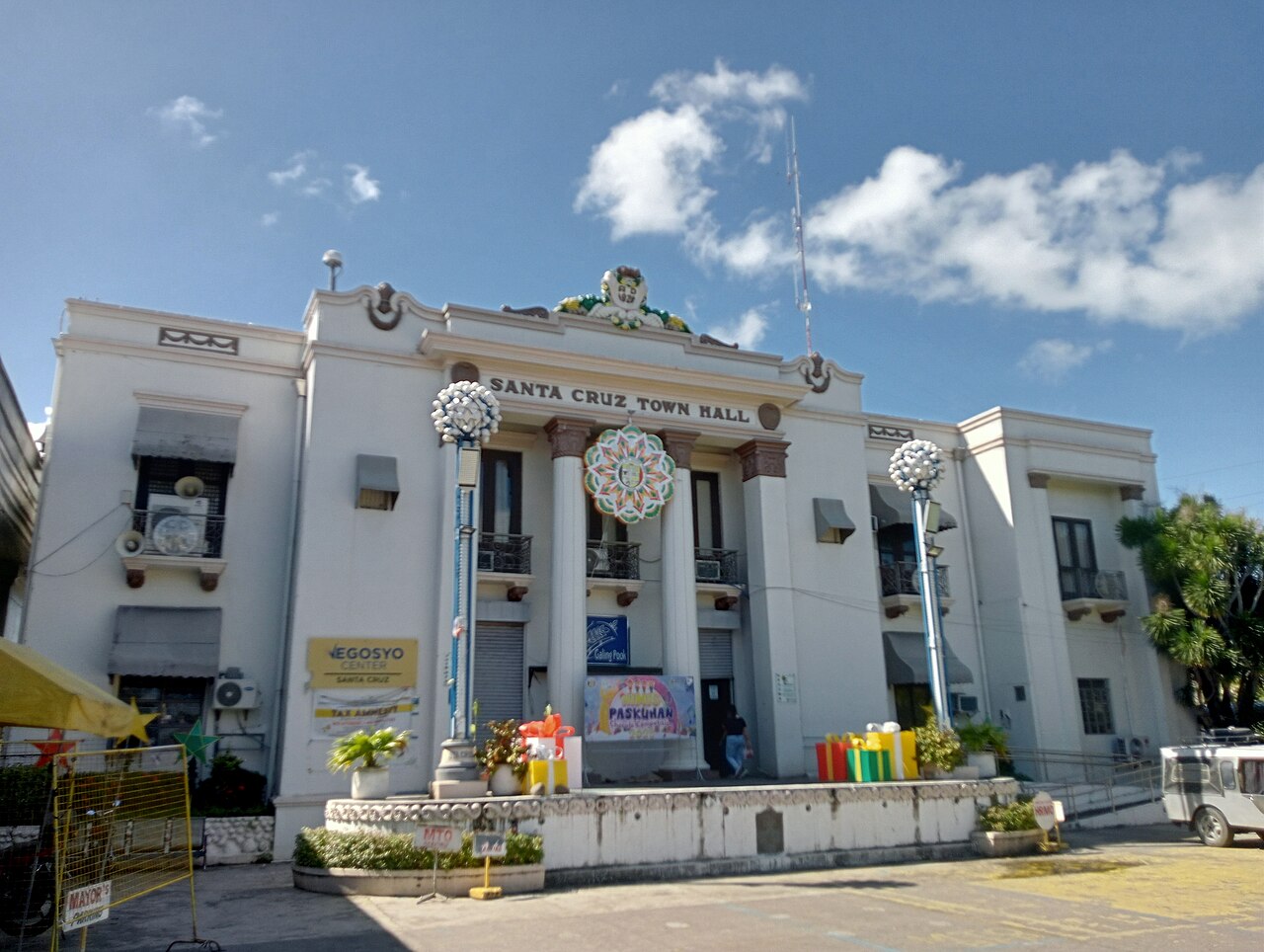
Santa Cruz
Santa Cruz, officially the Municipality of Santa Cruz, is a municipality and capital of the province of Laguna, Philippines.
Government administration · Philippines · 0 followers
Overview
Santa Cruz, officially the Municipality of Santa Cruz, is a municipality and capital of the province of Laguna, Philippines. According to the 2024 census, it has a population of 126,844 people.
Interested in working with us in the future?
Follow to see new jobs and posts in your feed.
No news yet.
About

Santa Cruz, officially the Municipality of Santa Cruz, is a municipality and capital of the province of Laguna, Philippines. According to the 2024 census, it has a population of 126,844 people.
Kaynak: Wikipedia · CC BY-SA 4.0
History
Spanish colonial period
During the late 16th century, Santa Cruz was a densely populated barrio of the present-day municipality of Lumban, along with neighboring areas that would later become towns such as Pagsanjan, Cavinti, Paete and Pangil. On September 6, 1602, Santa Cruz separated from Lumban and became a pueblo with its church and local government. For being in an unhealthy state, the center of the town was moved in 1608 to where it is today.
Since its foundation in 1602, the town had been ravaged by calamitous forces such as fires, typhoons, floods and human vandalism during the Philippine Revolution of 1896–1899, the war of the Philippine Independence (1899–1902), the Battle of Santa Cruz and the assault of the tulisanes (bandits) during the Spanish period.
Characterized by fertile flatlands along the coastal plains of Laguna de Bay, the town's economic base has traditionally been anchored on two primary industries, namely agriculture and fishing, which remain in the present. In view of Santa Cruz's strategic location relative to the other coastal settlements around the lake, trading activities have likewise been rooted in the town during those early settlement days. The town proper, which has always been the focal point of activities, used to be accessible to the other lakeshore areas via the navigable Santa Cruz River, aside from Laguna de Bay itself. Since those early days, water has been the principal mode of transportation.
World War II
The Filipino guerrillas and irregular forces also came from the town and were involved in the Second Battle of Santa Cruz on January 26, 1945.
Modern period
Today, Santa Cruz serves as the capital of Laguna and is considered the business and commercial center of the eastern part of the province.
Geography

Situated in the central portion of Laguna province along the southeastern coast of Laguna de Bay, Santa Cruz lies 87 kilometres (54 mi) southeast of Metro Manila via Calamba and is located at approximately 14 degrees 17 minutes north latitude and 121 degrees 25 minutes east longitude. The municipality is bounded on the north and northwest by Laguna de Bay, on the northeast by Lumban, on the east by Pagsanjan, on the southeast by Magdalena, on the south by Liliw, and on the southwest by Pila. It has 26 barangays and covers an approximate land area of 3,860 hectares (9,500 acres), which comprises about 2% of Laguna's total land area.
It is situated on the banks of the Santa Cruz River, which flows into the eastern part of Laguna de Bay. It is 88 kilometres (55 mi) from Manila via Calamba and Los Baños. It is accessible by land from Metro Manila, passing through Rizal Province via the Manila East Road or Western Laguna via the South Luzon Expressway (SLEX).
Geology
The two types of rocks found in Santa Cruz are alluvium and clastic rocks. Clastic rocks are located in the eastern portion of the municipality, specifically in Barangays Alipit, San Jose, Oogong, Jasaan, San Juan, Palasan, and portions of Barangays Pagsawitan, Patimbao, Bubukal, Labuin and Malinao. These rocks consist of interbedded shale and sandstone with occasional thin lenses of limestone, tuff and reworked sandy tuffs, calcareous sandstone and partly tuffaceous shale.
Climate
Like most areas in the province of Laguna, the climate of Santa Cruz is characterized by two pronounced seasons: dry from January to April and wet for the rest of the year. The municipality has an annual temperature of 27.2 °C and an annual rainfall of 1962.7 mm. Northeasterly winds with an average wind speed of 9 knots prevail in the municipality.
Barangays
Santa Cruz is politically subdivided into 26 barangays, as indicated below. The town is composed of five barangays in the Poblacion area and 21 classified urban barangays.
Demographics
In the 2024 census, the population of Santa Cruz was 126,844 people, with a density of 3,300 inhabitants per square kilometre or 8,500 inhabitants per square mile.
Economy
Santa Cruz is considered the service and commercial center of the eastern part of the province. Although relatively far from the immediate urbanizing influence of Metropolitan Manila, Santa Cruz continues to progress. Santa Cruz has also been the seat of the provincial government since 1885, giving the municipality an additional administrative function over the entire province.
It also functions as the service center for transportation, commerce, health, education, and other social services for the predominantly rural northeastern municipalities of the province. The incipient and fast-growing agribusiness industries, such as livestock raising, horticulture and aquaculture, boost the municipal economy. The town is composed of 26 urban barangays.
Commerce
Santa Cruz serves as the provincial service center, particularly for the municipalities in its northeastern part.
Trade and commerce remain some of the primary economic activities in the locality. The presence of jeepney services plying Lumban, Paete, Siniloan, San Pablo, Pila, Victoria, Cavinti-Caliraya, Luisiana, Majayjay, Calumpang, Nagcarlan, Liliw, Magdalena, Pagsanjan, Lucban, Lucena and Calamba has further enhanced the municipality's role as a commerce and trade center.
The center of business activities is in the poblacion, specifically Barangay V, where the four buildings of the Public Market are situated.
Santa Cruz has many establishments that contribute to its development. Development in this vicinity has been of a quasi-residential commercial type, manifested by the proliferation of structures used for both business and residential purposes by the proprietors/owners. There is also a concentration of business establishments along the section of the national highway, especially Barangay Gatid, where a mall is located, and the abandoned PNR Railway (road), while a strip pattern of commercial development is noticeable along Quezon Avenue, the old highway and Pedro Guevarra Avenue. Along P. Guevarra Avenue, several establishments are also located such as hospitals, a Meralco office, a PLDT office, Red Cross, several banking institutions, and Executive Eminent Lending Company. There is also SL Agritech Corporation in Barangay Oogong.
Tourism
Points of interest
Santa Cruz has famous white cheese or kesong puti, freshly made from carabao's milk.
Immaculate Concepcion Parish Church (Catholic)
Cathedral of the Our Lady of Maulawin (Aglipayan Church)
Events
Santa Cruz hosted the Palarong Pambansa from May 4–10, 2014.
Education
The Santa Cruz Schools District Office governs all educational institutions within the municipality. It oversees the management and operations of all private and public schools from the primary to secondary levels.
Transportation
The development of Santa Cruz as the administrative, commercial, and service center of Laguna makes it accessible to all private and public vehicles going to nearby places, particularly Pagsanjan, Lake Caliraya, Liliw, Paete and Nagcarlan.
Kaynak: Wikipedia – Santa Cruz, Laguna · CC BY-SA 4.0