


Siegen
Siegen ist eine Großstadt und Universitätsstadt in Nordrhein-Westfalen.
Government administration · Germany · 0 followers
Overview
Siegen ist eine Großstadt und Universitätsstadt in Nordrhein-Westfalen. Sie liegt im Landesteil Westfalen und gehört zum Regierungsbezirk Arnsberg. Sie ist Verwaltungssitz des Kreises Siegen-Wittgenstein und hat somit den Status einer großen kreisangehörigen Stadt.
Interested in working with us in the future?
Follow to see new jobs and posts in your feed.
No news yet.
About

Siegen ist eine Großstadt und Universitätsstadt in Nordrhein-Westfalen. Sie liegt im Landesteil Westfalen und gehört zum Regierungsbezirk Arnsberg. Sie ist Verwaltungssitz des Kreises Siegen-Wittgenstein und hat somit den Status einer großen kreisangehörigen Stadt.
Kaynak: Wikipedia · CC BY-SA 4.0
Geographie

Lage
Siegen ist die südlichste Stadt Westfalens bzw. des Siegerlands. Sie liegt in einem verzweigten Talkessel der oberen Sieg. Neben der Sieg sind die größten Fließgewässer innerhalb des Stadtgebiets die Sieg-Zuflüsse Ferndorf, Weiß, Alche, Eisernbach und Gosenbach. Vom Talkessel zweigen noch zahlreiche weitere Nebentäler ab. Die Höhen der umgebenden Berge sind, sofern nicht besiedelt, von Niederwald bedeckt. Nördlich schließt sich das Sauerland an, im Nordosten das Wittgensteiner Land im Rothaargebirge, südlich der Westerwald und im Westen das Wildenburger Land.
Die nächsten größeren Städte in der Umgebung von Siegen sind (in durchschnittlicher Verkehrsentfernung) im Norden Hagen (83 km), im Südosten Gießen (70 km) und Frankfurt am Main (125 km), im Südwesten Koblenz (105 km) und im Westen Köln (93 km). Die räumlichen Entfernungen (Luftlinie) zu den umliegenden Großstädten betragen in etwa 65 km (Hagen), 95 km (Frankfurt), 65 km (Koblenz) und 75 km (Köln).
Die Stadt liegt an der deutsch-niederländischen Ferienstraße Oranier-Route.
Berge
Im Kerngebiet Siegens liegen acht Berge:
Weitere Berge im Siegener Stadtgebiet sind zum Beispiel der Gilberg zwischen Eiserfeld und Hengsbach oder der Pfannenberg zwischen Eiserfeld und Salchendorf mit Spitze in Eiserfeld.
Ausdehnung des Stadtgebiets
Die Gesamtfläche des Stadtgebiets beträgt rund 115 Quadratkilometer. Die maximale West-Ost-Ausdehnung beträgt elf, in nord-südlicher Richtung zwölf Kilometer. Die Stadtgrenze ist 48 Kilometer lang. Die höchste Erhebung der Stadt ist der Pfannenberg mit 499 m ü. NHN an der südlichen Stadtgrenze. Der niedrigste Punkt des Kreises liegt mit 215 m ü. NHN bei Niederschelden an der südwestlichen Stadtgrenze, die hier gleichzeitig die Landesgrenze zu Rheinland-Pfalz bildet. Der Waldanteil am Stadtgebiet beträgt rund 51 Prozent.
Nachbargemeinden und -städte
Die Stadt Siegen grenzt im Norden an die Stadt Kreuztal, im Osten an die Stadt Netphen, im Südosten an die Gemeinde Wilnsdorf, im Süden an die Gemeinde Neunkirchen und die Stadt Herdorf in Rheinland-Pfalz, im Südwesten an die Gemeinde Mudersbach (Landkreis Altenkirchen (Westerwald) in Rheinland-Pfalz), im Westen an die Stadt Freudenberg und im Nordwesten an die Gemeinde Wenden (Kreis Olpe).
Geschichte

Frühgeschichte und Mittelalter
Der Name Siegen geht auf den vielleicht keltischen Flussnamen der Sieg zurück, ungewiss ist eine Verwandtschaft mit dem Namen des keltisch-germanischen Stammes der Sugambrer, der in vorchristlicher Zeit in Teilen des heutigen Nordrhein-Westfalen lebte. Erste urkundliche Erwähnungen des Ortes Sigena reichen bis in das Jahr 1079 zurück.
Die Spatenforschung hat für das Siegerland Erzförderung und „eine beachtliche latènezeitliche Eisenverhüttung“ für den Zeitraum von etwa 500 v. Chr. bis 100 n. Chr. nachgewiesen. Einzelne solcher Fundstellen befinden sich auch auf dem heutigen Gebiet der Stadt Siegen, so Schmelzöfen im Engsbach-Seifen bei Achenbach. Sie gehören zu den ältesten im Siegerland. Diese älteste Eisenverhüttung erfuhr eine mehrhundertjährige Unterbrechung, um im Frühmittelalter (10./11. Jahrhundert) wieder aufgenommen zu werden. Erzförderung und -verhüttung dauerten bis vor wenigen Jahrzehnten an.
Auf einer Münze, die um das Jahr 1175 entstanden ist, wird Siegen unter der Bezeichnung „civitas“ (deutsch: Stadt) genannt.
Im Jahre 1224 wurde Siegen als eine aufs Neue erbaute oder wiederaufgebaute Stadt oder Landgemeinde (genauer lateinischer Wortlaut: „oppidi Sige de novo constructi“) in einer neunzeiligen Urkunde in lateinischer Sprache erwähnt, die Erzbischof Engelbert I. von Köln dem Grafen von Nassau, Heinrich dem Reichen, zum halben Miteigentum übertrug. Möglicherweise wurde der alte Siedlungsplatz von der Weiß-Mündung auf den Bergsporn verlegt, auf dem sich die Altstadt befindet. Es ist belegt, dass das Obere Schloss zu dieser Zeit schon existierte. Am 19. Oktober 1303 erhielt die Stadt das Soester Stadtrecht. Auf den 21. August 1345 datiert die erstmalige Erwähnung des Hof Winterbach rechts des Leimbachtals. Bis zum 1. Februar 1381 hatte die Stadt zwei Eigentümer. Erst dann ging sie gänzlich in die Hände der Nassauer über. Das älteste Siegel stammt vom 25. März 1309. Seit dem Jahr 1404 sind heute noch identifizierbare Straßen und Quartiere Siegens belegt.
Politik

Stadtrat
Die Sitze des Stadtrates verteilen sich nach den Kommunalwahlen seit 2025 wie folgt:
Der Gesamtschuldenstand der Stadt lag 2007 bei etwa 320,5 Millionen Euro. 100,7 Millionen entfallen auf den Kernhaushalt, 118,1 Millionen auf städtische Eigenbetriebe und 101,6 Millionen auf Kassenkredite.
Aus dem Rat konstituieren sich die gesetzlich vorgeschriebenen Ausschüsse. Ferner existiert in der Stadt Siegen ein aus 21 Mitgliedern bestehender Integrationsrat. Dieser setzt sich aus 14 gewählten Migrantenvertretern und sieben bestellten Ratsmitgliedern zusammen. In der Stadt Siegen wird zudem ein 36-köpfiger (18 ordentliche Mitglieder sowie 18 Stellvertreter) Seniorenbeirat und ein 22-köpfiger (elf ordentliche Mitglieder sowie elf Stellvertreter) Behindertenbeirat durch Wahl bestellt.
Bürgermeister
An der Spitze der Stadt sind seit dem 13. Jahrhundert mehrere Bürgermeister nachweisbar. 1304 und 1305 wurde erstmals ein Rat (consules) genannt. Bereits seit 1224 gab es jedoch „Burgmänner“ und drei jährlich wechselnde Bürgermeister. Ab 1500 wurden im Jahr nur noch zwei Bürgermeister gewählt. Im 18. Jahrhundert errangen die Zünfte zunehmend Einfluss in der Stadt. Danach vertrat der „regierende“ oder „im Amt stehende“ alte Schuhmachermeister beim Rat die „gemeinsame Bürgerschaft“. Die mittelalterliche Stadtverfassung galt bis 1809, teilweise bis 1815. Ab 1815 herrschte ein Rat mit zwölf Mitgliedern, der sich selbst ergänzte. Ihm stand der Bürgermeister vor. Die Vorstädte erhielten ab 1824 eigene Vorsteher, die dem Siegener Bürgermeister nachgeordnet waren. 1836 wurde die preußische Städteordnung eingeführt. Nach dem Ausscheiden der Stadt aus dem Kreis Siegen 1923 trug das Stadtoberhaupt den Titel Oberbürgermeister. Der seit 1919 als Bürgermeister amtierende Alfred Fissmer blieb während der Zeit der Nationalsozialisten im Amt.
Kultur und Sehenswürdigkeiten

Theater
Mit der Eröffnung des Apollo-Theaters, dem zum Theater umgebauten früheren Apollo-Kinocenter, erhielt die Stadt Siegen am 1. September 2007 erstmals ein eigenes Theatergebäude.
Seit 1992 ist das Medien- und Kulturhaus Lÿz Spielort für Kleinkunst, Kabarett, Musik und Theater. Auf den beiden Bühnen des Hauses finden pro Saison etwa 150 Veranstaltungen statt.
Größere Veranstaltungen finden in der Siegerlandhalle (1800 m2, 2300 Sitzplätze) sowie in der Bismarckhalle statt. Daneben gibt es auch Konzerte und Aufführungen unter freiem Himmel.
Museen
Das Siegerlandmuseum für Kunst- und Kulturgeschichte ist aus dem 1902 gegründeten Schulmuseum des Siegener Realgymnasiums hervorgegangen und befindet sich seit 1905 im Oberen Schloss. Die Sammlungen des Museums umfassen Gemälde und Grafiken des Malers Peter Paul Rubens, eine Porträtsammlung des Fürstenhauses Nassau-Oranien, Exponate zur Geschichte des Siegerlands von der Urzeit bis zur Gegenwart, zur regionalen Bergbau- und Wirtschaftsgeschichte und Eisengewinnung einschließlich eines künstlich angelegten Schaubergwerks, zur Geschichte der Siegerländer Wohnkultur im 19. Jahrhundert sowie Mineralien. Eine Außenstelle des Museums, das Ausstellungsforum, befand sich bis in die 2010er Jahre in einer Villa in der Oranienstraße. Trägerin des Siegerlandmuseums ist die Stadt Siegen.
Seit 1996 besteht in den Räumen eines 1941 errichteten Luftschutzbunkers am zentralen Siegberg das Aktive Museum Südwestfalen, das sich als Dokumentations- und Lernort für regionale Zeitgeschichte versteht. Am Standort befand sich bis zur Brandstiftung am 10. November 1938 die Synagoge Siegen. Das Museum ist zugleich eine Gedenkstätte für die Opfer des Nationalsozialismus in der Region Siegerland-Wittgenstein. Es beherbergt auf 200 m2 eine Dauerausstellung, in deren Mittelpunkt die Geschichte der regionalen jüdischen Minderheit steht. Anhand lokaler Beispiele werden die Verbrechen an weiteren Verfolgtengruppen thematisiert: an den sogenannten Zigeunern, den behinderten Menschen, den Ernsten Bibelforschern (Zeugen Jehovas), den ausländischen Zwangsarbeitern und den politisch Verfolgten. Im Rahmen der Ausstellung wird beispielhaft der Lebensweg des Siegener Kommunisten Walter Krämer, unter anderem Abgeordneter der KPD im Preußischen Landtag, nachgezeichnet. Ihm wurde posthum im Jahr 2000 die höchste Auszeichnung des Staates Israel verliehen, der Ehrentitel Gerechter unter den Völkern. Regelmäßige Ausstellungen zu besonderen Themen und öffentliche Veranstaltungen mit einem breiten Themenspektrum erweitern das thematische Angebot. Träger des Aktiven Museum Südwestfalen ist ein privater Verein.
Wirtschaft und Infrastruktur

Siegen ist als Oberzentrum Dienstleistungs- und Verwaltungszentrum von Südwestfalen. Die verarbeitende Industrie ist durch einen hohen Anteil metallverarbeitender Betriebe geprägt. Die Arbeitslosenquote lag im November 2010 bei 6,5 Prozent.
Der Stadtkern gliedert sich in zwei Bereiche: die Unterstadt im Siegtal zwischen der alten B 54 und Hauptbahnhof und die Oberstadt auf dem Siegberg, in beiden konzentrieren sich die Einkaufsmöglichkeiten Siegens. Die Oberstadt ist das etwa tausendjährige historische Zentrum der Stadt mit zum Teil historischer Architektur. Beginnend am Kölner Tor über die Alte Poststraße mit überwiegend Gastronomiebetrieben über den Marktplatz bis hinauf zu Marburger Straße und Marburger Tor wird die Oberstadt größtenteils von der steilsten Fußgängerzone Deutschlands durchzogen. Als Fußgängerzone ist die Kölner Straße jedoch erst seit dem 16. November 1970 ausgestaltet. Ebenfalls als Fußgängerzone ausgestaltet wurde 1972 die Bahnhofstraße, eine zentral gelegene Einkaufspassage im traditionellen Stil mit diversen Einzelhändlern, die zum Eisenbahn- und Bus-Bahnhof und der dort befindlichen mehrstöckigen City-Galerie sowie dem Sieg-Carré führt. Ergänzt wurden diese Einkaufspassagen seit den 1960er Jahren durch die Sieg-Überkragung in der Unterstadt, eine mehrere hundert Meter lange Überbauung der Sieg durch einen Großparkplatz, ein Parkhaus und Geschäftshäuser.
Der 2012 erfolgte Abriss des als Siegplatte bezeichneten Parkplatzes über dem Ende der 1960er Jahre zubetonierten Siegbett war schon 1991 diskutiert worden, jedoch anfangs nicht finanzierbar, im Rahmen der Südwestfalen-Regionale 2013 waren Fördergelder verfügbar, jedoch nur für eine Umgestaltung aber nicht für eine Sanierung die mittlerweile dringend nötig geworden war, also entschied man sich für den Abriss, hierfür bewilligte die Bezirksregierung Arnsberg Anfang September 2011 im Rahmen der Umsetzung der EG-Wasserrahmenrichtlinie 2,94 Millionen Euro Fördermittel, die Stadt Siegen steuerte selbst 232.700 Euro zur Verwirklichung des Projekts bei. Im Rahmen der Regionale wurden ebenfalls Bereiche um die Sieg und das Kölner Tor, im Übergang zwischen Siegener Unterstadt und Oberstadt, umgestaltet, und das Stadtbild städtebaulich wieder attraktiver gemacht.
Kaynak: Wikipedia – Siegen · CC BY-SA 4.0
Geography

Location
The city of Siegen lies in the basin of the upper reaches of the river Sieg. From there, lateral valleys branch off in many directions. The heights of the surrounding mountains, wherever they are not actually settled, are covered in coppice. To the north lies the Sauerland, to the northwest the Rothaargebirge and to the southwest the Westerwald.
The nearest cities to Siegen, taking into account average travelling distances, are Hagen to the north 83 km (52 mi), Frankfurt am Main to the southeast 125 km (78 mi), Koblenz to the southwest 105 km (65 mi) and Cologne to the west 93 km (58 mi).
As the crow flies the distances to these places are, however, 65 km (40 mi) (Hagen), 95 km (59 mi) (Frankfurt), 65 km (40 mi) (Koblenz) and 75 km (47 mi) (Cologne).
The city lies on the German-Dutch holiday road called the Orange Route, joining towns, cities and regions associated with the House of Orange.
City area
The city's total land area is roughly 115 km2 (44 sq mi). Its greatest east-west span is about 12 km (7 mi), and its greatest north-south span is about 12 km (7 mi). City limits are 48 km (30 mi) long. Siegen lies at a median elevation of 290 m (951 ft) above sea level. The city's greatest elevation is the peak of the Pfannenberg at 499 m (1,637 ft) above sea level at southern city limits. Siegen's lowest point is 215 m (705 ft) above sea level at Niederschelden at southwestern city limits, which there also forms the state boundary with Rhineland-Palatinate. Roughly 60% of the city's land is wooded, making Siegen one of Germany's greenest cities.
The city area is divided into six zones, called Bezirke in German and comparable to boroughs in some cities, which themselves are further divided into various communities (Ortsteile and Stadtteile). Each "borough" has a borough board consisting of 15 voting and 15 non-voting members who are appointed by city council with regard to each party's share of the vote in the municipal elections in the borough in question. The borough boards decide on matters particular to their respective boroughs. These matters are laid down in Siegen's city charter.
History
The name Siegen comes from the possibly Celtic river name Sieg. It is, however, unclear whether there is any relation between this name and the Celtic-Germanic Sicambri (Ger. Sugambrer) people, who in pre-Christian times lived in parts of North Rhine-Westphalia. The first documentary mention of the place called Sigena dates from 1079. The city's history is markedly shaped by mining, which locally began as far back as La Tène times. Bearing witness to this longtime industry are the many mines that can be found within city limits.
In 1224, Siegen is mentioned as a newly built town whose ownership was shared by the Count of Nassau, Heinrich the Rich, and Engelbert II of Berg, Archbishop of Cologne after the latter transferred one half of the ownership to the former. Moreover, there is proof that the Oberes Schloss ("upper stately home") was already standing at this time. On 19 October 1303, the town was granted Soester Stadtrecht, or Soest town rights. The town remained under the two overlords' joint ownership until 1 February 1381, only then passing fully into Nassau hands.
In the 16th century, the town of Siegen bore a formidable defensive look. It was surrounded by mighty walls with 16 towers and three town gates, and was home to a great castle. The town was stricken several times by townwide fires. Documents record such fires in 1592, and from 10 to 20 April 1695.
In 1536, Heinrich the Rich built a "paedagogium" in the buildings that had once housed a Franciscan Monastery. It later grew into today's Gymnasium at Siegen's Löhrtor (gate). John VII of Nassau-Siegen ("John the Middle") built the Unteres Schloss ("lower stately home") on the site of an old Franciscan Monastery. In 1616, John VII founded a knightly war school in the still standing old armoury on Burgstraße, "expressly to produce an officer corps for Calvinism".
Politics
Mayor
The current mayor of Siegen is Tristan Vitt of the Social Democratic Party (SPD).
Previous mayoral election was held on 13 September 2020 and the results were as follows:
At the city's helm since the 13th century, there have been several mayors of whom evidence survives. In 1304 and 1305, a council ("consules") was mentioned for the first time. As early as 1224, however, documents mention Burgmänner ("Castle Men") as well as three Bürgermeister ("Mayors") who were changed yearly. As of 1500, only two mayors were chosen every year. In the 18th century, the guilds were achieving ever greater influence in the town. Thereafter the "ruling" or "office-holding" old shoemaking master represented the "common townsfolk" on the council. The mediaeval town charter was kept right up until 1809, and parts of it even held until 1815, but that year there was a self-endorsing council with 12 members, over which presided the mayor. As of 1824, the suburbs got their own chief administrator who was subordinate to the mayor of Siegen. In 1836, the Prussian municipal system was introduced. After the town was separated from Siegen district in 1923, the mayor was given the title Oberbürgermeister (roughly equivalent to Lord Mayor). The mayor who came to office in 1919 kept his position right through the time of the Third Reich, whereas some mayors in other German and Austrian towns, whose political views were at odds with the Nazis', were removed forcibly.
After the Second World War, the military government of the British Zone of Occupation installed a new mayor, and in 1946 it introduced a new town charter based on a British model, leading to a "Council of the town" elected by the people, whose members were called Stadtverordnete (town councillors). In the beginning, the council chose one from its midst as the mayor as the town's head and representative, which was an honorary function. Furthermore, as of 1946, the council also began choosing a full-time Oberstadtdirektor, or Higher Town Director, to lead the town's administration.
Sights
Although the town was about 80% destroyed in the World War II, Siegen has kept a number of buildings worth seeing, such as the two stately homes, the Oberes Schloss and the Unteres Schloss.
Oberes Schloss
The castle on the Siegberg was first mentioned in a document in 1259 and was the family seat of the House of Nassau. Since 1905, the Siegerland Museum has been here. Alongside regional exhibits – among them an artificial demonstration mine – are many paintings. The centrepiece of this collection is made up of works by the man who is arguably the best known native, Peter Paul Rubens. There is also quite a comprehensive collection of portraits of members of the Houses of Nassau and Orange. The top floor is devoted to 19th-century home décor. A kitchen from the Siegerland, a bedroom and many pieces of furniture from the Biedermeier era give one an impression of life in the region in bygone days.
Unteres Schloss
Late in the 17th century, the Lower Stately Home came into being in its current form, somewhat like an open rectangle. The Protestant line of the House of Nassau-Siegen resided here. Also belonging to the Schloss is the "Dicker Turm", or "Fat Tower" with a carillon. In 1959, the then town of Siegen built a memorial for victims of war and tyranny. Inside the Schloss is also found the crypt of the Evangelical branch of the Nassau princely house.
Today, the Schloss serves as a state authority building in which the North Rhine-Westphalia Building and Property Establishment, the State Environment Office, the Office for Occupational Health and Safety and the Attendorn Correctional Facility (Siegen Branch Facility) are all housed. By the city's plans, a university is supposed to move into the Unteres Schloss within the next few years, but at this time, the plan is failing to find any financial backing.
Churches
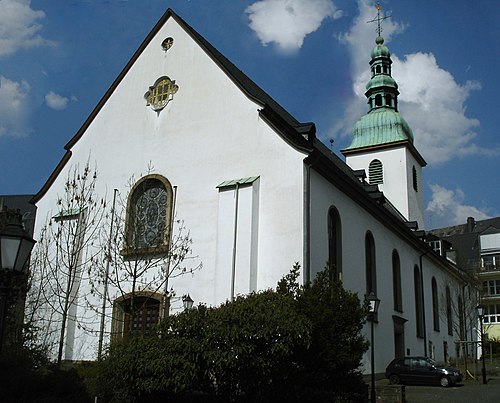
Two churches in downtown Siegen are to be brought to the visitor's attention: The Martinikirche dating from the 11th century and the Nikolaikirche at the marketplace with its unusual eight-sided shape and its golden Krönchen ("coronet") – the city's landmark – on the church tower, which is a prominent feature of Siegen's skyline (Siegen is sometimes called Krönchenstadt for this unusual feature). Another church is the Marienkirche, built by the Jesuits between 1702 and 1729. Also worth seeing are Siegen's Old Town and several museums in the city core.
Culture
Theatre
In the Apollo-Theater (a downtown former 1930s cinema that underwent remodelling and opened in mid-2007), Siegen has one of the current decade's most important newly built theatres. A controlling interest in this venture is held by TheaterSiegen intendant Magnus Reitschuster.
Since 1992, the media and cultural house Lÿz has been a venue for cabaret, music and theatre in Siegen. On the two stages, roughly 150 events appear every season.
Bigger events take place at the Bühne der Stadt ("City's Stage", with about 820 seats), the Siegerlandhalle (1 800 m2, 2,300 seats) or the Bismarckhalle. As well, there are regular open-air concerts and productions in the inner yard at Unteres Schloss.
Museums
The main centre of art in Siegen are the Museum for Contemporary Art and the Haus Seel – city gallery.
The Siegerland Museum is dedicated to regional history. The Oranienstraße House, built at 1900 in the Italian country house style, is attached to the Siegerland Museum since 1993 as an exhibit forum. There is a varied program of temporary exhibitions of all kinds, from archaeological excavations to contemporary avant-garde art. Poet and author readings are also part of the program, such as classic concerts.
In Geisweid is found the Beatles Home Museum, run by Harold Krämer. According to the 2000 Guinness Book of Records, the 27 m2 museum is the smallest public museum in the world devoted to the four Liverpudlian musicians. The collection holds more than 17,000 recordings, souvenirs, film posters, and autographs and other memorabilia.
Regular events
Early in the year: SILA (Siegerlandausstellung – Siegerland Exhibition), even-numbered years only
March to November, first Saturday in each month: Flea market in Siegen-Geisweid (since 1970), no new goods
June to August: "Mittwochs in" different bands every Wednesday in Siegen-Weidenau
Sport
The city sport league includes 160 sport clubs in which roughly 37,000 members are active. National importance was achieved in 2005 by the Sportfreunde Siegen men's football team at Leimbachstadion when they rose from the Regionalliga Süd up to the 2nd Bundesliga, although the next year they dropped back down again. As six-time German Champions, the TSV Siegen women's football team was very successful in the 1990s.
Transport

Air transport
In the south of the district in the community of Burbach lies the Siegerland Airport. There are no scheduled services to other German cities. The airport is mainly used for general aviation and parachuting. The nearest international airports are Cologne Bonn Airport, located 88 km (55 mi) to the west and Frankfurt Airport, located 137 km (85 mi) to the south east of Siegen.
Bicycle transport
The city of Siegen lies on European long-distance path E1 running from the middle of Sweden to Umbria in Italy. There is, however, no organized cycling trail network in Siegen. Riding in bus lanes is sporadically allowed. Bicycle transport is generally poorly developed in Siegen. Owing to dual carriageways within the city and nearby, as well as transport planning that rather favours cars, bicycle transport has been somewhat thwarted. Together with the partly hilly topography, there is therefore little in the way of bicycle transport in Siegen.
Rail transport
Siegen station lies at the junction of the following railway lines:
The two-track electrified Ruhr–Sieg line (Ruhr-Sieg-Strecke) is used for regional services, usually hourly, of the Ruhr-Sieg-Express (RE 16) and the Ruhr-Sieg-Bahn (RB 91).
The Rothaar Railway (Rothaarbahn) is served, usually hourly by Rothaar-Bahn (RB 93) services, connecting in Erndtebrück to Obere Lahntal-Bahn (RB 94/RMV Line 43) services, usually two-hourly, on the Upper Lahn Valley Railway (Obere Lahntal-Bahn).
The two-track electrified Dill Railway (Dill-Strecke) is served, usually two-hourly, by the Rhein-Sieg-Express (RE 9) and the Main-Sieg-Express (RE 99) and hourly by the Sieg-Dill-Bahn (RB 95) (only to and from Dillenburg).
The mostly two-track electrified Sieg line (Siegstrecke) is served, usually hourly, by the Rhein-Sieg-Express (RE 9) and Sieg-Dill-Bahn (RB 95) services (only to and from Au).
Economy

Siegen is South Westphalia's service and administrative centre. Much of its industry is based on metalworking.
Pedestrian precincts in Bahnhofsstraße ("Railway Station Street") and Kölner Tor ("Cologne Gate"), both downtown, have made shopping in Siegen very convenient, as have the shopping centres City-Galerie (opened in 1998) and Sieg Carré (opened in 2006, both downtown) and Siegerlandzentrum (Siegen-Weidenau), and the Marburger Straße shopping street (downtown). In 2005, an IKEA store and a Peek & Cloppenburg location opened.
Public institutions
Siegen is home to the Siegen-Wittgenstein district administration and location of a Chamber of Industry and Trade (Industrie- und Handelskammer, or IHK, one of 81 such regional institutions in Germany) for the districts of Siegen-Wittgenstein and Olpe.
Home to the Siegen State Court, a local court and a labour court, the city is also an important court centre.
Media
In Siegen, the Westdeutscher Rundfunk (WDR) maintains a studio where regional radio and television news for South Westphalia is produced. The daily broadcast goes out in the "South Westphalia" regional window following the programme Aktuelle Stunde (a newsmagazine show) on WDR's third channel. Moreover, WDR also runs a transmission facility for VHF radio and television (once also medium wave) at the Giersberg.
Daily newspapers in Siegen include not only the Siegener Zeitung but also local editions of the Westfälische Rundschau and the Westfalenpost. All three appear in the morning, although the first was until 2000 an afternoon paper. Furthermore, at the "Obergraben" is found the regional, Radio-NRW-connected Radio Siegen's studio building.
Education
In the early decades of the 17th century, the Herborn Academy temporarily relocated to Siegen, in the buildings of the Unteres Schloss, which came to an end when the Plague broke out.
Siegen's oldest school is the Gymnasium am Löhrtor, a grammar school.
Grammar schools
Peter-Paul-Rubens-Gymnasium, formerly known as Ganztagsgymnasium am Rosterberg
Higher education
Siegen is headquarters of the University of Siegen, founded on 1 August 1972 as the Gesamthochschule Siegen.
As well, the FOM University of Applied Sciences has a study centre, which is shared with the Academy of Administration and Economics.
Siegen also has various general-education and professional schools, and the Siegerlandkolleg.
Twin towns – sister cities
Katwijk, Netherlands (1963, formerly Rijnsburg)
Leeds, England, United Kingdom (1966, formerly Morley
Kaynak: Wikipedia – Siegen · CC BY-SA 4.0