
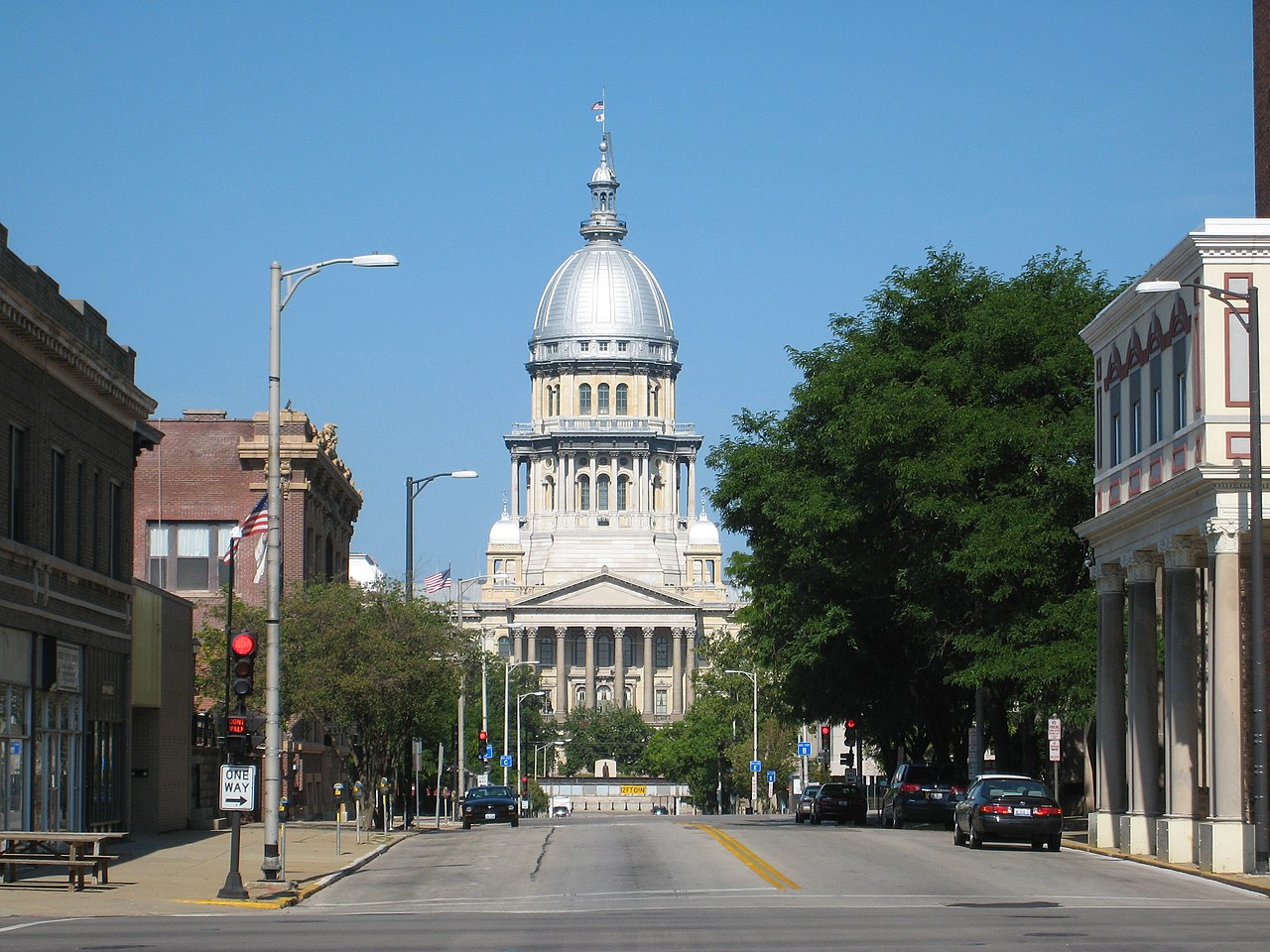
Springfield
Springfield es la capital del estado de Illinois y del condado de Sangamon, Estados Unidos.
Government administration · United States · 0 followers
Overview
Springfield es la capital del estado de Illinois y del condado de Sangamon, Estados Unidos. La ciudad fue fundada en 1819 y pasó a ser centro administrativo en 1823, convirtiéndose en la capital de Illinois en 1837 y recibiendo su fuero en 1840. La asamblea legislativa se convocó allí por primera vez en 1839. Según el censo del año 2020, la ciudad tenía 114.394 habitantes.
Interested in working with us in the future?
Follow to see new jobs and posts in your feed.
No news yet.
About

Springfield es la capital del estado de Illinois y del condado de Sangamon, Estados Unidos. La ciudad fue fundada en 1819 y pasó a ser centro administrativo en 1823, convirtiéndose en la capital de Illinois en 1837 y recibiendo su fuero en 1840. La asamblea legislativa se convocó allí por primera vez en 1839. Según el censo del año 2020, la ciudad tenía 114.394 habitantes.
Kaynak: Wikipedia · CC BY-SA 4.0
Geografía

La ciudad está ubicada en las coordenadas 39°47′00″N 89°39′01″O y se encuentra a 178 m sobre el nivel del mar.
Topografía
Según la Oficina del Censo de los Estados Unidos, la ciudad ocupa un área total de 156,2 km2, de los cuales 139,9 km2 son terrestres y 16,3 km2 (10,46 %) son cuerpos de agua. Ubicada en la cuenca inferior del río Illinois, la ciudad se asienta en una extensa área conocida como la Llanura Till. Tanto el Condado de Sangamon como la ciudad de Springfield se encuentran en la Llanura de Springfield, una subdivisión específica de la Llanura Till. Esta llanura es el resultado de la acción glaciar, denominada "glaciación illinoisiana", que dejó una marcada impronta en las regiones de Illinois.
Clima
Springfield experimenta un clima típico de latitud media. Es común que los veranos sean cálidos y los inviernos fríos. Illinois también experimenta un gran número de tornados. Durante la primavera y el verano el clima puede volverse peligroso debido a la amenaza de tornados, habiendo sido testigo de al menos dos en su historia. Para el período 1991-2020, la ciudad de Springfield tuvo un promedio de 966 mm de precipitaciones anuales. Durante aquel mismo período la temperatura media anual fue de 12,2 °C, con máximas en el verano de 30,4 °C en julio y mínimas durante el invierno de -6,7 °C en enero.
Paisaje urbano
La ciudad tiene al menos once divisiones, designadas vecindarios: Eastside, Enos Park, Hawthorne Place, Historic West Side, Lincoln Park, Near South, Oak Ridge, Shalom, Springfield Lakeshore, Twin Lakes y Vinegar Hill.
Economía
Muchos de los empleos del centro de la ciudad tienen relación con labores del gobierno con sede en Springfield. Desde 2002, el Estado de Illinois es el mayor empleador, tanto de la ciudad, como del condado, dando trabajo a 17 000 personas a través del Condado de Sangamon. Desde febrero de 2007, empleos del gobierno, incluyendo los locales, estatales y del condado, representan aproximadamente 30 000 de los empleos no agrícolas de la ciudad. El comercio, el transporte, y las industrias de asistencia médica proveen cada uno entre 17 000 y 18 000 empleos a la ciudad. El mayor empleador del sector privado en 2002 era Memorial Health Systems, con 3 400 personas trabajando para aquella empresa. Según estimaciones de la «Calculadora del Salario Mínimo vital», mantenida por la Universidad Estatal de Pensilvania, el mínimo vital para la ciudad de Springfield es de 6,50 dólares por hora para un adulto. Siendo aproximadamente 13 100 dólares trabajando 2080 horas anuales. Para una familia de cuatro personas, los gastos aumentan y el mínimo vital llega a 19,49 dólares por hora dentro de la ciudad. Según la Oficina de Estadística De trabajo (BLS) del Departamento de Trabajo de los Estados Unidos (DOL), la mano de obra local cayó de 116 500 en septiembre de 2006 a 113 400 en febrero de 2007. Además, la tasa de desempleo se elevó durante el mismo período del 3,8 % al 5,1 %.
La feria estatal de Illinois se celebra en Illinois State Fairgrounds desde 1894. El predio posee un óvalo para carreras de automovilismo y motociclismo desde 1910 y ha albergado carreras del Campeonato Nacional de la AAA y el Campeonato Nacional del USAC.
Infraestructura
Sistema de salud
Existen dos hospitales en Springfield: el Springfield Memorial Medical Center y el St. John's Hospital. Este último es sede del Prairie Heart Institute, que realiza más procedimientos cardiovasculares que cualquier otro hospital en Illinois.
Servicios públicos
El propietario del Lago Springfield, City Water y Light and Power, provee de electricidad a la ciudad de Springfield y a las localidades aledañas, suministrando además agua potable a todo el sector ya abastecido de electricidad. El gas natural es suministrado por AmerenCILCO, dependiente de la Central Illinois Light Company (CILCO).
Transporte
La Interestatal 55 corre de norte a sur pasando por Springfield, mientras la Interestatal 72 (también conocida como US 36) lo hace de este a oeste. En Springfield opera el servicio de trenes de pasajeros Amtrak, que funciona entre Chicago y Saint Louis y se detiene en la Unión Station de la ciudad. Las necesidades de transporte local de pasajeros son atendidas por un servicio de autobuses. El Distrito de Tránsito de Población de Springfield (Springfield Mass Transit District, SMTD) opera el sistema de autobuses de Springfield. Asimismo, por la ciudad también pasa la histórica Ruta 66.
El Abraham Lincoln Airport Capital es el aeropuerto de la ciudad y provee de rutas hacia Chicago y St. Louis.
Kardeş şehirler
Springfield'in resmen 5 tane kardeş şehri vardır:
History

Pre-Civil War
Settlers originally named this community "Calhoun", after Senator John C. Calhoun of South Carolina, expressing their cultural ties. The land that Springfield now occupies was visited first by trappers and fur traders who came to the Sangamon River in 1818.
The first cabin was built in 1820 by John Kelly, after he discovered that the area was plentiful with deer and other wild game. He built his cabin on a hill, overlooking a creek known eventually as the Town Branch. A stone marker on the north side of Jefferson street, halfway between 1st and College streets, marks the location of this original dwelling. A second stone marker at the northwest corner of 2nd St. and Jefferson St., often mistaken for the original home site, marks instead the location of the first county courthouse, which was later built on Kelly's property. In 1821, Calhoun was designated as the county seat of Sangamon County due to its location, fertile soil, and trading opportunities.
Settlers from Kentucky, Virginia, and North Carolina came to the developing settlement. By 1832, Senator Calhoun had fallen out of the favor with the public, and the town renamed itself as Springfield. According to local history, the name was suggested by the wife of John Kelly, after Spring Creek, which ran through the area known as "Kelly's Field".
Kaskaskia was the first capital of the Illinois Territory from its organization in 1809, continuing through statehood in 1818, and through the first year as a state in 1819. Vandalia was the second state capital of Illinois, from 1819 to 1839. In 1839, Springfield was designated as the third capital. The designation was largely due to the efforts of Abraham Lincoln and his associates, who were nicknamed the "Long Nine" for their combined height of 54 feet (16 m).
The Potawatomi Trail of Death passed through Springfield in 1838. The Native Americans were forced west to Indian Territory by the government's Indian Removal policy.
Geography

Located within the central section of Illinois, Springfield is 80 miles (130 km) northeast of St. Louis. The Champaign/Urbana area is to the east, Peoria is to the north, and Bloomington–Normal is to the northeast. Decatur is 40 miles (64 km) due east. Chicago is 200 miles to the northeast.
Topography
The city is at an elevation of 558 feet (170 m) above sea level. According to the 2010 census, Springfield has a total area of 65.764 square miles (170.33 km2), of which 59.48 square miles (154.05 km2) (or 90.44%) is land and 6.284 square miles (16.28 km2) (or 9.56%) is water. The city is located in the Lower Illinois River Basin, in a large area known as Till Plain. Sangamon County, and the city of Springfield, are in the Springfield Plain subsection of Till Plain. The Plain is underlain by glacial till that was deposited by a large continental ice sheet that repeatedly covered the area during the Illinoian Stage.
The majority of the Lower Illinois River Basin is flat, with relief extending no more than 20 feet (6.1 m) in most areas, including the Springfield subsection of the plain. The differences in topography are based on the age of drift. The Springfield and Galesburg Plain subsections represent the oldest drift, Illinoian, while Wisconsinian drift resulted in end moraines on the Bloomington Ridged Plain subsection of Till Plain.
Lake Springfield is a 4,200-acre (1,700 ha) human-made reservoir owned by City Water, Light & Power, the largest municipally owned utility in Illinois. It was built and filled in 1935 by damming Lick Creek, a tributary of the Sangamon River which flows past Springfield's northern outskirts. The lake is used primarily as a source for drinking water for the city of Springfield, also providing cooling water for the condensers at the power plant on the lake. It attracts approximately 600,000 visitors annually, and its 57 miles (92 km) of shoreline is home to over 700 lakeside residences and eight public parks.
Demographics

2020 census
At the 2010 Census, 75.8% of the population was White, 18.5% Black or African American, 0.2% American Indian and Alaska Native, 2.2% Asian, and 2.6% of two or more races. 2.0% of Springfield's population was of Hispanic or Latino origin (they may be of any race). Non-Hispanic Whites were 74.7% of the population in 2010, down from 87.6% in 1980.
As of the census of 2000, there were 111,454 people, 48,621 households, and 27,957 families residing in the city. The population density was 2,063.9 people per square mile (796.9 people/km2). There were 53,733 housing units at an average density of 995.0 per square mile (384.2/km2). The racial makeup of the city was 81.0% White, 15.3% African American, 0.2% Native American, 1.5% Asian, 0.1% Pacific Islander, 0.5% from other races, and 1.5% from two or more races. Hispanic or Latino of any race were 1.2% of the population.
There were 48,621 households, out of which 27.5% had children under the age of 18 living with them, 41.1% were married couples living together, 12.9% had a female householder with no husband present, and 42.5% were non-families. 36.1% of all households were made up of individuals, and 11.7% had someone living alone who was 65 years of age or older. The average household size was 2.24 and the average family size was 2.94.
In the city, the population was spread out, with 28.0% under the age of 18, 8.8% from 18 to 24, 29.8% from 25 to 44, 23.0% from 45 to 64, and 14.4% who were 65 years of age or older. The median age was 37 years. For every 100 females, there were 88.6 males. For every 100 females age 18 and over, there were 86.6 males.
The median income for a household in the city was $39,388, and the median income for a family was $51,298. Families with children had a higher income of about $69,437. Males had a median income of $36,864 versus $28,867 for females. The per capita income for the city was $23,324. About 8.4% of families and 11.7% of the population were below the poverty line, including 17.3% of those under age 18 and 7.7% of those age 65 or over.
Economy

Many of the jobs in the city center around state government, which is headquartered in Springfield. As of 2002, the State of Illinois is both the city's and county's largest employer, employing 17,000 people across Sangamon County. As of February 2007, government jobs, including local, state, and county, account for about 30,000 of the city's non-agricultural jobs. Trade, transportation and utilities, and the health care industries each provide between 17,000 and 18,000 jobs to the city. The largest private sector employer in 2002 was Memorial Health System with 3,400 people working for the organization. According to estimates from the "Living Wage Calculator" the living wage for the city of Springfield is $7.89 per hour for one adult, approximately $15,780 working 2,000 hours per year. For a family of four, costs are increased and the living wage is $17.78 per hour within the city. According to the United States Department of Labor's Bureau of Labor Statistics (BLS), the Civilian Labor force dropped from 116,500 in September 2006 to 113,400 in February 2007. In addition, the unemployment rate rose during the same time period from 3.8% to 5.1%.
Largest employers
According to the city's 2025 Annual Comprehensive Financial Report, the largest employers in the city are:
Arts and culture

Springfield has been home to a wide array of individuals who, in one way or another, contributed to the broader American culture. Wandering poet Vachel Lindsay, most famous for his poem "The Congo" and a booklet called "Rhymes to be Traded for Bread", was born in Springfield in 1879.
At least two notable people affiliated with American business and industry have called the Illinois state capital home at one time or another. Both John L. Lewis, a labor activist, and Marjorie Merriweather Post, the founder of the General Foods Corporation, lived in the city; Post in particular was a native of Springfield. In addition, astronomer Seth Barnes Nicholson was born in Springfield in 1891.
A Madeiran Portuguese community resided in the vicinity of the Carpenter Street Underpass, one of the earliest and largest Portuguese settlements in the Midwest. The Portuguese immigrants that originated the community left Madeira because they experienced social ostracization due to being Protestants in their largely Catholic homeland, having been converted to Protestantism by a Scottish reverend named Robert Reid Kalley, who visited Madeira in 1838. These Protestant Madeiran exiles relocated to the Caribbean island of Trinidad before settling permanently in Springfield in 1849. By the early twentieth century, these immigrants resided in the western extension of a neighborhood known as the "Badlands". The Badlands was included in the widespread destruction and violence of the Springfield Race Riot in August 1908, an event that led to the formation of the National Association for the Advancement of Colored People (NAACP). The Carpenter Street archaeological site possesses local and national significance for its potential to contribute to an understanding of the lifestyles of multiple ethnic/racial groups in Springfield during the nineteenth and early twentieth centuries.
Sports
Historically, Springfield has been home to a number of minor league baseball franchises, the latest club, the college-prep Springfield Sliders, arriving in the city in 2008. In the 1948 baseball season, Springfield was also home to an All-American Girls Professional Baseball League team, the Springfield Sallies, but the team's lackluster performance led them to be folded in with the Chicago Colleens as rookie development teams the following year.
The city was the home of the Springfield Stallions, an indoor football team who played at the Prairie Capital Convention Center in 2007. Today, the city is host to the Springfield Jr. Blues, a North American Hockey League team that plays at the Nelson Recreation Center. The city is also a host to several Semi Pro Football Teams. The oldest organization is the Capital City Outlaws, which was established in 1992. The Outlaws which played 11 man football, most recently in The Midwest Football League until 2004, switched to an 8-man Semi Pro Football League (8FL) in 2004. The Sangamon County Seminoles became an expansion team in the 8FL in 2008. A newly formed team in 2010, the Springfield Foxes, play in the Mid States Football League (MSFL) (11 man). The Foxes were league runners-up in the MSFL League Championship in 2012.
The city has produced several notable professional sports talents. Current and former Major League Baseball players Kevin Seitzer, Jeff Fassero, Ryan O'Malley, Jason and Justin Knoedler, and Hall of Famer Robin Roberts were all born in Springfield. Springfield's largest baseball field, Robin Roberts Stadium at Lanphier Park, takes its full name in honor of Roberts and his athletic achievements. Former MLB player Dick "Ducky" Schofield is currently an elected official in Springfield, and his son Dick also played in the Major Leagues, as does Ducky's grandson, Jayson Werth. Ducky, Dick, and Jayson were all born in Springfield. Ducky's daughter (and Jayson's mother) Kim Schofield Werth, also from Springfield, is a track star who competed in the U.S. Olympic Trials. National Basketball Association players Dave Robisch, Kevin Gamble, and Andre Iguodala are all from the city. Long-time NFL announcer (NBC) and former Cincinnati Bengal Pro Bowl tight end Bob Trumpy is a city native, having graduated from Springfield High School. Former NFL wide receiver Otto Stowe was a 1967 graduate of the now-defunct Feitshans High School. A UFC fighter, Matt Mitrione, attended and played football for Sacred Heart Griffin. He also played in the NFL as an undrafted free agent.
Government

Springfield city government is structured under the mayor-council form of government. It is the strong mayor variation of that type of municipal government, the mayor holds executive authority, including veto power, in Springfield. The executive branch also consists of 17 non-elected city "offices". Ranging from the police department to the Office of Public Works, each office can be altered through city ordinance.
Elected officials in the city (mayor, aldermen, city clerk, and treasurer) serve four-year terms. The elections are not staggered. The council members are elected from ten districts throughout the city while the mayor, city clerk and city treasurer are elected on an at-large basis. The council, as a body, consists of the ten aldermen and the mayor, though the mayor is generally a non-voting member who only participates in the discussion. There are a few instances where the mayor does vote on ordinances or resolutions: if there is a tie vote, if more than half of the aldermen support the motion, whether there is a tie or not, and where a vote greater than the majority is required by the municipal code.
Members
City elections are technically non partisan, however most candidates are affiliated with a political party. As such, party affiliation is a matter of self identification.
State government
As the state capital, Springfield is home to the three branches of Illinois government. Much like the United States federal government, Illinois government has an executive branch, occupied by the state governor, a legislative branch, which consists of the state senate and house, and a judicial branch, which is topped by the Illinois Supreme Court. The Illinois legislative branch is collectively known as the Illinois General Assembly. Many state bureaucrats work in offices in Springfield, and it is the regular meeting place of the Illinois General Assembly. All persons elected on a statewide basis are required to have at least one residence in Springfield, and the state government funds these residences.
Education

Springfield is currently home to six public and private high schools.
The majority of Springfield is within the District No. 186. District 186 operates 24 elementary schools and an early learning center, (pre-K). District 186 operates three high schools, Lanphier High School, Springfield High School and Springfield Southeast High School, which replaced Feitshans High School in 1967, and five middle schools. Some portions of Springfield are in the Ball-Chatham Community Unit School District 5, the Community Unit School District 16, the Pleasant Plains Community Unit School District 8 the Rochester Community Unit School District 3A, the Riverton Community Unit School District 14 and the Williamsville Community Unit School District 15. By 2019, increasing numbers of residents were moving to school districts on the outskirts instead of D186.
Springfield's Sacred Heart-Griffin High School is a city Catholic high school. Other area high schools include Calvary Academy and Lutheran High School. Ursuline Academy was a second Catholic high school founded in 1857, first as an all-girls school, and converted to co-ed in 1981. The school was closed in 2007.
Springfield hosts one University. The University of Illinois Springfield (UIS, formerly Sangamon State University), which is located on the southeast side of the city.
Springfield is also home to a junior college Lincoln Land Community College, located just south of UIS. From 1875 to 1976, Springfield was also home to Concordia Theological Seminary. The seminary was moved back to its original home of Fort Wayne, Indiana, and the campus now serves as the Illinois Department of Corrections Academy.
The city is home to the Springfield campus of the Southern Illinois University School of Medicine, which includes Simmons Cancer Institute in Springfield's Medical District.
Media
The State Journal-Register is the primary daily newspaper for Springfield, and its surrounding area. The newspaper was founded in 1831 as the Sangamon Journal, and claims to be "the oldest newspaper in Illinois". The local alternative weekly is the Illinois Times.
Television stations
Springfield is part of the Springfield-Decatur-Champaign TV market. Four TV stations broadcast from the Springfield area: WCIX MYTV 49, WICS ABC 20, WRSP FOX 55, and WSEC PBS 14. Both WICS and WRSP are currently owned by the same parent company Sinclair Broadcast Group. Springfield is also served by two stations in Decatur, WAND NBC 17 and WBUI CW 23, and two stations in Champaign, WCIA CBS 3 and WILL PBS 12. One television station that has since ceased to exist was WJJY-TV, which operated in the Springfield area for three years (1969–1971).
Radio stations
The following radio stations broadcast in the Springfield area:
Infrastructure

Health systems
There are two Springfield hospitals, Memorial Medical Center and St. John's Hospital. A third hospital, originally Springfield Community Hospital, and later renamed Doctor's Hospital operated on Springfield's south side until 2003. Kindred Healthcare opened a long term acute care hospital in Springfield in 2010, however, the facility was purchased by Vibra Healthcare in 2013, and was operated by Vibra under the name Vibra Hospital of Springfield until it closed in 2019.
St. John's Hospital is home to the Prairie Heart Institute, which performs more cardiovascular procedures than any other hospital in Illinois. The dominant health care providers in the area are SIU HealthCare and Springfield Clinic. The major medical education center in the area is the Southern Illinois University School of Medicine. The major regional cancer center is the SIU Simmons Cancer Institute.
Public utilities
The owner of Lake Springfield – City Water, Light & Power – supplies electric power generated from the Dallman Power Plants to the city of Springfield and eight surrounding communities. The company also provides these cities and towns with water from the lake. In 2005, ground was broken for a third municipally owned power plant, which came online in 2009. Natural gas is provided via Ameren Illinois, formerly Central Illinois Light Company (CILCO).
Transportation
Interstate 55 runs from north to south past Springfield, while I-72, which is concurrent with U.S. Route 36 from the Missouri state line to Decatur, runs from east to west.
Amtrak serves Springfield daily with its Lincoln Service and Texas Eagle routes. Service consists of four Lincoln Service round-trips between Chicago and St. Louis, and one Texas Eagle round-trip between San Antonio and Chicago. Three days a week, the Eagle continues on to Los Angeles. Springfield is served by the following freight railroads: Canadian National, Illinois and Midland Railroad, Kansas City Southern, Norfolk Southern and Union Pacific. Springfield is also served by Greyhound buses at a station on North Dirksen Parkway.
Sister cities
Springfield, Illinois has two sister cities, as designated by Sister Cities International:
It maintains a "Friendship" city designation with Killarney, Ireland.
Places of interest
Springfield is known for several popular food items: the corn dog is claimed to have been invented in the city under the name "Cozy Dog", although there is some debate to the origin of the snack. The horseshoe sandwich, not well known outside of central Illinois, also originated in Springfield. Springfield was once the site of the Reisch Beer brewery, which operated for 117 years under the same name and family from 1849 to 1966.
The Maid-Rite Sandwich Shop in Springfield still operates what it claims as the first U.S. drive-thru window. The city is also known for its chili ― or "chilli", as it is spelled in many chili shops throughout Sangamon County. The unique spelling is said to have begun with the founder of the Dew Chilli Parlor in 1909, due to a spelling error in its sign. Another interpretation is that the misspelling represented the "Ill" in the word Illinois. In 1993, the Illinois state legislature adopted a resolution proclaiming Springfield the "Chilli Capital of the Civilized World".
Springfield is dotted with sites associated with U.S. President Abraham Lincoln, who started his political career there. These include the Lincoln Home National Historic Site, a National Historical Park that includes the preserved surrounding neighborhood; the Lincoln-Herndon Law Offices State Historic Site, the Lincoln Tomb State Historic Site, the Old State Capitol State Historic Site, the Lincoln Depot, from which Abraham Lincoln departed Springfield to be inaugurated in Washington, D.C.; the Elijah Iles House, Edwards Place and the Abraham Lincoln Presidential Library and Museum. The church that the Lincoln family belonged to, First Presbyterian Church, still has the original Lincoln family pew on display in its narthex. Near the village of Petersburg, is New Salem State Park, a restored hamlet of log cabins. This is a reconstruction of the town where Lincoln lived as a young man. With the opening of the Presidential Library and Museum in 2004, the city has attracted numerous prominent visitors, including Presidents George W. Bush and Barack Obama, the actor Liam Neeson, and the Emir of Qatar.