

Sugar Land
Sugar Land es una ciudad ubicada en el condado de Fort Bend en el estado estadounidense de Texas.
Government administration · United States · 0 followers
Overview
Sugar Land es una ciudad ubicada en el condado de Fort Bend en el estado estadounidense de Texas. En el censo de 2010 tenía una población de 78.817 habitantes y una densidad poblacional de 894,57 personas por km².
Interested in working with us in the future?
Follow to see new jobs and posts in your feed.
No news yet.
About

Sugar Land es una ciudad ubicada en el condado de Fort Bend en el estado estadounidense de Texas. En el censo de 2010 tenía una población de 78.817 habitantes y una densidad poblacional de 894,57 personas por km².
Kaynak: Wikipedia · CC BY-SA 4.0
Historia
Población nativa
Las tribus karankawa y atakapa estaban situadas en lo que es actualmente Sugar Land.
Fundación de Sugar Land
Sugar Land tiene un patrimonio regresando a la concesión de tierra mexicana original a Stephen F. Austin. Uno de los primeros pobladores de la tierra, Samuel M. Williams, la llamó "Plantación de Oakland" porque había muchas variedades diferentes de robles en la tierra, como el quercus phellos, el roble para postes, el roble del agua, el quercus falcata, y el quercus virginiana. El hermano de Williams, Nathaniel, compró la tierra en 1838. Ellos operaron la plantación haciendo crecer algodón, maíz, y caña de azúcar. Durante estos primeros años, el área que actualmente es Sugar Land era el centro de la vida social a lo largo del Río Brazos. En 1853, Benjamin Terry y William J. Kyle le compraron la Plantación de Oakland a la familia de S. M. Williams. Terry es conocido por haber organizado a los Rangers de Texas de Terry durante la Guerra Civil y por haber nombrado a la ciudad. Luego de la muerte de Terry y Kyle, el coronel E. H. Cunningham compró la plantación de 51 kilómetros cuadrados poco después de la Guerra Civil y desarrolló la ciudad alrededor de su planta de refinería de azúcar alrededor del año 1879.
Pueblo de compañía
En 1906, la familia Kempner de Galveston, bajo el liderazgo de Isaac H. Kempner y en partneriado con William T. Eldridge, compró la Plantación de Ellis de 21 kilómetros cuadrados, una de las pocas plantaciones en el condado de Fort Bend que sobrevivió a la Guerra Civil. La Plantación de Ellis originalmente había sido parte de la liga de Jesse Cartwright y en los años posteriores a la Guerra Civil había operado por un sistema de agricultura arrendada bajo la dirección de Will Ellis. En 1908, el partneriado adquirió los 51 kilómetros cuadrados contiguos de la Plantación de Cunningham con su fábrica de azúcar y refinería de caña de azúcar. El partneriado cambió su nombre a Imperial Sugar Company; Kempner asoció el nombre Imperial, el cual era también el nombre de una pequeña fábrica de azúcar en la Plantación de Ellis, con el Hotel Imperial de Nueva York. A fines de siglo, la mayoría de los cultivos de caña de azúcar fueron destruidos por un duro invierno. Como parte del acuerdo Kempner-Eldridge, Eldridge se mudó al lugar para servir como director general y construir el Pueblo manejado por la compañía de Sugar Land.
Geografía y clima
Geografía
Sugar Land está situada en el noreste del Condado de Fort Bend, 40 kilómetros al sudoeste de Houston. Sugar Land se encuentra ubicada en las coordenadas 29°35′49″N 95°37′46″O. Según la Oficina del Censo de los Estados Unidos, Sugar Land tiene una superficie total de 88.11 km², de la cual 83.86 km² corresponden a tierra firme y (4.82%) 4.24 km² es agua.
La elevación de la mayor parte de la ciudad está entre 21 y 27 metros. La elevación del Aeropuerto Región de Sugar Land es de 25 metros.
Sugar Land tiene dos vías acuáticas importantes a través de la ciudad. El Río Brazos corre a través de las porciones sudoeste y sur de la ciudad y luego hacia el Condado de Brazoria. La Ensenada Oyster corre desde la porción noroeste hasta la oriental de la ciudad y dentro de la Missouri City.
Sugar Land tiene muchos lagos naturales y hechos por el hombre conectando a la Ensenada Oyster y uno conectando al Río Brazos. Los lagos restantes en Sugar Land son hechos por el hombre a través del desarrollo de muchas comunidades planeadas.
Geología
Apuntalando la superficie de la tierra del área hay arcillas no consolidadas, pizarras de arcilla, y arenas pobremente cementadas extendiéndose a la profundidad de varias millas. La geología de la región se desarrolló desde los depósitos de caudales hasta la erosión de las Montañas Rocosas. Estos sedimentos consisten en una serie de arcillas y arenas depositadas en materias orgánicas descompuestas que, con el tiempo, fueron transformadas en petróleo y gas natural. Debajo hay una capa de halita depositada en agua, una sal de roca. Las capas porosas fueron comprimidas por el tiempo y forzadas hacia arriba. Cuando fueron presionadas hacia arriba, la sal dragó los sedimentos circundantes en formas de bóveda, a menudo atrapando petróleo y gas desde las arenas porosas circundantes.
Economía

Sugar Land alberga su economía a través de la diversificación, vitalidad corporativa, y calidad de vida y fue posicionada como una de las "Principales Ciudades en Texas" para el reacomodo y la expansión de los negocios por la Outlook Magazine y la Texas Business. Las industrias que tiene a Sugar Land como sede son tan diversas como su población residente. Yendo desde semiconductores hasta equipamiento de datos sísmicos, la industria de Sugar Land ha crecido dramáticamente en los últimos 10 años. La ciudad ha atraído numerosos reacomodos corporativos de empresas importantes internacionales y regionales en una gran variedad de industrias incluyendo la ingeniería, la construcción, los servicios técnicos, la exploración y producción de energía, la tecnología e investigación, la electrónica y las comunicaciones.
Aunque todavía es conocido como un suburbio residencial de Houston de "nuevo dinero", Sugar Land tiene una significativa presencia de corporaciones. Como el resto del área de Gran Houston, muchas de las grandes corporaciones están involucradas en la industria de la energía, específicamente la exploración y el refinamiento de petróleo/gas. La ciudad tiene un gran número de empresas internacionales de energía, software y productos. En Sugar Land se encuentran las sedes de Nalco/Exxon y Western Airways. Las empresas de ingeniería y otras industrias relacionadas se las han ingeniado para tomar el lugar como motores económicos. Como impulsos a su crecimiento económico en los años recientes, Sugar Land ha visto la llegada de su primer centro comercial, una distribuidora de Mercedes-Benz, y un Hotel Marriott, los cuales están todos situados cerca de uno de los principales distritos comerciales del Condado de Fort Bend, conocido como la Sugar Land Town Square.
Sugar Land Town Square es un centro orientado a los peatones en la calle principal y un distrito financiero que está a poca distancia de tiendas, servicios, edificios de oficina, restaurantes de cadena, cafeterías, entretenimientos y un Marriott International y un centro de conferencias.
Ley y gobierno

Sugar Land opera bajo una forma de gobierno de concejo municipal. Bajo este sistema, el concejo designa al gerente de la ciudad, quien obra como jefe ejecutivo del gobierno. El gerente de la ciudad lleva a cabo la política y administra los programas de la ciudad. Todos los jefes de departamento, incluyendo el abogado de la ciudad, el jefe de policía y el jefe de bomberos son, a fin de cuentas, responsables al gerente de la ciudad. La composición del concejo municipal de Sugar Land consiste de un alcalde, cuatro miembros del concejo a ser elegidos por un único miembro de los distritos y dos miembros del concejo por una posición general. Todas las posiciones de concejo municipal son sin afiliación oficial.
Política
Sugar Land es vista como una de las áreas más predominantemente republicanas de la nación, y también es vista como una gran fortaleza republicana en la política local y federal. Por ejemplo, el voto presidencial en Sugar Land ha ido consistentemente hacia el candidato republicano en las últimas elecciones, y mientras el concejo municipal de Sugar Land es oficialmente no partidario, todos sus actuales ocupantes de cargos políticos son republicanos endorsados.
Representación estatal
Sugar Land es representada en la Legislatura de Texas por el representante estatal Charlie Howard y el senador estatal Kyle Janek, ambos republicanos. Howard, quien reside en Sugar Land y representa 26vo Distrito de la Casa de Representantes de Texas, derrotó a su contrincante demócrata con casi el 70% de los votos en el 2000 y desde ese momento no ha enfrentado a otro candidato demócrata. Cuando el cargo fue ganado por Tom DeLay, Janek, cuyo distrito no sólo incluye Sugar Land sino también otras áreas prominentes con mayorías republicanas de Gran Houston como Katy y otras áreas afluentes de Houston incluyendo West University Place, lugar de residencia de Janek, fue reelegido en 2006 sin un oponente demócrata.
Demografía
Según el censo de 2010, había 78 817 personas residiendo en Sugar Land. La densidad de población era de 894,57 hab./km². De los 78817 habitantes, Sugar Land estaba compuesto por el 51,96% blancos, el 7,43% eran afroamericanos, el 0,22% eran amerindios, el 35,27% eran asiáticos, el 0,04% eran isleños del Pacífico, el 2,26% eran de otras razas y el 2,83% pertenecían a dos o más razas. Del total de la población el 10,56% eran hispanos o latinos de cualquier raza.
Gente y cultura
Sugar Land tiene una gran fuerza de trabajo de collar blanco, con educación universitaria empleada en la industria energética de Houston. Sugar Land también es conocida por su afluente población minoritaria, ya que también es un lugar de residencia popular en Houston de la cada vez más influyente comunidad asiático estadounidense.
En 2004, la ciudad fue nombrada uno de los mejores 100 lugares para vivir según HomeRoute, una compañía nacional de mercadotecnia inmobiliaria, la cual identifica cada año las mejores ciudades estadounidense para su programa Relocate-America. Las ciudades son seleccionadas teniendo en cuenta las oportunidades educacionales, las tasas de delitos y el empleo. La revista comenzó con estadísticas de 271 ciudades estadounidenses provistas por la OnBoard LLC, una compañía de información inmobiliaria. Estas ciudades tienen los ingresos promedio más elevados de la nación y por encima del crecimiento promedio de la población.
Sugar Land fue premiada con el título de la "Ciudad Más Apta de Texas" para el rango de población de 50.000-100.000 en 2004, 2005 (empatando con Round Rock y en 2006. El programa de la "Ciudad Más Apta de Texas" es parte del programa Texas Roundup.
Gente famosa
Las celebridades que viven en Sugar Land incluyen al exjugador de los Carolina Panthers David Carr, Ryan West, el exjugador de los Houston Astros Terry Puhl así como también Kelly Rowland de las Destiny's Child. El árbitro de la NFL y Supervisor de Oficiales de la Conferencia de los 12 Grandes Walt Anderson vive en Sugar Land. Otras celebridades tienen casas en algunas áreas de la ciudad, notablemente en la comunidad planeada de First Colony, como los baquetbolistas Tracy McGrady, Hakeem Olajuwon, Shaquille O'Neal, el jugador de los Houston Texas Ahman Green, y el jugador de los Houston Astros Carlos Lee.
Atracciones locales
Sugar Land Town Square es el corazón del entretenimiento del distrito en Sugar Land y el Condado de Fort Bend. Tiene una serie de restaurantes, cafeterías, centros comerciales, un Hotel Marriott y un centro de conferencias, casas y oficinas de mediana altura, una plaza pública, y el Salón de la Ciudad de Sugar Land. Los festivales y eventos importantes toman lugar en la plaza. Justo afuera del Sugar Land Town Square se encuentra el First Colony Mall. La plaza del pueblo es un símbolo irónico del reciente surgimiento en los suburbios creando falsas áreas céntricas patrocinadas por empresas. En el caso de Sugar Land, el verdadero pueblo ha sido ignorado deconstruido por varios de los recientes cambios en las subdivisiones planeadas.
El nuevo salón de la ciudad y la plaza pública, un punto principal del Sugar Land Town Square, recibió el premio de "Mejor Impacto en la Comunidad" del Houston Business Journal en la quinta ceremonia anual de los Premios Landmark.
En Sugar Land tienen sus campos de entrenamiento los Houston Aeros y los Houston Comets. Situado justo fuera del Sugar Land Town Square se encuentra el Centro de Deportes y Superficie de Hielo de Sugar Land (anteriormente el Aeródromo de Sugar Land), donde entrenan los Houston Aeros. También está abierto al público como un complejo de patinaje sobre hielo.
Al lado está el First Colony Mall, un centro comercial muy grande que recientemente se expandió de su tradicional diseño bajo techo para incluir actividades exteriores y varios garajes de estacionamiento. Dentro y fuera, bordeando el centro comercial, música tranquila y feliz es tocada. El centro comercial es afirmado por Dillard's, Macy's, J. C. Penney, y Barnes & Noble, junto con 130 tiendas, incluyendo Pottery Barn, Coach, Williams-Sonoma, Ann Taylor, Forever 21, Chico, y Talbots. Otras tiendas importantes situadas cerca del centro comercial en varias áreas del Centro del Pueblo incluyen a Target, Best Buy, Circuit City, Toys "R" Us, Linens 'n Things, Finger Furniture, PetSmart, Kroger, Garden Ridge, Lowe's, Lane Home Furnishings, y DSW, así como también una premiada distribuidora de Mercedes-Benz.
Distritos y comunidades
Sugar Land es casa de muchas comunidades planeadas que contienen canchas de golf, clubes de campo, y lagos. La ciudad tiene la mayoría de las comunidades planeadas en el Condado de Fort Bend, el cual alberga el mayor número de comunidades planeadas de la nación. La primera comunidad planeada que fue desarrollada en Sugar Land fue Sugar Creek. Ahora hay trece comunidades planeadas situadas en los límites de la ciudad de Sugar Land y su jurisdicción extraterritorial combinadas.
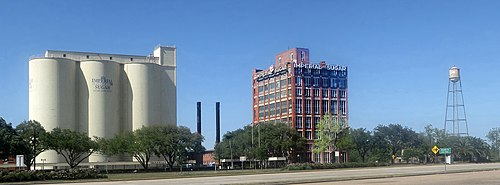
La porción norte de Sugar Land, a veces referida por sus residentes y oficiales del gobierno como "Vieja Sugar Land" está al norte de la Ruta 90 de los Estados Unidos, pero también incluye las subdivisiones/áreas de las Haciendas Venecianas, y Belknap/Brookside, que está al sur de la Ruta 90 de los Estados Unidos. La mayoría de esa área eran los límites de la ciudad originales de Sugar Land cuando fue incorporada en 1959. Situada en ese lado del pueblo están la antigua refinería y el antiguo centro de distribución de la compañía Imperial Sugar que fueron sacados de operación en 2003, pero el Cuartel General sigue estando dentro de la ciudad. Al noreste de Sugar Land está el Parque de Negocios de Sugar Land. Muchas de las compañía de electrónica y energía están situadas acá. El Parque de Negocios de Sugar Land es el área de negocios e industrial más grande de la ciudad.
Las actividades económicas y de entretenimiento más grandes están en las áreas del sur y el sudeste de Sugar Land. La mayoría de lo población dentro de los límites de la ciudad está concentrada aquí. El área está formada completamente por comunidades planeadas e incluye casi la totalidad de First Colony, la más grande en Sugar Land ocupando 40 kilómetros cuadrados. Otras comunidades planeadas en esta área son Sugar Creek, Sugar Lakes, Commonwealth, Avalon, y Riverstone. En esta área se sitúan el First Colony Mall, el Sugar Land Town Square, el nuevo Salón de la Ciudad de Sugar Land, y otras importantes áreas comercial. Esta área se jacta de un amplio rango de actividades de recreación incluyendo tres canchas de golf y clubes de campo. Otro complejo recreativo en el área es el Centro de Deportes y Superficie de Hielo de Sugar Land (antes Aeródromo de Sugar Land), sede del complejo de entrenamiento de los Houston Aeros.
Hitos arquitectónicos
El Auditorio Lakeview, situado en el campus de la Escuela Primaria Lakeview, es el edificio histórico más antiguo que todavía queda en el área. Originalmente uno de los once edificios que componían el campus del antiguo Distrito Escolar Independiente de Sugar Land, el auditorio era un punto focal para una vibrante y creciente comunidad. El imponente auditorio todavía funciona hoy en día y es un Hito Histórico Recordado de Texas, en el 2002.
En 1912, la compañía Imperial Sugar construyó un pequeño edificio en la esquina de la Calle Wood y el Paseo Lakeview (luego conocido como Calle Third) para servir como escuela. El campus original consistía de 11 edificios dispuestos en un semicírculo con el grande y aereado auditorio en el centro. Los edificios estaban conectados por un pasillo cubierto soportados por una grandes columnas blancas. Había una entrada de vehículos para autobuses y automóviles. Todos los edificios estaban finalizados con estuco blanco afuera y tenían ventanas grandes que permitían al aire fresco circular y enfriar los edificios. El auditorio era un puerto de actividades comunitarias.
Transporte
Sugar Land actualmente no tiene un sistema de tránsito masivo. De todos modos, esto puede cambiar ya que ha sido un posible candidato para la expansión del sistema de METRORail de Houston poniendo un planeado tren a lo largo de la Ruta 90 de los Estados Unidos. Dado que muchos de los residentes de Sugar Land trabajan en Houston, creando este tipo de transporte se disminuiría el tránsito en la Autopista 59 de los Estados Unidos, por lo que ha habido un gran apoyo para este proyecto.
Calles importantes
La Ruta 59 de los Estados Unidos, la autopista más importante que va diagonalmente por la ciudad, ha estado bajo un importante proyecto de ampliación para acomodar los pasajeros diarios de Sugar Land. La porción finalizada de la autopista al este de la Autopista 6 de Texas actualmente tiene ocho carriles principales. Actualmente, la ampliación de la Ruta 59 de los Estados Unidos se da solamente al oeste de la Autopista 6 de Texas hacia la Autopista 99 de Texas. También está esperado que se convierta en la Interestatal 69, en algún momento en el futuro.
La Ruta 90 de los Estados Unidos es una importante autopista que pasa a través de Sugar Land de este a oeste y pasa por un área histórica de la ciudad, conocida como "Vieja Sugar Land". La Ruta 90 de los Estados Unidos actualmente está siendo ampliada a una autopista de ocho carriles con una media de 30 pies entre la Autopista 99 de Texas de la Autopista 59 de los Estados Unidos.
La Autopista 6 de Texas es una importante autopista que va de norte a sudeste por Sugar Land y pasa por la comunidad planeada de 40 kilómetros cuadrados de First Colony. La construcción está a punto de comenzar sobre un puente en el Bulevar University y la Autopista 90A de los Estados Unidos desde el Bulevar First Colony al norte de la Autopista 90A de los Estados Unidos. Cuando esté completa, tendrá seis carriles principales y calles de acceso.
Educación

Universidades
La Universidad Junior del Condado de Wharton y la Universidad del Sistema de Houston en Sugar Land están situadas en Sugar Land.
La Universidad del Sistema de Houston en Sugar Land (UHSSL) es un centro de enseñanza multi-institución (MITC) para las cuatro universidades dentro de la Universidad del Sistema de Houston, que abarca la Universidad de Houston, la UH-Clear Lake, la UH-Downtown, la UH-Victoria. Actualmente, los programas y títulos ofrecidos en el centro de enseñanza de Sugar Land son de la UH del Centro y de la UH-Victoria.
La Universidad Junior del Condado de Wharton (WCJC) es una universidad comunitaria abarcativa que ofrece un amplio rango de programas y servicios educacional postsecundarios incluyendo grados de asociados, certificados y cursos de educación continua. La universidad prepara a estudiantes interesados en ser transferidos a instituciones de licenciaturas.
Escuelas públicas
Todos los sistemas de educación pública en Texas son administrados por la Agencia de Educación de Texas (TEA). El Distrito Escolar Independiente de Fort Bend es el distrito escolar que sirve a casi toda la ciudad de Sugar Land. La porción sudoeste de la jurisdicción extraterritorial (ETJ) de Sugar Land y algunas áreas muy pequeñas dentro de los límites de la ciudad de Sugar Land se encuentran en el Distrito Escolar Independiente Consolidado de Lamar. El LCISD sirve a las comunidades planeadas de Greatwood y River Park. Otras comunidades en la ETJ servidas por el Consolidado de Lamar incluyen Canyon Gate en el Brazos y Tara Colony.
La Escuela Secundaria Clements en Sugar Land y la Escuela Secundaria Austin en la parte no incorporada del Condado de Fort Bend (y sirviendo a Sugar Land), ambas del ISD de Fort Bend, han sido reconocidas por la revista Texas Monthly como unas de las mejores 10 escuelas secundarias en el estado de Texas. Además, las escuelas secundarias Clements y Austin y la Escuela Secundaria Elkins en la cercana Missouri City están posicionadas 313ra, 626ta, y 702da, respectivamente, entre las 1000 mejores escuelas de los Estados Unidos según un reporte en el 2005 de Newsweek. Elkins sirve algunas porciones de Sugar Land.
Servicio postal
El Servicio Postal de los Estados Unidos gestiona dos oficinas postales en Sugar Land:
Sugar Land Post Office en 225 Matlage Way, 77478-9998
First Colony Post Office en 3130 Grants Lake Boulevard, 77479-9998
Medios de comunicación
Referencias en películas
Una parte de la película de 1974, The Sugarland Express, toma lugar en Sugar Land. Muchas de las primeras escenas fueron filmadas en la cercana cárcel Beauford H. Jester. Otras escenas de la película fueron filmadas dentro y alrededor de Sugar Land. El título de la película deletrea el nombre de la ciudad incorrectamente, y está entre las primeras películas de Steven Spielberg antes de que se volviera famoso.
En una producción televisiva, The Crooked E: The Unshredded Truth About Enron (2003) (TV), Sugar Land fue mencionada como un área afluente para comprar una casa como lo hizo el personaje principal femenino (Courtney).
Periódicos
El principal periódico que sirve a los residentes de Sugar Land es el Houston Chronicle, el cual es el único periódico importante en la región de Gran Houston. Los jueves, el Houston Chronicle ofrece un suplemento local cubriendo el área de Sugar Land bajo su sección "Fort Bend". Un periódico alternativo, el Houston Press, es también repartido en esta área.
Adicionalmente, los residentes de Sugar Land reciben el cubrimiento de noticias locales por medio de FortBendNow, que cubre noticias locales y sucesos políticos en el área de Sugar Land. Los residentes también son servidos por dos periódicos gratuitos, el Fort Bend Star y el Sugar Land Sun. El Fort Bend Herald and Texas Coaster, un periódico diario cubriendo principalmente el área de Richmond-Rosenberg al oeste de Sugar Land, también cubre noticias de Sugar Land.
Televisión
Sugar Land es servida por el mercado televisivo de Houston, que es el décimo más grande de la nación según Nielsen Media Research.
DT 8.2: PBS-X (programación alternativa de la PBS)
DT 8.3: V-me (televisión pública en idioma castellano)
DT 13.2: Programación original, incluyendo repeticiones del noticiero
DT 32.9: The Tube (videos de música y programación relacionada)
Kaynak: Wikipedia – Sugar Land · CC BY-SA 4.0
History
Sugar Land's founding
Sugar Land has roots in the original Mexican land grant made to Anglo-American Stephen F. Austin. One of the first settlers of the land, Samuel M. Williams, called this area Oakland Plantation. Williams' brother, Nathaniel, purchased the land from Austin in 1838. They developed the plantation by growing cotton, corn, and sugarcane. The neighborhood of First Colony, located in the town, refers to Stephen F. Austin's land grant, for it was one of the first Anglo settlements legally established in Texas.
During these early years, the plantation was the center of social life along the Brazos River. In 1853, Benjamin Terry and William J. Kyle purchased the Oakland Plantation from the Williams family. Terry is known for organizing a division of Texas Rangers during the Civil War and for naming the town.
Upon the deaths of Terry and Kyle, Colonel E. H. Cunningham bought the 12,500-acre (5,100 ha) plantation soon after the Civil War. He had a sugar-refining plant built here, and developed the town around it in 1879, platting the land and attracting settlers during the post-Reconstruction era.
Company town
In 1906, the Kempner family of Galveston, under the leadership of Isaac H. Kempner, and in partnership with Logan J. Copenhaver, purchased the 5,300-acre (2,100 ha) Ellis Plantation, one of the few plantations in Fort Bend County to survive the Civil War. The Ellis Plantation had originally been part of the Jesse Cartwright league; Will Ellis had operated it after the Civil War by a system of tenant farming, made up mostly of African-American families who were previously enslaved on the land.
In 1908, the partnership acquired the adjoining 12,500-acre (5,100 ha) Cunningham Plantation, with its raw-sugar mill and cane-sugar refinery. The partnership changed the name to Imperial Sugar Company; Kempner associated the name "Imperial", which was also the name of a small raw-sugar mill on the Ellis Plantation, with the Imperial Hotel in New York City.
Geography

Sugar Land is located in northeast Fort Bend County, 20 miles (32 km) southwest of downtown Houston. It is bordered by Houston to the northeast, and by Stafford, Missouri City, and Meadows Place to the east. According to the United States Census Bureau, the city of Sugar Land has a total area of 42.9 square miles (111.1 km2), of which 40.5 square miles (104.8 km2) are land and 2.4 square miles (6.3 km2), or 5.7%, are covered by water. The elevation of most of the city is between 70 and 90 feet (21 and 27 m) above sea level. The elevation of Sugar Land Regional Airport (SGR) is 82 feet (25 m).
Sugar Land has two major waterways running through the city. The southwestern and southern portion of the city were developed along the Brazos River, which runs into Brazoria County. Oyster Creek runs from the northwest to the eastern portion of the city limits and into Missouri City. Sugar Land developers have built many artificial lakes connecting to Oyster Creek or the Brazos River, as part of new master-planned communities.
Sugar Land and other surrounding areas are subsiding, and the rate of subsidence is increasing. The area sank about 1 foot between 1943 and 1964, while it sank over 6 feet between 1988 and 2016. Currently, it is estimated that Sugar Land is subsiding at a rate of between 10 and 25 millimeters per year. The subsidence is exacerbated by climate change, increased suburban development, and inadequate replenishment. The subsidence has significant human cost. For example, the historic flooding caused by Hurricane Harvey was worse than it would have otherwise been due to the effect, and houses and buildings in the city are sinking and having their foundations damaged. To manage the rapidly increasing subsidence, the Texas State Legislature created the Fort Bend Subsidence District in 1989. The US Geologic Survey and the US Army Corps of Engineers have performed studies and monitoring of the subsidence.
Demographics

2020 census
As of the 2020 census, Sugar Land had a population of 111,026, 38,100 households, and 31,110 families. The population density was 2,743.6 per square mile (1,059.3/km2), and there were 40,118 housing units at an average density of 991.4 per square mile (382.8/km2). 100.0% of residents lived in urban areas, while 0.0% lived in rural areas. Of the housing units, 5.0% were vacant; the homeowner vacancy rate was 1.8% and the rental vacancy rate was 10.2%.
Of the 38,100 households, 37.5% had children under the age of 18; 68.8% were married couples living together; 10.3% had a male householder with no spouse or partner present, and 18.5% had a female householder with no spouse or partner present. About 16.1% of all households were made up of individuals, and 7.8% had someone living alone who was 65 years of age or older. The average household size was 3.0 and the average family size was 3.4. The percent of those with a bachelor’s degree or higher was estimated to be 46.8% of the population.
23.0% of the population was under the age of 18, 7.9% from 18 to 24, 21.6% from 25 to 44, 29.7% from 45 to 64, and 17.8% who were 65 years of age or older. The median age was 43.2 years. For every 100 females, there were 95.3 males, and for every 100 females age 18 and over, there were 92.7 males.
The racial makeup was 40.7% (45,186) white or European American (38.1% non-Hispanic white), 7.32% (8,122) black or African-American, 0.33% (367) Native American or Alaska Native, 38.58% (42,831) Asian, 0.04% (40) Pacific Islander or Native Hawaiian, 3.14% (3,482) from other races, and 9.91% (10,998) from two or more races. Hispanic or Latino people of any race were 12.1% (13,430) of the population.
The most reported ancestries in 2020 were:
The 2016–2020 5-year American Community Survey estimates show that the median household income was $123,261 (with a margin of error of +/- $5,980). The median family income was $138,436 (+/- $6,912). Males had a median income of $72,404 (+/- $4,690) versus $42,910 (+/- $2,800) for females. The median income for those above 16 years old was $56,192 (+/- $3,664). Approximately, 3.6% of families and 4.4% of the population were below the poverty line, including 4.3% of those under the age of 18 and 5.2% of those ages 65 or over.
Economy
As in the rest of the Greater Houston area, the energy industry presence is large, specifically petroleum exploration and refining. Sugar Land holds the headquarters to Fortune 500 company CVR Energy, Inc. (NYSE: CVI), Western Airways, and NalcoChampion's Energy Services division. CVR Energy was listed as the city's only resident 2012 Fortune 500 company and the Houston Chronicle ranked it the No. 5 public company in the Houston area. Sugar Land also has a large number of international energy, software, engineering, and product firms.
Sugar Land is home to the headquarters of the Imperial Sugar Company. It was once the home of the company's main (and sole) refinery and distribution center. The refinery and distribution center have been closed since 2003.
Schlumberger, an oil services company, moved its Houston-area offices from 5000 Gulf Freeway in Houston to a campus in Sugar Land in 1995. This 33-acre (13 ha) campus is at the northeast corner of U.S. Highway 90A and Gillingham Lane. (The former Gulf Freeway headquarters was repurposed as the University of Houston Energy Research Park after 2009.)
As of 2015, Schlumberger was the second-largest employer in Sugar Land. In 2015, Schlumberger announced that it was moving its U.S. corporate headquarters to the Sugar Land facility from a Houston office building. The company plans to build new buildings with a scheduled completion time of late 2017. They include a total of 250,000 square feet (23,000 m2) of class A office space and an "amenities" building with 100,000 square feet (9,300 m2) of space.
Fluor Daniel also has a major office in Sugar Land. Minute Maid opened its headquarters in Sugar Land Town Square in First Colony on February 16, 2009; previously, it was headquartered in 2000 St. James Place in Houston.
In 1991, BMC Software leased about 120,000 square feet (11,000 m2) at the Sugar Creek National Bank Building and about 16,000 square feet (1,500 m2) in the Fluor Daniel Building, both in Sugar Land. BMC planned to vacate both Sugar Land facilities when its current headquarters, located in Westchase, opened; BMC's headquarters were scheduled to open in 1993.
Government and infrastructure

Local government
Sugar Land operates under the council-manager form of government. The council appoints the city manager, who acts as the chief executive officer of the government. The city manager carries out policy and administers city programs. All department heads, including the city attorney, police chief and fire chief, are responsible to the city manager.
Sugar Land's composition of the city council consists of a mayor, four councilmembers elected by single-member districts in odd-numbered years, and two councilmembers by at-large positions in even-numbered years with the mayor.
Some of the strengths of the council-manager form of government as opposed to a strong-mayor form of government include - all councilmembers have equal rights, obligations and opportunities, the power is assigned to the council as a whole, and the city manager must be responsive in providing day-to-day services to citizens.
Sugar Land has had four city managers since instituting the council-manager form of government in 1986:
The average tenure nationwide for municipal and county managers is 7.4 years. The City of Sugar Land's last two city managers have had an average tenure of over 13 years.
The city hall was built as part of the Sugar Land Town Square development in First Colony. Prior to the opening of the current city hall, city hall was located at 10405 Corporate Drive. That space was converted for use by the offices of the Sugar Land Fire Department.
Politics
At the start of the 21st century, Sugar Land was well-known as a Republican stronghold. More recently, the city has been trending Democratic in presidential elections; after voting Republican in 2012 and 2016, Sugar Land was won by Joe Biden in 2020.
Sugar Land is located in Texas's 22nd congressional district. It is represented in the US House of Representatives by Republican Troy Nehls, a former Fort Bend county sheriff. The district had long elected former House Majority Leader Tom DeLay, who served from here from 1985 until his 2006 resignation. Previously in 1976, Republicans ran a write-in campaign and gained election of Republican Ron Paul, who served briefly in 1976. He ran for a full term in 1978, serving from 1979 until 1985.
Culture and sports

Sugar Land has a largely white-collar, university-educated workforce employed in Houston's energy industry.
In 2004, the city was named one of the top 100 places to live, according to HomeRoute, a national real estate marketing company which identifies top American cities each year through its Relocate-America program. Cities are selected based on educational opportunities, crime rates, employment and housing data. The magazine started with statistics on 271 U.S. cities provided by OnBoard LLC, a real estate information company.
Sugar Land was awarded the title of "Fittest City in Texas" for the population range 50,000–100,000 in 2004, 2005 (in a tie with Round Rock) and 2006. The "Fittest City in Texas" program is a part of the Texas Roundup program, a statewide fitness initiative.
Local sports are popular both at the recreational and competitive levels. Sugar Land formed its first community swim team, the Sugar Land Sharks, in 1967, and it is still competing as of 2016.
Sugar Land is home to the Smart Financial Centre, an indoor concert hall that is the only such venue of its kind in Greater Houston, and can seat 6,400 seats for multiple events including concerts, cultural events and graduations. An outdoor arts plaza is also being constructed around the concert hall, and will be incorporated with a new mixed-use development that will include two hotels, a conference center, office and ground-level retail, and an age-restricted senior living multifamily complex.
Sugar Land is the home of the Sugar Land Space Cowboys Minor League Baseball team, founded in 2012, who play at Constellation Field in the Imperial master-planned community, located between the Sugar Land Regional Airport and the former Imperial Sugar property. Originally known as the Sugar Land Skeeters, they won the 2016 and 2018 championship in the independent Atlantic League of Professional Baseball. In 2021, the Skeeters joined the Triple-A West as the Triple-A affiliate of the Houston Astros. After the 2021 season, the team rebranded as the Sugar Land Space Cowboys while its league rebranded to the Pacific Coast League.
Local attractions

Sugar Land Town Square serves as the primary entertainment district in Sugar Land and Fort Bend County. It offers an array of restaurants, sidewalk cafes, shopping venues, a Marriott Hotel and conference center, mid-rise offices and homes, a public plaza, and Sugar Land City Hall. Festivals and important events take place in the plaza. The new city hall and public plaza, a cornerstone of Sugar Land Town Square, received the "Best Community Impact" award from the Houston Business Journal at the fifth annual Landmark Awards ceremony.
Next door to the district is First Colony Mall, a major regional shopping mall that recently expanded from its original indoor design to include an outdoor lifestyle component, several parking garages, and new signage that blends in with the surrounding area.
Sugar Land also hosts the Sugar Land Ice and Sports Center (formerly Sugar Land Aerodrome), offers ice skating and hockey lessons. It is open to the public as an ice skating facility. Previously, it served as the practice facility for the Houston Aeros of the American Hockey League. Also Olympic medalist Tara Lipinski trained at the Sugar Land Ice and Sports Center.
In May 2016, two sculptures in the Town Square's public plaza were installed as part of a 10-piece collection donated by a Sugar Land resident to the city through the Sugar Land Legacy Foundation. One of the statues, which depicts two girls taking a selfie, has received criticism and acclaim from the media and general public.
Future developments in the city include new mixed-use developments on the grounds of the former Imperial Sugar refinery, Imperial Market, which will incorporate the property's 1920s-era char house as a boutique hotel, as well as in the southern part of the Telfair master-planned community with the Smart Financial Centre as an anchor.
Education

Higher education
A branch campus of Wharton County Junior College and a branch campus of University of Houston are both located in Sugar Land.
Sugar Land is under state law in the service area of Wharton County Junior College, as its extraterritorial jurisdiction. Wharton County College is a comprehensive community college offering a wide range of postsecondary educational programs and services including associate degrees, certificates, and continuing-education courses. The college prepares students interested in transferring to baccalaureate-granting institutions.
Public schools
All public school systems in Texas are administered by the Texas Education Agency (TEA). The Fort Bend Independent School District (FBISD) is the school district that serves almost all of the city of Sugar Land; it formed in 1959 by the consolidation of Missouri City Independent School District and the Sugar Land Independent School District. The southwest portion of Sugar Land and some very small areas within its extraterritorial jurisdiction (ETJ) are in the Lamar Consolidated Independent School District (LCISD).
High schools serving Sugar Land residents in Fort Bend ISD include Clements High School, Dulles High School and Kempner High School, as well as Austin High School and Travis High School north of the city, which both serve students in New Territory, while Lamar Consolidated ISD's Lamar Consolidated High School and George Ranch High School, respectively, serve the River Park and Greatwood master-planned communities in Sugar Land.
Dulles, Clements, and Austin have been recognized by Texas Monthly magazine in its list of the top high schools in Texas. Dulles, Clements, and Austin high schools were also ranked among the top 1000 schools in the United States by Newsweek's 2009 report.
Prior to 1959, Sugar Land High School, which merged into Dulles that year, served the city. At the time FBISD formed, white students attended an elementary school in Sugar Land, a junior high school in Sugar Land, and a high school site in Missouri City. The elementary and junior high campus now houses Lakeview Elementary School and the high school site now houses Missouri City Middle School. Dulles High School became the zoned high school for white students in FBISD. Black students in Sugar Land for grades 1–12 were served by M.R. Wood School, one of FBISD's three schools for black children. Following racial desegregation in 1965, Dulles became the only zoned high school for students of all races in FBISD until Willowridge High School opened in 1979.
Media
Movie and television references
A portion of the 1974 movie The Sugarland Express takes place in Sugar Land. Many of the movie's earliest scenes were filmed at the nearby Beauford H. Jester prison pre-release center. Other parts of the set were filmed in and around Sugar Land. The movie's title parses the name of the city as one word rather than two. It was among Steven Spielberg's first films before he became famous. The film was the first theatrical feature film directed by Spielberg.
In 2010, The Legend of Action Man was filmed in Sugar Land. The film was produced by Dingoman Productions, a sketch comedy group formed by Sugar Land residents Andy Young, Derek Papa and James McEnelly, who attended Austin High School together. The story takes place in the Sugar Land area and makes use of many of the landmarks there. Action Man is famous for being one of the least expensive films ever made, made on a budget of $200. Director Andy Young wrote about the experience for Moviemaker magazine.
Sugar Land is a setting in the Lifetime series The Client List, starring Jennifer Love Hewitt. Hewitt's character lives in Beaumont, but commutes to Sugar Land to work at a scandalous massage parlor.
Sugar Land is mentioned in the ABC police procedural
television series The Rookie. The character Miles Penn, portrayed by Deric Augustine, is said to have worked as a police officer in Sugar Land for two years before transferring to the Los Angeles Police Department, being introduced in the 7th season.
Music references
Folk musician Lead Belly's song "Midnight Special" discusses his arrest in Houston and his stay at the Sugar Land Prison (now the Beauford H. Jester pre-release center) in 1925.
Country music band Sugarland gets its name from the city. They reference it in their song "Sugarland".
Bruce Springsteen recorded but did not release a song called "Sugar Land", about the economic crisis facing American agriculture in the 1980s.
Transportation

It has been a possible candidate for expansion of Houston's METRORail system by means of a planned commuter rail along U.S. Highway 90A. The city is not a participant in the Houston area's METRO transit authority. Fort Bend County Public Transit provides commuter service from Sugar Land to Houston.
In the 2020s, Sugar Land started proposing numerous public transit options. On March 18, 2025, the city opened a public micro-transit service, known as Sugar Land On-Demand. This service is a city-sponsored ride-share program, with a flat rate of 2 dollars as base fare.
Major thoroughfares
Interstate 69/U.S. Highway 59, the major freeway running diagonally through the city, has undergone a major widening project in recent years to accommodate the region's daily commuters. The finished portion of the freeway from east of State Highway 6 to just west of State Highway 99 currently has eight main lanes, with two diamond lanes and six continuous frontage road lanes. The freeway is currently undergoing a major expansion west of the city to accommodate growth in the nearby Richmond/Rosenberg area and western Fort Bend County, as well as upgrading it to federal highway standards to reflect its newfound status as an interstate highway.
U.S. Highway 90 Alternate is another major highway running through Sugar Land from west to east and traverses a historic area of the city, known as "Old Sugar Land". Originally the main highway in Sugar Land prior to the construction of what is now Interstate 69, U.S. Highway 90A is currently widened to an eight-lane highway with a 30-foot (9.1 m) median between State Highway 6 and Interstate 69/U.S. Highway 59.
State Highway 6 is a major highway running from north to southeast Sugar Land and traverses through the 10,000 acres (40 km2) master-planned community of First Colony. There is a freeway section that opened in 2008 from just west of Brooks Street/First Colony Blvd all the way to 3/4 miles north of U.S. Highway 90A.
Kaynak: Wikipedia – Sugar Land, Texas · CC BY-SA 4.0