
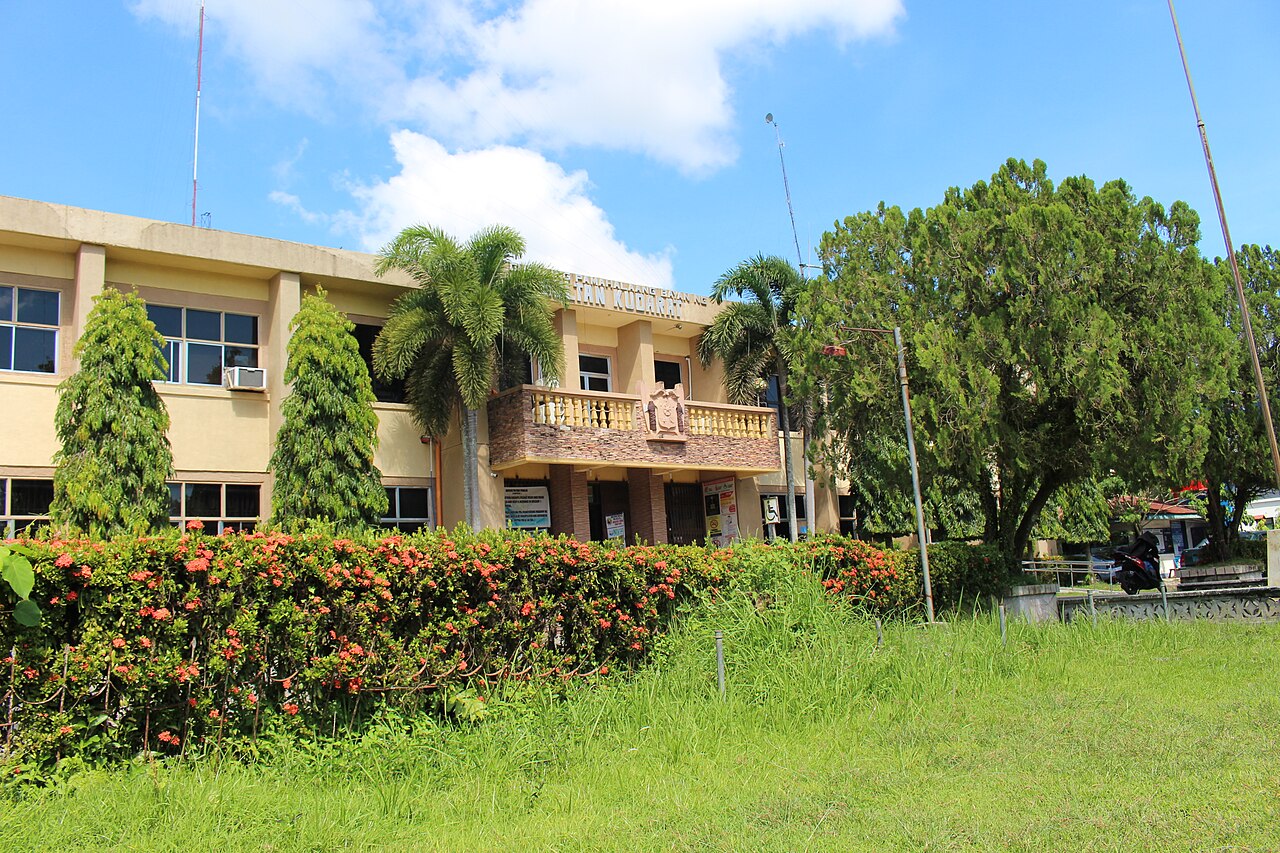
Sultan Kudarat
Sultan Kudarat, officially the Municipality of Sultan Kudarat, is a municipality of the province of Maguindanao del Norte, Philippines.
Government administration · Philippines · 0 followers
Overview
Sultan Kudarat, officially the Municipality of Sultan Kudarat, is a municipality of the province of Maguindanao del Norte, Philippines. According to the 2024 census, it had a population of 124,965.
Interested in working with us in the future?
Follow to see new jobs and posts in your feed.
No news yet.
About

Sultan Kudarat, officially the Municipality of Sultan Kudarat, is a municipality of the province of Maguindanao del Norte, Philippines. According to the 2024 census, it had a population of 124,965.
Kaynak: Wikipedia · CC BY-SA 4.0
History
The original seat of the Sultanate of Maguindanao was located at the mouth of the Maguindanao river (now Matampay) but later transferred to the nearby sitio at the bank of the Nuling Creek of Barangay Salimbao of this Municipality.
Sultan Mastura Kudarat, a royal lineage of the hero soldier Sultan Dipatuan Kudaratullah was appointed by American Governor Carpenter as President of the Municipal District of Nuling. The former declined and instead designated his son, Datu Mamadra Mastura for the position, who served from 1922 to 1923.
Nuling was a municipal district already prior to its reorganization as one of the twenty-eight, in the then-undivided Cotabato province, through Executive Order No. 9 issued by Department of Mindanao and Sulu acting governor Ponciano Reyes on March 8, 1917. It had six barrios then.
By virtue of Executive Order (EO) No. 82, issued by President Manuel Roxas on August 18, 1947, which organized the remaining municipal districts of the province into ten new municipalities, Nuling, Gubpañgan, and Balut, became part of the town bearing the name of the former, which would be its seat of government.
The boundary line with Parang was fixed twice through executive orders by President Elpidio Quirino, in 1949 and in 1953.
During the presidency of Carlos P. Garcia, the seat of municipal government was moved to Barrio Dalumangcob in 1957 through EO No. 267. Republic Act (RA) No. 3357, which became effective a year after its issuance in 1961, provided the conversion of ten sitios into barrios.
The municipality was renamed Sultan Kudarat through RA No. 5647, issued on June 21, 1969, in honor of Sultan of Maguindanao, Mohammad Dipatuan Kudarat.
In a plebiscite conducted on March 15, 2003, the electorate of the Municipality unanimously voted in favor of the creation of a new Municipality in the name of Sultan Mastura, being a son of Sultan Kudarat. The new Municipality of Sultan Mastura absorbed 13 barangays from the former leaving 39 for its mother town.
Geography
Barangays
Sultan Kudarat is politically subdivided into 39 barangays. Each barangay consists of puroks while some have sitios.
Economy
The LGU had a poverty incidence of 35.1% or there are about 57,147 of the 181,419 population who are living below the ARMM's poverty threshold of 75,000 or an annual per capita income of P10,714 for the family size of 7. This poverty incidence is 1.4% lower than the National average of 32.9%.
Though Sultan Kudarat hosts seventy percent of the agro-industries of the Province of Shariff Kabunsuan, its main economy is derived from the agriculture sector.
The municipality of Sultan Kudarat hosts Lamsan, one of the largest corn products manufacturers in the Philippines. The company provides employment to hundreds of workers in the municipality and nearby towns of Maguindanao del Norte.
The Gross Domestic Product of the Municipality (2022) is 23,646,300,000(PHP).
Farming
The municipality has 23,152.263 hectares of agricultural lands. While based on the year 2005 MAO's report, only 10,035 hectares of which or forty percent (49%) have been productively used, reflecting a yield of 121.4, 13,282 and 7,820 metric tons for copra, rice and corn respectively, earning a gross income of P169,279,300.00 for the year 2005. Its High Value Commercial crops have so far covered 273 hectares and shared a total yield of 536 metric tons that earned P9, 357,000.00.
Ave. / Yield, crop, ha (in Metric Tons) / Remarks
Rice / 12,000 / 3.5 / Mostly upland rice
Coconut intercropped with corn and other crops / 12,000 / 2 (for coconut) 2,5 (for other crops)
Fishing
The town possesses vast fishing grounds, the Maguindanao and Matampay Rivers, Illana Bay, lakes and its 1,393.4 hectares fishpond have been the major source of fish that supplies the fish requirements of the municipality and its neighboring towns. However, development programs have to be introduced to fully develop its potentials. The fish production reported is only 167,300 kilograms for the year 2005 which is not enough to supply the municipality's fish requirement of 3.9 million kilograms.
Social services
Education and literacy
About 79.2 percent of the municipality's school age population are literate, that is able to read and write, based on the 1995 census. The data likewise shows that 43% are in elementary level and 26% are in high school level. College undergraduate shared with 5.4%, and 2.4% are college graduate.
Health
There is one government hospital in the town, the Cotabato Sanitarium, but it caters only to specific health needs. There are about 26 Barangay Health Centers and 10 health personnel, composed of 1 medical doctor, 1 dental doctor, 6 midwives, 1 nurse and 1 sanitary inspector, serving the 39 barangays of the municipality. The health personnel are being augmented by 8 health workers and 39 trained hilots.
Kaynak: Wikipedia – Sultan Kudarat, Maguindanao del Norte · CC BY-SA 4.0