
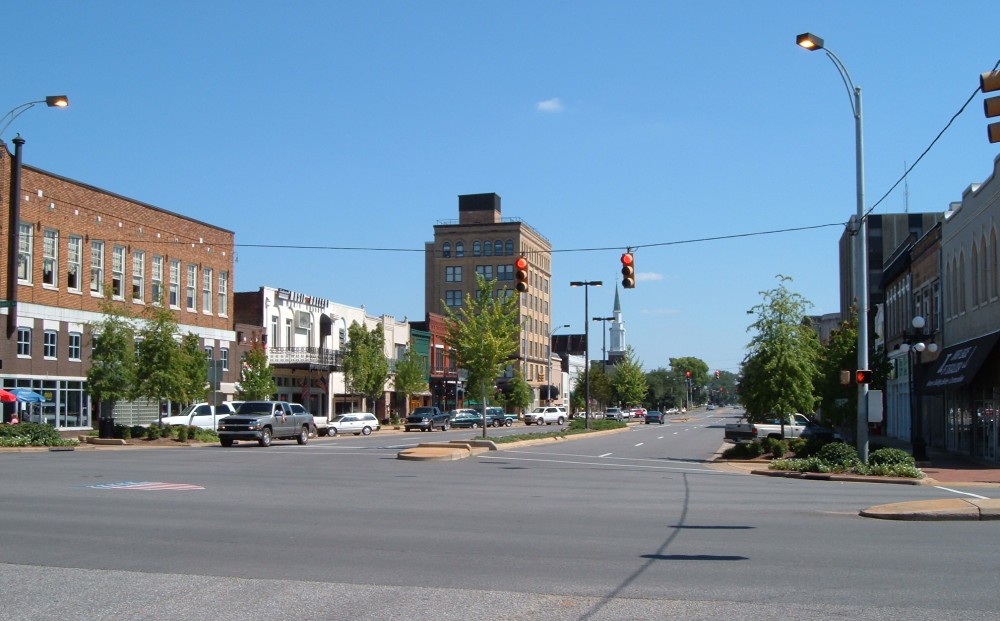
Tuscaloosa
La ciudad de Tuscaloosa o Tuscalusa es la capital del condado de Tuscaloosa, en el estado sureño de Alabama, en los Estados Unidos, situada a orillas del río Black Warrior.
Government administration · United States · 0 followers
Overview
La ciudad de Tuscaloosa o Tuscalusa es la capital del condado de Tuscaloosa, en el estado sureño de Alabama, en los Estados Unidos, situada a orillas del río Black Warrior. Es la quinta ciudad más grande del estado, con 80 181 habitantes en la ciudad y 120 000 h. para la población en los alrededores (2005).
Interested in working with us in the future?
Follow to see new jobs and posts in your feed.
No news yet.
About

La ciudad de Tuscaloosa o Tuscalusa es la capital del condado de Tuscaloosa, en el estado sureño de Alabama, en los Estados Unidos, situada a orillas del río Black Warrior. Es la quinta ciudad más grande del estado, con 80 181 habitantes en la ciudad y 120 000 h. para la población en los alrededores (2005).
Kaynak: Wikipedia · CC BY-SA 4.0
Historia

Nativos americanos
Hace casi 12 000 años, los nativos americanos (paleo-indios) llegaron a lo que hoy se conoce como el Deep South (sur profundo de los Estados Unidos). Estos paleo-indios del sur eran cazadores-recolectores de la megafauna propia de la época y que se extinguió hacia el final del Pleistoceno. Luego de miles de años, los paleo-indios desarrollaron una sociedad agrícola rica y compleja. Los arqueólogos llaman a estas personas la cultura Misisipi. Se caracterizaban por ser constructores de montículos. Sus grandes movimientos de tierra, construidos para rituales religiosos y expresando su cosmología, aún siguen en pie a lo largo de los valles de los ríos Ohio y Misisipi, así como en sus afluentes en el sureste.
En 1828 Andrew Jackson fue elegido presidente de los Estados Unidos. Había ganado popularidad cuando derrotó a Menawa en la batalla de Horseshoe Bend en 1814, lo que se sumó a sus victorias en la guerra anglo-estadounidense de 1812. Jackson era un defensor de la idea de que había que eliminar a los indios del sur y desplazarlos al oeste del Misisipi, para hacer la tierra disponible para la colonización euro-americana. Jackson abandonó la política de sus predecesores del tratamiento de diferentes grupos indígenas como naciones independientes. En cambio, persiguió agresivamente planes para trasladar a todas las tribus indígenas que viven al este del río Misisipi, en un intento de desterramiento. Después de la Indian Removal Act, en 1832, el Consejo Nacional Creek firmó el Tratado de Cusseta, cediendo sus tierras restantes al este del Misisipi al gobierno de Estados Unidos, y aceptando la reubicación de su territorio. La mayoría de los pueblos de habla muscogui se retiraron al territorio indio durante lo que se conoce como Sendero de Lágrimas en 1834, aunque algunos se quedaron atrás. Algunos muscoguis aún viven cerca de la Reserva Poarch Creek, en Atmore, Alabama.
Medios de comunicación
El principal periódico de la ciudad es el Tuscaloosa News.
Kaynak: Wikipedia – Tuscaloosa (Alabama) · CC BY-SA 4.0
Kardeş şehirler
Tuscaloosa şehrinin 3 kardeş şehri vardır
Sunyani–Techiman, Gana (Two cities partnered as one sister city)
Kaynak: Wikipedia – Tuscaloosa, Alabama · CC BY-SA 4.0
History

Reportedly the name Tuscaloosa is a compound Choctaw Indian word; "tusko" meaning "warrior" and "loosa" meaning "black". The Black Warrior River flows through the north portion of the city. In 1809 Creek chief Occechemolta established a settlement at the falls of the river. (US-T125/Alabama: A Guide to the Deep South/p 244). County seat of Tuscaloosa County 1818 to 1822 and 1826 to the present. State capital from 1826 to 1846.
Native American
In 1828, Andrew Jackson was elected president of the United States. He had gained popularity when he defeated the Creek at the Battle of Horseshoe Bend in 1814, following victories in the War of 1812. He long proposed Indian removal to an Indian Territory to be established west of the Mississippi, to make land available in the Southeast for European-American settlement. Jackson abandoned the policy of his predecessors of treating different Indian groups as separate nations. Instead, he aggressively pursued plans to move all Indian tribes living east of the Mississippi River.
Following Congressional passage of the Indian Removal Act, in 1832 the Creek National Council signed the Treaty of Cusseta, ceding their remaining lands east of the Mississippi to the U.S., and accepting relocation to the Indian Territory. They had already been under pressure from new settlers encroaching on their territory. Most Muscogee-speaking peoples were removed to Indian Territory during the Trail of Tears in 1834, although some remained behind. Some Muscogee in Alabama live near Poarch Creek Reservation in Atmore (northeast of Mobile).
Statehood and origin of name
The pace of European settlement in the Southeast increased greatly after the War of 1812 and the Treaty of Fort Jackson and the subsequent availability of land previously settled by Native Americans. A small assortment of log cabins soon arose near the large Creek village at the fall line of the river, which the new settlers named in honor of the 16th-century Chief Tuskaloosa of a Muskogean-speaking tribe—combining the Choctaw words "tushka" or "tashka" ("warrior") and "lusa" ("black").
Geography

According to the United States Census Bureau, the city has a total area of 72.22 square miles (187.0 km2), of which 62.15 square miles (161.0 km2) is land and 10.07 square miles (26.1 km2), is water as of 2023. Most water within the city limits is in Lake Tuscaloosa, which is entirely in the city limits, and the Black Warrior River.
This city is located at 33°12′35″N 87°34′09″W (33.2098407, -87.5691735), approximately 60 miles (97 km) southwest of Birmingham. It lies on the fall line of the Black Warrior River, approximately 193 miles (311 km) upriver from the river's confluence with the Tombigbee River at Demopolis. Because of its location on the boundary between the Appalachian Highland and the Gulf Coastal Plain, the geography of the area around Tuscaloosa is diverse, varying from heavily forested hills to the northeast to a low-lying, marshy plain to the southwest.
Cityscape
Major areas of Tuscaloosa city proper include:
Climate
Typical of the Deep South, Tuscaloosa experiences a humid subtropical climate (Köppen: Cfa). The Gulf of Mexico heavily influences the climate by supplying the region with warm, moist air. During the fall, winter, and spring seasons, the interaction of this warm, moist air with cooler, drier air from the North along fronts creates precipitation. These fronts usually move from west to east as they track along the jet stream. Notable exceptions occur during hurricane season, where storms may move from due south to due north or even from east to west during land-falling hurricanes. The interaction between low- and high-pressure air masses is most pronounced during the severe weather seasons in the spring and fall. During the summer, the jet stream flows well to the north of the southeastern U.S., and most precipitation is consequently convectional, i.e., caused by the warm surface heating the air above.
Demographics

2020 census
As of the 2020 census, Tuscaloosa had a population of 99,600 and 40,817 households, including 19,203 families. The median age was 27.1 years. 16.9% of residents were under the age of 18 and 12.1% of residents were 65 years of age or older. For every 100 females there were 89.4 males, and for every 100 females age 18 and over there were 87.1 males age 18 and over.
Of the 40,817 households, 22.3% had children under the age of 18 living in them. Of all households, 26.0% were married-couple households, 27.8% were households with a male householder and no spouse or partner present, and 40.8% were households with a female householder and no spouse or partner present. About 39.2% of all households were made up of individuals and 9.6% had someone living alone who was 65 years of age or older.
There were 47,465 housing units, of which 14.0% were vacant. The homeowner vacancy rate was 1.9% and the rental vacancy rate was 12.7%. The population density was 1,609.1 inhabitants per square mile (621.3/km2).
98.2% of residents lived in urban areas, while 1.8% lived in rural areas.
In 2023, the City of Tuscaloosa secured an updated count for the 2020 Census, after proving an undercount of at least 1,100 University of Alabama students who were residing temporarily off-campus due to the COVID-19 pandemic. The U.S. Census Bureau accepted the review, bringing the official 2020 Tuscaloosa population count to over 100,000 residents.
2010 census
As of the 2010 census, there were 90,468 people, 36,185 households, and 17,592 families residing in the city. The population density was 1,502.8 inhabitants per square mile (580.2/km2). There were 40,842 housing units at an average density of 678.4 per square mile (261.9/km2). The racial makeup of the city was 53.8% White, 41.5% Black or African American, 0.2% Native American, 1.8% Asian, 0.0% Pacific Islander, 1.5% from other races, and 1.1% from two or more races. 3.0% of the population were Hispanic or Latino of any race.
Economy

Higher education continues to be the foundation of Tuscaloosa's economy; however, the metropolitan area consists of a blend of retail, automotive, manufacturing, healthcare, education and public sector employment.
The University of Alabama is the city's largest employer and generates over $2.5 billion in economic impact annually and supports industries related to retail, housing, dining and tourism activity in the area. Major national research centers are also hosted in the city, including the U.S. Geological Survey's Hydrologic Instrumentation Facility and the National Water Center, both located on the campus of The University of Alabama.
Mercedes-Benz U.S. International (MBUSI) serves as a major contributor to the industrial economy. More than 6,100 people are employed by MBUSI and over 11,000 additional jobs are aided through a system of regional suppliers. According to 2024 data, it manufactures an array of SUV models, including the GLS, GLE, EQS, EQE, and the Maybach EQS. Brose Tuscaloosa, ARD Logistics and ZF Chassis Systems are some of the component manufacturers located in the area to support MBUSI operations.
Other significant employers include JVC America, Nucor Steel, BFGoodrich Tire Manufacturing, Hunt Refining Company, GAF Materials Corporations, The Westervelt Company, which houses its headquarters in Tuscaloosa, and gChem, which houses its production facility in the city.
Retail trade is also a vital sector. The Shoppes at Legacy Park, University Mall, Midtown Village and other service businesses and restaurants are all centrally located in the city at 15th Street and McFarland Boulevard.
Targeted workforce development advancements are offered through agencies such as AIDT, West AlabamaWorks!, and partnerships with local postsecondary institutions.
Arts and culture

Libraries and museums
The Tuscaloosa Public Library is a joint city-county agency with nearly 200,000 items and approximately 47,000 registered patrons (28% of the county's population). There are currently three branches: the Main branch, on Jack Warner Parkway; the Weaver-Bolden branch, in western Tuscaloosa; and the Brown branch in suburban Taylorville.
The University of Alabama, Stillman College and Shelton State Community College also have libraries open to the public for non-circulation use.
Museums in Tuscaloosa are located all over town, but are primarily concentrated in the downtown area or on the campus of UA. Museums that are downtown include CHOM: the Children's Hands-On Museum of Tuscaloosa and the Murphy African-American Museum. The Alabama Museum of Natural History and the Paul W. Bryant Museum are located on the UA campus. Additional museums and galleries are found across the river in Northport. The Jones Archaeological Museum is located 15 miles (24 km) south of Tuscaloosa at the Moundville Archaeological Park in Moundville.
Performing arts
Tuscaloosa is home to several performing arts organizations. Though some are affiliated with UA or Shelton State, several are independent organizations, including the Tuscaloosa Community Theater and Shakespeare troupe The Rude Mechanicals. These various organizations cooperate and coordinate their operations through the Arts and Humanities Council of Tuscaloosa County. The Arts Council also operates the Bama Theatre.
The Bama Theatre is a 1,094-seat proscenium theatre located in downtown Tuscaloosa and is operated by The Arts and Humanities Council. The Bama Theatre was built between 1937 and 1938 under the New Deal-era Public Works Administration as a movie palace. At the time of its construction in 1938, it was the only air-conditioned building in Tuscaloosa. The theatre was renovated as a performing arts center in 1976 and housed the Tuscaloosa Symphony Orchestra and Theatre Tuscaloosa troupe until those groups moved into their own facilities.
Sports

Tuscaloosa is known for its collegiate athletics—particularly the University of Alabama Crimson Tide football team. The University of Alabama also currently fields championship-caliber teams in baseball, basketball, golf, women's gymnastics, and softball. These teams play in athletics facilities on the university campus, including Bryant–Denny Stadium (capacity: 102,000+), Coleman Coliseum (formerly Memorial Coliseum), Sewell-Thomas Stadium, Rhoads Stadium, Foster Auditorium and the Ol' Colony Golf Complex.
Stillman College fields teams in football, men's and women's basketball, baseball and softball, among other sports, although the school discontinued the football program after completing the 2015 season. In the past decade, Stillman has gone through a series of renovations, including a new football stadium, Stillman Stadium.
Previous professional teams calling Tuscaloosa home included the World Basketball Association's Druid City Dragons in 2006, and Tuscaloosa Warriors football team in 1963, with both folding after one season.
In 2008, Tuscaloosa hosted the USA Olympic Triathlon trials for the Beijing Games.
World renowned putter company T.P. Mills Co. was founded and is located in Tuscaloosa.
Tuscaloosa is also the birthplace and home of Deontay Wilder. He is a professional boxer that held the WBC Heavyweight Title from 2015 to 2020, making 10 successful title defenses. He is still active and boasts a record of 43 wins, 3 losses, and 1 draw, with 42 wins coming by way of KO.
Parks and recreation

Tuscaloosa County Parks and Recreation Authority, known by the acronym PARA, is a county agency that receives a large amount of its funding from the city, and operates several parks and activity centers within the city. PARA is known for its participation in work therapy programs with the local United States Department of Veterans Affairs. Additional public recreational sites are owned and maintained by the University of Alabama and federal agencies such as Corps of Engineers.
The University of Alabama Arboretum is located on 60 acres (243,000 m2) of land at the intersection of Veterans Memorial Parkway and Pelham Loop Road, adjacent to the VA Hospital. The arboretum's primary emphasis is on Alabama's native flora and fauna. It includes 2.5 miles (4.0 km) of walking trails through native piney woods and oak-hickory climax forest, a wildflower garden containing more than 250 species, ornamental plants, an experimental garden, a bog garden, an open-air pavilion, and a children's garden. Two greenhouses contain collections of orchids, cacti, and tropical plants.
Capitol Park, Tuscaloosa at 6th Street and 28th Avenue is home to the ruins of the former state capitol building or State House from 1826 to 1845. It was later used by the Alabama Central Female College and burned down in 1923.
Other parks in Tuscaloosa include the Randall Family Park and Trailhead, Parker-Haun Park, the Western Riverwalk, Veterans Memorial Park, Tuscaloosa River Walk, the Park at Manderson Landing, J. Oviatt Bowers Park, Snow Hinton Park, Monnish Park, Annette N. Shelby Park, Kaulton Park, Palmore Park, and many others.
Government

Tuscaloosa has a strong-mayor variant mayor-council form of government, led by a mayor and a seven-member city council. The mayor and council members are elected concurrently for four-year terms. The mayor is elected by the city at-large while council members are elected to single-member districts. Neither the mayor nor the members of the city council are term-limited. All elected offices are nonpartisan. Elections take place in years following presidential election years, with runoff elections taking place six weeks later if necessary. Terms begin immediately after election. The most recent municipal elections were held in 2021.
The mayor is the chief executive and administrative officer of the city. His main duty is to oversee the day-to-day operation of city departments pursuant to executing policy enacted by the city council or, in the absence of any council policy, his own discretion. His other duties include preparing an operating budget each year for approval by the city council and acting as ambassador of the city. The mayor also presides over city council meetings but votes only in case of ties. The current mayor of Tuscaloosa is Walter Maddox, who was elected to office in September 2005.
The city council acts as the legislative body of the city. It is powered by state law to consider policy and enact law and to make appointments to city boards. The council also considers the budget proposed by the mayor for approval. The majority of work in the council is done by committee. These committees usually consist of three council members, one of whom will be chairman, and relevant non-voting city employees.
Tuscaloosa, as the largest county seat in western Alabama, serves a hub of state and federal government agencies. In addition to the customary offices associated with the county courthouse, namely two district court judges, six circuit court judges, the district attorney and the public defender, several Alabama state government agencies have regional offices in Tuscaloosa, such as the Alabama Department of Transportation and the Alabama State Troopers (the state police).
Education

Higher education
The University of Alabama is the largest university in the state of Alabama in terms of enrollment. Enrolling approximately 40,000 students on a 1,970-acre (8.0 km2) campus, UA has been a part of Tuscaloosa's identity since it opened its doors in 1831. Stillman College, which opened in 1875, is a historically black liberal arts college enrolling approximately 1,200 students on a 105-acre (0.42 km2) campus. Additionally, Shelton State Community College, one of the largest community colleges in Alabama, is located in the city. The school enrolls around 4,000 students from all backgrounds and income levels.
Primary and secondary education
The Tuscaloosa City Schools serves the city. It is overseen by the Tuscaloosa City Board of Education, which is composed of eight members elected by district and a chairman elected by a citywide vote. The Board appoints a Superintendent to manage the day-to-day operations of the system. Operating with a $100 million budget, the system enrolls approximately 10,300 students. The system consists of 24 schools: 13 elementary schools (12 zoned and 1 magnet), 6 middle schools (5 zoned and 1 magnet), 3 high schools (Paul W. Bryant High School, Central High School and Northridge High School), and 2 specialty schools (the Tuscaloosa Center for Technology, a vocational school, and Oak Hill School for special needs students). In 2002, the system spent $6,313 per pupil, the 19th highest amount of the 120 school systems in the state.
The Tuscaloosa County School System serves the county excluding the city. It is overseen by the Tuscaloosa County Board of Education, which is composed of seven elected members. The Board appoints a Superintendent to lead the school system. The system enrolls approximately 18,000 students which are served utilizing a budget of approximately $180 million. The school system consists of 34 schools—6 high schools, 8 middle schools and 19 elementary schools. It also provides services for special needs students at Sprayberry Education Center. In 2013 the school system hired its first minority superintendent of Hispanic/Latin origin who is also only the second female.
Media

The Tuscaloosa News is the major daily newspaper serving the city. The Tuscaloosa News also publishes several websites. The primary news website is tuscaloosanews.com. Tidesports.com focuses on University of Alabama sports. The Tuscaloosa News offices were located west of downtown on a bluff overlooking the Black Warrior River. In October 2023, Maddox announced that the former News office building were to be removed to make way for the Saban Center.
Each of the three colleges in the area are served by student-published periodicals, the largest being The Crimson White, the independent, student-run newspaper of the University of Alabama and one of several UA-affiliated student publications.
Kids Life Magazine is a free publication which focuses on family friendly events in the Tuscaloosa area.
Tuscaloosa is part of the Birmingham-Tuscaloosa-Anniston television market, which is the 40th largest in the nation. All major networks have a presence in the market: WBRC 6 (Fox), WVUA-CD 7 (Cozi TV), WBIQ 10 (PBS), WVTM 13 (NBC, with CBS on DT4), WTTO 21 (Independent), WSES 33 (Heroes & Icons), WIAT 42 (The CW) and WABM 68 (MyNetworkTV, with ABC [via WBMA-LD] on DT2). WVUA-CD is the only station that originates its broadcast in Tuscaloosa; it is owned by the University of Alabama, and its studios are part of UA's Digital Media Center.
Tuscaloosa is the 200th largest radio market in the nation. In Fall 2024, of the top-ten-rated radio stations, two were country, two were Christian and one each were urban, gospel, hip hop, talk radio, contemporary, and sports.
Tuscaloosa serves as home base to Alabama Public Radio, the state's largest public-radio network. APR's main studios are housed at the University of Alabama, and the flagship signal, WUAL-FM, originates from a transmitter south of town. WUAL serves Tuscaloosa, portions of the Birmingham metro area and several counties of west-central Alabama. The University of Alabama also houses WVUA-FM, a 24/7 college radio station run completely by students. Clear Channel Communications and Townsquare Media both own and operate a cluster of radio stations in Tuscaloosa, that form the majority of the market.
Infrastructure

Health and medicine
DCH Regional Medical Center is the main medical facility in Tuscaloosa. Operated by the publicly controlled DCH Healthcare Authority, the 610-bed hospital opened in 1916 as the Druid City Infirmary. The emergency department at DCH operates a trauma center (but it is not verified as one by the American College of Surgeons, however) that serves all of west central Alabama and is one of the busiest in the state. The DCH Healthcare authority also operates Northport Medical Center in neighboring Northport.
Other major medical centers in Tuscaloosa include the 702-bed Veterans Affairs Medical Center-Tuscaloosa, the 422-bed Bryce Hospital, Mary S. Harper Geriatric Psychiatry Center, and Taylor Hardin Secure Medical Facility.
Utilities
Tuscaloosa owns and operates its Water and Sewer system utility. The water system features three lakes and approximately 720 miles of water mains in service and supplies water to nearly 200,000 customers in the metropolitan Tuscaloosa area.
Transportation
Tuscaloosa is connected to other parts of the country via air, rail, road and sea. The city lies at the intersection of several highways, including three federal highways (US 11, US 43, and US 82), three Alabama state highways (SR 69, SR 215, and SR 216) and two duplexed (conjoined) Interstates (I-20/I-59). Interstate 359 spurs off from I-20/I-59 and heads northward, ending in downtown Tuscaloosa.
Tuscaloosa also contains one toll road on the Black Warrior Parkway (I-20/I-59), charging $1.25 for automobiles, and one toll bridge (Black Warrior Parkway bridge).
Rail
Amtrak provides passenger rail service to Tuscaloosa though the Crescent line, which connects the area to major cities along the east coast from New York City to New Orleans. Tuscaloosa station is situated at 2105 Greensboro Avenue, one mile (1.6 km) south of downtown. Norfolk Southern Railway and Alabama Southern Railroad provide freight services to the area. KCS previously provided service to the area before leasing its lines to Watco in July 2005.
Sister cities
The Tuscaloosa Sister Cities Commission was formed in 1986. The city currently has sister city relationships with cities in three countries:
Sunyani–Techiman, Ghana (Two cities partnered as one sister city)
Kaynak: Wikipedia – Tuscaloosa, Alabama · CC BY-SA 4.0