
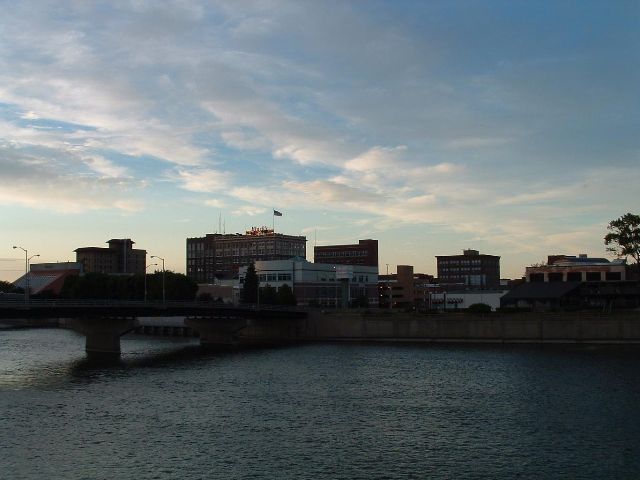
Waterloo
Waterloo es una ciudad ubicada en el condado de Black Hawk en el estado estadounidense de Iowa.
Government administration · United States · 0 followers
Overview
Waterloo es una ciudad ubicada en el condado de Black Hawk en el estado estadounidense de Iowa. En el Censo de 2010 tenía una población de 68406 habitantes y una densidad poblacional de 417,73 personas por km².
Interested in working with us in the future?
Follow to see new jobs and posts in your feed.
No news yet.
About

Waterloo es una ciudad ubicada en el condado de Black Hawk en el estado estadounidense de Iowa. En el Censo de 2010 tenía una población de 68406 habitantes y una densidad poblacional de 417,73 personas por km².
Kaynak: Wikipedia · CC BY-SA 4.0
Geografía
Waterloo se encuentra ubicada en las coordenadas 42°29′32″N 92°21′7″O. Según la Oficina del Censo de los Estados Unidos, Waterloo tiene una superficie total de 163.75 km², de la cual 159 km² corresponden a tierra firme y (2.91%) 4.76 km² es agua.
Demografía
Según el censo de 2010, había 68406 personas residiendo en Waterloo. La densidad de población era de 417,73 hab./km². De los 68406 habitantes, Waterloo estaba compuesto por el 77.28% blancos, el 15.5% eran afroamericanos, el 0.29% eran amerindios, el 1.06% eran asiáticos, el 0.29% eran isleños del Pacífico, el 2.6% eran de otras razas y el 2.98% pertenecían a dos o más razas. Del total de la población el 5.59% eran hispanos o latinos de cualquier raza.
Kaynak: Wikipedia – Waterloo (Iowa) · CC BY-SA 4.0
Tarihi
Waterloo şehri Cedar nehri yakınları üzerinde yer almaktadır. 29 Aralık 1851 tarihinde Amerika Birleşik Devletleri'nce ele geçirilmiş ve şehre Waterloo, ismi verilmiştir.
Nüfus
2010 sayımı
15 Mart 2010 tarihinde yapılan nüfus sayımına göre şehirde 68,406 kişi, 28,607 ev ve 17,233 aile bulunmaktadır. Şehrin nüfus dağılımı ise 79.0% Beyaz, 11.3% Afrikan Amerikan, 0.3% Yerli Amerikan, 5.2% Asyalı, 0.1% Pasifik Adalı, 1.1%'i ise diğer gruplardandır.
2000 Sayımı
1 Nisan 2000 tarihinde yapılan nüfus sayımına göre şehirde 68,747 kişi, 28,169 ev ve 17,746 aile bulunmaktadır. Şehrin nüfus dağılımı ise 79.0% Beyaz, 11.3% Afrikan Amerikan, 0.3% Yerli Amerikan, 5.2% Asyalı, 0.1% Pasifik Adalı, 1.1%'i ise diğer gruplardandır.
Kaynak: Wikipedia – Waterloo, Iowa · CC BY-SA 4.0
History

Waterloo was originally known as Prairie Rapids Crossing. The town was established near two Meskwaki American tribal seasonal camps alongside the Cedar River. It was first settled in 1845 when George and Mary Melrose Hanna and their children arrived on the east bank of the Red Cedar River (now just called the Cedar River). They were followed by the Virden and Mullan families in 1846. Evidence of these earliest families can still be found in the street names Hanna Boulevard, Mullan Avenue and Virden Creek.
On December 8, 1845, the Iowa State Register and Waterloo Herald was the first newspaper published in Waterloo.
The name Waterloo supplanted the original name, Prairie Rapids Crossing, shortly after Charles Mullan petitioned for a post office in the town. Since the signed petition did not include the name of the proposed post office location, Mullan was charged with selecting the name when he submitted the petition. Tradition has it that as he flipped through a list of other post offices in the United States, he came upon the name Waterloo. The name struck his fancy, and a post office was established under that name. There were two extended periods of rapid growth over the next 115 years. From 1895 to 1915, the population increased from 8,490 to 33,097, a 290% increase. From 1925 to 1960, population increased from 36,771 to 71,755. The 1895 to 1915 period was a time of rapid growth in manufacturing, rail transportation and wholesale operations. During this period the Waterloo Gasoline Traction Engine Company moved to Waterloo and, shortly after, the Rath Packing Company moved from Dubuque. Another major employer throughout the first two-thirds of the 20th century was the Illinois Central Railroad. Among the others was the less-successful brass era automobile manufacturer, the Maytag-Mason Motor Company.
Geography

According to the United States Census Bureau, the city has a total area of 63.23 square miles (163.76 km2), of which 61.39 square miles (159.00 km2) is land and 1.84 square miles (4.77 km2) is water.
The average elevation of Waterloo is 846 feet above sea level. The population density is 1101 people per square mile, considered low for an urban area.
Climate
Waterloo has a humid continental climate zone (Köppen classification Dfa), typical of the state of Iowa, and is part of USDA Plant Hardiness zone 5a. The normal monthly mean temperature ranges from 18.5 °F (−7.5 °C) in January to 73.6 °F (23.1 °C) in July. On average, there are 22 nights annually with a low at or below 0 °F (−18 °C), 58 days annually with a high at or below freezing, and 16 days with a high at or above 90 °F (32 °C). As the mean first and last occurrence of freezing temperatures is October 1 and April 29, respectively, this allows for a growing season of 154 days. Temperature records range from −34 °F (−37 °C) on March 1, 1962, and January 16, 2009, up to 112 °F (44 °C) on July 13 and 14, 1936, during the Dust Bowl. The record cold daily maximum is −16 °F (−27 °C) on February 2, 1996, while conversely the record warm daily minimum is 80 °F (27 °C) on July 31, 1917, and August 16, 1988.
Normal annual precipitation equivalent is 34.60 inches (879 mm) spread over an average of 112 days, with heavier rainfall in spring and summer, but observed annual rainfall has ranged from 17.35 to 53.07 inches (441 to 1,348 mm) in 1910 and 1993, respectively. The wettest month on record is July 1999 with 12.82 inches (326 mm); on the 2nd of that month, 5.49 inches (139 mm) of rain fell, making for the heaviest rainfall in a single calendar day. The driest months are October 1952 and November 1954 with trace amounts in each month.
Demographics
2020 census
As of the 2020 census, Waterloo had a population of 67,314 and a population density of 1,092.8 inhabitants per square mile (421.9/km2). There were 31,603 housing units at an average density of 513.1 units per square mile (198.1 units/km2), of which 8.4% were vacant; the homeowner vacancy rate was 1.9% and the rental vacancy rate was 9.4%.
There were 28,962 households in Waterloo, of which 27.2% had children under the age of 18 living in them. Of all households, 36.5% were married-couple households, 22.6% were households with a male householder and no spouse or partner present, and 32.4% were households with a female householder and no spouse or partner present. About 35.3% of all households were made up of individuals, and 13.1% had someone living alone who was 65 years of age or older.
The median age was 37.4 years. 23.1% of residents were under the age of 18 and 17.1% were 65 years of age or older. For every 100 females there were 95.3 males, and for every 100 females age 18 and over there were 93.2 males age 18 and over. About 97.0% of residents lived in urban areas, while 3.0% lived in rural areas.
2010 census
As of the census of 2010, there were 68,406 people, 28,607 households, 17,233 families residing in the city. The population density was 1,114.3 inhabitants per square mile (430.2/km2). There were 30,723 housing units at an average density of 500.5 units per square mile (193.2 units/km2). The racial makeup of the city was 77.3% White, 15.5% African American, 0.3% Native American, 1.1% Asian, 0.3% Pacific Islander, 2.6% from other races, and 3.0% from two or more races. Hispanic or Latino people of any race were 5.6% of the population.
There were 28,607 households, of which 29.9% had children under the age of 18 living with them, 40.3% were married couples living together, 14.9% had a female householder with no husband present, 5.1% had a male householder with no wife present, and 39.8% were non-families. 31.6% of all households were made up of individuals, and 11.2% had someone living alone who was 65 years of age or older. The average household size was 2.35 and the average family size was 2.95.
Economy
Waterloo has an economy currently based in agricultural manufacturing, healthcare, meatpacking, education, banking, and tourism. Large national corporations with locations in the Waterloo area include John Deere, MercyOne, UnityPoint, Tyson Foods, Ferguson Enterprises, and Masterbrand Cabinets which is a subsidiary of Fortune Brands Innovations. Large locally owned businesses and public employers include the City of Waterloo, Black Hawk County, Hawkeye Community College, Veridian Credit Union, Isle Casino, and Lost Island Theme Park and Waterpark. Other major employers located in adjoining Cedar Falls but within the combined metropolitan area include the University of Northern Iowa, Cedar Falls Community Schools, CBE Companies, Inc., a Target Distribution Center, and Viking Pump.
Arts and culture

The Cedar Valley Arboretum & Botanic Gardens is a 40-acre (16 ha) public garden located directly east of Hawkeye Community College. Admission is $5/adult and $2/child, under five and members are free.
The tropically themed Lost Island Waterpark, which opened in 2001, has regularly been featured in USA Today's Top 10 waterparks in the United States listings. It was joined in 2022 by Lost Island Theme Park, which received industry awards recognition for its interactive dark ride Volkanu: Quest for the Golden Idol.
The Iowa Irish Fest is held in Waterloo in early August, and the National Cattle Congress is held there in September.
Silos & Smokestacks National Heritage Area
Silos & Smokestacks National Heritage Area (SSNHA) preserves and tells the story of American agriculture and its global significance through partnerships and activities that celebrate the land, people, and communities of the area. SSNHA is one of 62 federally designated National Heritage Areas and is an Affiliated Area of the National Park Service. Through the development of a network of 113 partner sites, programs and events, SSNHA's mission is to interpret farm life, agribusiness and rural communities-past and present. Waterloo partner sites include the Waterloo Center for the Arts and the Grout Museum. The SSNHA office is located in the Fowler Building, Suite 2, 604 Lafayette Street.
Waterloo Center for the Arts
The Waterloo Center for the Arts (WCA) is a regional center for visual and performance arts. It is owned and operated by the City of Waterloo with oversight by the advisory Waterloo Cultural and Arts Commission. The center is located at 225 Commercial Street. It is also an anchor for the Waterloo Cultural and Arts District (a State of Iowa designation).
The permanent collection at the WCA includes the largest collection of Haitian art in the country, Midwest Regionalist art (including works by Grant Wood and Thomas Hart Benton), Mexican folk art, international folk art, American decorative arts, and public art.
Government
Waterloo is administered by the mayor and council system of government. One council member is elected from each of Waterloo's five wards, and two are elected at-large. Serving since 2026, the current mayor is Dave Boesen, who unseated Quentin Hart in the 2025 city elections.
The city holds elections to elect its mayor and city council every two years, in odd-numbered off-year elections. The mayor is elected to a two-year term, city councilors to four-year terms.
Education
Hawkeye Community College is located in Waterloo. Neighboring Cedar Falls is home to the University of Northern Iowa.
Almost all of the city is within the Waterloo Community School District. The three public high schools in the city are Waterloo West High School, Waterloo East High School, and Expo High School. Additionally, a portion of the city is within the Cedar Falls Community School District.
Waterloo's private high schools are Waterloo Christian School and Columbus Catholic High School, which is supported by the Catholic parishes of Waterloo and Cedar Falls. Waterloo Christian is a non-denominational college preparatory school located on the grounds of Walnut Ridge Baptist Church. The school's colors are green and yellow, and its mascot is the "Regent". Columbus' mascot is the "Sailor", a connection to the school's namesake Christopher Columbus, and its colors are green and white.
There is also a wide array of elementary and junior high schools in the area, with open enrollment available.
Media
Television
2 KGAN (CBS, Fox on DT2) – located in Cedar Rapids
7 KWWL (NBC, Heroes & Icons on DT2, MeTV on DT3) – located in Waterloo
9 KCRG-TV (ABC, MyNetworkTV on DT2, The CW on DT3) – located in Cedar Rapids
12 KIIN (PBS/Iowa PBS) – located in Iowa City
20 KWKB (TCT, This TV on DT5) – located in Iowa City
28 KFXA (Dabl) – located in Cedar Rapids
32 KRIN (PBS/Iowa PBS) – located in Waterloo
48 KPXR-TV (Ion) – located in Cedar Rapids
The Cedar Valley What Not, weekly advertiser
Infrastructure
Transportation
Waterloo is located at the northern end of Interstate 380. U.S. Highways 20, 63, and 218 and Iowa Highway 21 also run through the metropolitan area. The Avenue of the Saints runs through Waterloo.
American Airlines provides non-stop air service to and from Chicago from the Waterloo Regional Airport as of April 3, 2012. As of October 27, 2014, American Airlines runs two flights to/from Chicago O'Hare (ORD). Departures to Chicago are early morning and mid/late afternoon. Arrivals are early/mid-afternoon and evening.
Waterloo is served by a metropolitan bus system (MET), which serves most areas of Cedar Falls and Waterloo. Most routes meet at the central bus station in downtown Waterloo. The system operates Monday through Saturday. During the week the earliest bus is at 5:45 am from downtown Waterloo, and the last bus arrives downtown at 6:40 pm. Service is limited on Saturdays.
Waterloo is served by one daily intercity bus arrival and departure to Chicago and Des Moines, provided by Burlington Trailways. New service to and from Mason City and Minneapolis/St. Paul provided by Jefferson Lines started in the fall of 2009, however was canceled in 2012.
There are currently four taxi operators in Waterloo and Cedar Falls: First Call, Yellow, City Cab, Cedar Valley Cab, and Dolly's Taxi.
The Chicago Central railroad runs through Waterloo.
Utilities
The MidAmerican Energy Company supplies Waterloo with electricity and natural gas. The Waterloo Water Works supplies potable water with a capacity of 50,400,000 GPD (gallons per day) with an average use of 13,400,000 GPD and a peak use of 28,800,000 GPD. News reports indicate that 18.5% of the system's output in 2013, or 851 million gallons, was unaccounted for. Sanitation service (sewage) is operated by the city of Waterloo, with a capacity of 36,500,000 GPD and an average use of 14,000,000 GPD.
Kaynak: Wikipedia – Waterloo, Iowa · CC BY-SA 4.0